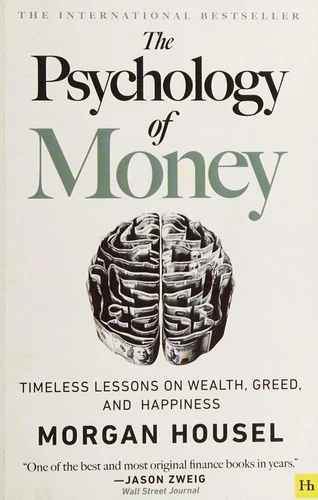
Morgan Housel opens his book with an idea that seems simple yet turns our understanding of money upside down. Financial success is not a hard science like physics. It is a soft skill that depends on behavior far more than knowledge. Consider a familiar scene. A university professor of finance knows pricing and portfolio theory by heart, yet is drowning in installments and loans. A modest employee who has never read a single investment book has quietly accumulated more than he needs, through regular saving and patience. The difference between them lies not in intelligence or information, but in behavior. From this central idea, the rest of the book unfolds.
First: Understanding Behavior — Why "No One Is Crazy"
Housel reminds us that every person makes financial decisions based on their own limited personal experience. A generation lived through the years of the oil boom (al-Tafra) and watched land values multiply within a few years. It absorbed the conviction that "real estate never betrays you," and finds it strange that anyone would put money in stocks. Another generation was scarred by the 2006 Saudi stock market crash, and watched families' savings evaporate in weeks. It grew up viewing the market with permanent suspicion, even at the cost of missing years of subsequent growth. Each generation thinks the other is "irrational," when in truth both are perfectly logical within their own experience. This humble starting point opens the door to two intertwined ideas:
Luck and risk: Outcomes in the world of money do not reflect the quality of decisions alone. Imagine two men who bought land in the same suburb at similar prices. Two years later a mega development project is announced next to the first man's plot, multiplying its value tenfold, while the second man's plot stays where it was. The first was not smarter or more far-sighted; he was simply luckier. The reverse is equally true. Whoever entered the stock market in early 2006 with an apparently sound decision came out crushed — not from foolishness, but because risk caught up with him before he could catch up with it. The wisdom here is to judge decisions rather than outcomes, neither over-glorifying the successful nor over-blaming the unlucky.
The idea of "enough": The hardest financial skill is getting the goalpost to stop moving. The stories of the 2006 crash are full of people who made spectacular profits in the years of the climb: one million, then three, then five. Each time they raised the ceiling — "I'll get to ten and then exit." So they borrowed, leveraged, and doubled down, until February 2006 arrived and took the profits and the capital together. Whoever does not know when what they have is enough will risk what they have and need for the sake of what they neither have nor need. It is a gamble no one wins in the long run.
Second: The Mathematics of Time — The Power of Compounding and the Fragility of Survival
For Housel, the essence of wealth is not achieving exceptional returns, but achieving good returns and sustaining them for as long as possible. Compounding is an enormous but slow and counterintuitive force. Take a simple numerical example. An employee saves three thousand riyals a month and invests it at an average annual return of 7%. After ten years he has about half a million riyals, perhaps a disappointment. But after thirty years the amount exceeds three and a half million. The last two decades produced six times what the first decade did, even though the monthly effort never changed. This is the secret of Warren Buffett that Housel points to. Most of his fortune came less from genius-level returns than from the fact that he started as a boy and never stopped into old age. Time is the senior partner in every fortune, and the one we squander most.
The book draws a sharp distinction between two different skills. Building wealth requires optimism, boldness, and risk-taking. Keeping wealth requires the opposite: caution, humility, and a healthy fear of losing what has been gained. Our recent economic history offers the lesson plainly. During the boom years many merchants expanded feverishly — new branches, heavy loans, projects beyond their capacity — on the assumption that prosperity was permanent. When oil prices fell in the mid-1980s and spending contracted, many of those shining names collapsed. The merchants who had kept liquidity and reserves, and had said "no" to some tempting opportunities, survived. Staying in the game matters more than winning any single round of it.
He then adds the idea of tail events: a small handful of decisions and events produce most of the final outcome. An investor who spread his money across ten stocks twenty years ago may discover today that a single one created most of his wealth — a bank that thrived, or a technology company that soared — while the rest netted out between small winners and small losers. The same holds in our careers. One decision to accept a job, one partnership, one city we moved to, may account for most of where we ended up. You can be wrong half the time and still win, as long as you do not miss the few decisive opportunities, and are not wiped out of the game before they arrive.
Third: Practical Wisdom — What Does Money Really Buy?
The most valuable thing money buys is not cars or houses, but freedom over your own time. Compare two physicians with identical incomes. The first disciplined his spending and saved until he could cut back his evening clinics and devote himself to his children, his research, and what he loves. The second raised his lifestyle with every raise — a fancier car, a bigger house, heavier installments — until he became a prisoner of a schedule he cannot escape no matter how exhausted he is. Both are "successful" in people's eyes, but only one of them owns his morning. This is the highest dividend money pays. It explains why happiness does not necessarily rise with income when a person loses control over their life.
From here flow the book's remaining practical lessons:
- Wealth is what you don't see: Your neighbor with the luxury car and the well-documented trips may be weighed down with installments, while the quiet man driving an ordinary car may own rental properties and a silent portfolio. Visible spending displays income; real wealth is the money that was never spent. Whoever buys everything to show people how rich they are spends their wealth proving it.
- Save without a specific reason: When the COVID-19 pandemic shut markets down suddenly in 2020, the difference between those who slept soundly and those who spent their nights anxious was neither intelligence nor job title, but the existence of savings sufficient for months without income. Those people had not saved "for a pandemic" — no one plans for a pandemic — they had saved for no reason at all, and in doing so bought flexibility against a surprise no one saw coming.
- Reasonable beats optimal: Spreadsheets may prove that putting all savings into index funds is the mathematically "optimal" choice, but an investor whose heart is settled by owning a property that pays tangible monthly income will stick to his plan through crises, while the "optimal" investor may panic-sell his portfolio at the bottom of a crash. A plan you can sleep with and stick to for thirty years beats a perfect plan you abandon in the first storm.
- Leave room for error: Whoever built his household budget on the assumption that allowances and bonuses would continue unchanged was shaken when they changed during the austerity years after the 2014–2016 oil slump. Whoever planned his installments on half his income rather than all of it passed through the same period in peace. The future cannot be predicted, and the only guaranteed survival strategy is to plan as if your plans might fail.
- The seduction of pessimism: After the 2006 crash, the gatherings were full of people swearing the market was "finished" and would never rise again; after the oil slump, many predicted decades of stagnation. At the time, these voices sounded deeper and wiser than the optimists — warning of danger always carries an air of wisdom. Yet the following years brought economic transformations, projects, and new markets the pessimists never imagined. Pessimism always sounds smarter, but the long arc of history sides with the patient optimists — not because crises don't happen, but because the capacity to adapt is stronger than we think.
Conclusion
Housel closes by describing his own approach: a high savings rate, simple index-fund investing, and long patience. Nothing more. It is an ending that captures the spirit of the entire book. Winning the money game requires no genius, only disciplined behavior that endures through time. Understand why each generation mistakes its own experience for the rule; distinguish luck from skill; know when to say "enough"; let time do its work; save for what you cannot foresee; and plan for your plans to fail. Whoever does that has acquired the most important tools of wealth. Money, in the end, is a mirror of our souls — of our greed, fear, patience, and pride. Whoever masters understanding themselves has, without realizing it, mastered the art of managing their money.
This is a translation of an essay written in Arabic. Quotations from the Qurʾān are rendered for sense; the Arabic page carries them in the original.
NEUTRAL FACT CHECKER
The factual claims in this essay — what Housel is said to have argued, the compounding arithmetic, and the Saudi economic events cited — were checked against the book itself and against published market data. The result is published as it came out, and the essay was not edited to agree with it. The fact-check is written in Arabic: read the neutral fact-check →
© 2026 Husain Alkhaldy — published in the site's essays.