وَإِذْ قَالَ اللَّهُ يَا عِيسَى ابْنَ مَرْيَمَ أَأَنْتَ قُلْتَ لِلنَّاسِ اتَّخِذُونِي وَأُمِّيَ إِلَهَيْنِ مِنْ دُونِ اللَّهِ قَالَ سُبْحَانَكَ مَا يَكُونُ لِي أَنْ أَقُولَ مَا لَيْسَ لِي بِحَقٍّ مَا قُلْتُ لَهُمْ إِلَّا مَا أَمَرْتَنِي بِهِ أَنِ اعْبُدُوا اللَّهَ رَبِّي وَرَبَّكُمْ
And when God said: O Jesus son of Mary, was it you who said to men, take me and my mother as two gods besides God? He said: Glory be to you, it is not for me to say what I have no right to say… I said to them nothing except what you commanded me: worship God, my Lord and your Lord. [Q. 5:116–118]
In the back streets of Alexandria, around the year 318, sailors in the harbour and millers in the markets were singing strange songs, unlike the usual songs of cities. They were not love songs, nor work chants, but a theology set to verse. Their author was a priest of Libyan origin, well advanced in years, tall, known for his asceticism and his powers of speech; his name was Arius. He gathered his songs into a book he called the Thalia (the Banquet), and in it was a single line sufficient to set the whole empire alight from end to end:
“There was a time when the Son was not.”
One sentence. But it meant that Christ — however exalted his rank — was a creature with a beginning, and that God alone is the eternal one who has no beginning. From that sentence exploded the longest doctrinal conflict in the history of Christianity. It summoned the intervention of emperors, the convening of councils, the exile of bishops and the burning of books. Its effects reached from Egypt to Spain, and from the fourth century to our own day.
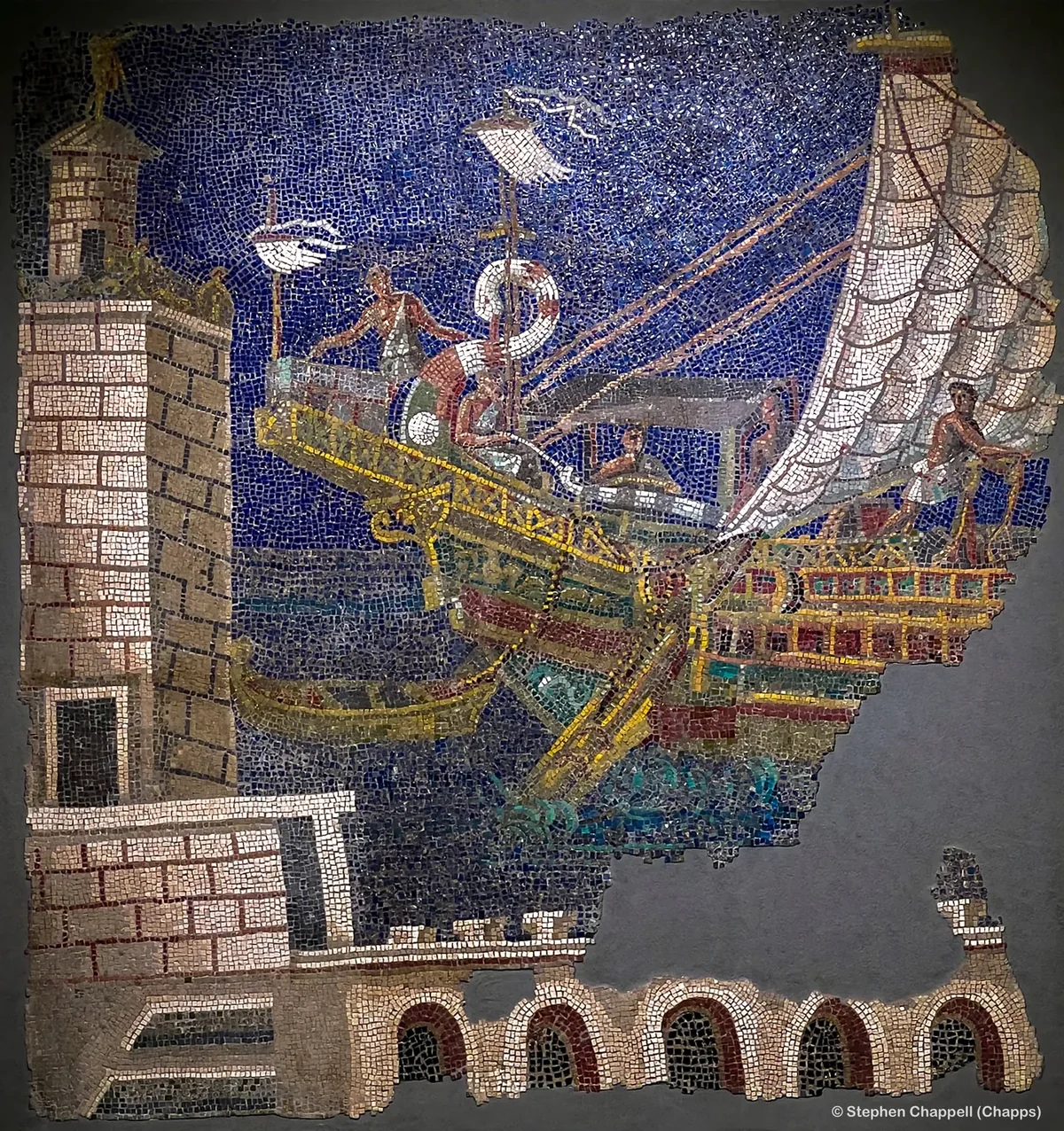
Before Arius: there was no single Christianity
It is a mistake to imagine that the Trinity was a finished, ready-made doctrine from the first day, and that Arius broke with it as an innovator breaks with a settled principle. The picture drawn by modern historians of doctrine is quite different. The first three centuries were a period of wide plurality in the understanding of the person of Christ and his relation to God, and no central authority existed to settle the dispute.
Among the oldest of the groups were the Ebionites, Christians of Jewish origin who saw in Jesus the awaited Messiah and a human prophet supported by God. They held fast to the Law of Moses, and many of them rejected the letters of Paul. In Rome, at the end of the second century, there appeared the Adoptionists, followers of Theodotus of Byzantium. They held that Jesus was a righteous man whom God “adopted,” and that the divine power descended upon him at his baptism. Then came Paul of Samosata, bishop of Antioch itself, teaching something close to this, until a local synod deposed him in 268.
And even those who prepared the ground for the idea of the Trinity did not state it in its final form. Tertullian of Carthage was the first to coin the Latin word trinitas, around the year 200. Yet he held the Son to be below the Father in rank, and to have come into being by his will. And Origen, the greatest of the scholars of Alexandria, taught that the Son was “a God of the second order,” subordinate to the Father. That is to say: the hierarchy between Father and Son, the very thing for which Arius would later be condemned, was the prevailing view among the leading theologians a full century before him. Arius did not produce an idea out of nothing; he pushed an old current to its logical conclusion, at a moment when the empire could no longer tolerate ambiguity.
What exactly did Arius say?
The core of Arius's teaching rests on a single severe premise: God is one, unbegotten, without beginning, and shares his essence with no one. If, then, the Son is “begotten” of the Father, as the texts say, then begetting means that he has a beginning. Whoever has a beginning is not eternal; whoever is not eternal is a creature. Yes: for Arius he is the first and noblest of created things, created before time, and by him God created the world. He stands above the angels and all mankind. But he remains a creature, equal to the Father neither in essence nor in eternity.
Arius did not consider himself to be diminishing Christ, nor did his followers consider him so; he was guarding the absolute oneness of God against any association. His opponents saw precisely the opposite: that a created Christ cannot save mankind, and that salvation itself collapses unless the redeemer is fully God. This is the nerve of the dispute: not a verbal quarrel over Greek terms, but two colliding questions. How do we preserve the oneness of God? And how do we explain the work of Christ?
What the historian notices is that Arius understood something many of his opponents did not: that doctrine spreads by singing faster than it spreads by episcopal letters. So he cast his theology as songs for the common people. The sailors and porters memorised them, and the theological dispute became the talk of the bathhouses and the markets. A writer later complained that if you asked a money-changer the price of bread, he would answer you with a lecture on the begotten and the unbegotten.
Nicaea, 325: when the emperor entered the science of doctrine
Constantine had unified the empire by the sword in 324, and found its church torn apart by the quarrel of Alexandria. The man was no theologian, nor was he even baptised at the time, but he understood that a unified empire needs a unified religion. So he summoned the bishops of the world to the city of Nicaea in the summer of 325, in the first “ecumenical” council in history. By the familiar figure, three hundred and eighteen bishops attended, with the state treasury covering their expenses. That was a precedent unknown to Christianity in its first three centuries, when it was a persecuted religion.
The council ended by condemning Arius, and framed the Nicene creed, which states that the Son is “begotten, not made, of one substance with the Father.” The decisive word here is homoousios, of the same substance. Everyone acknowledges that it is not in scripture at all; it was introduced as a philosophical term to close the door on Arius's interpretations. Then Arius was exiled, and Constantine ordered his books burned, and made concealing them a crime punishable by death. Thus two things were born together at Nicaea: the formula of equality in substance, and the precedent of state power intervening by force to settle doctrine.
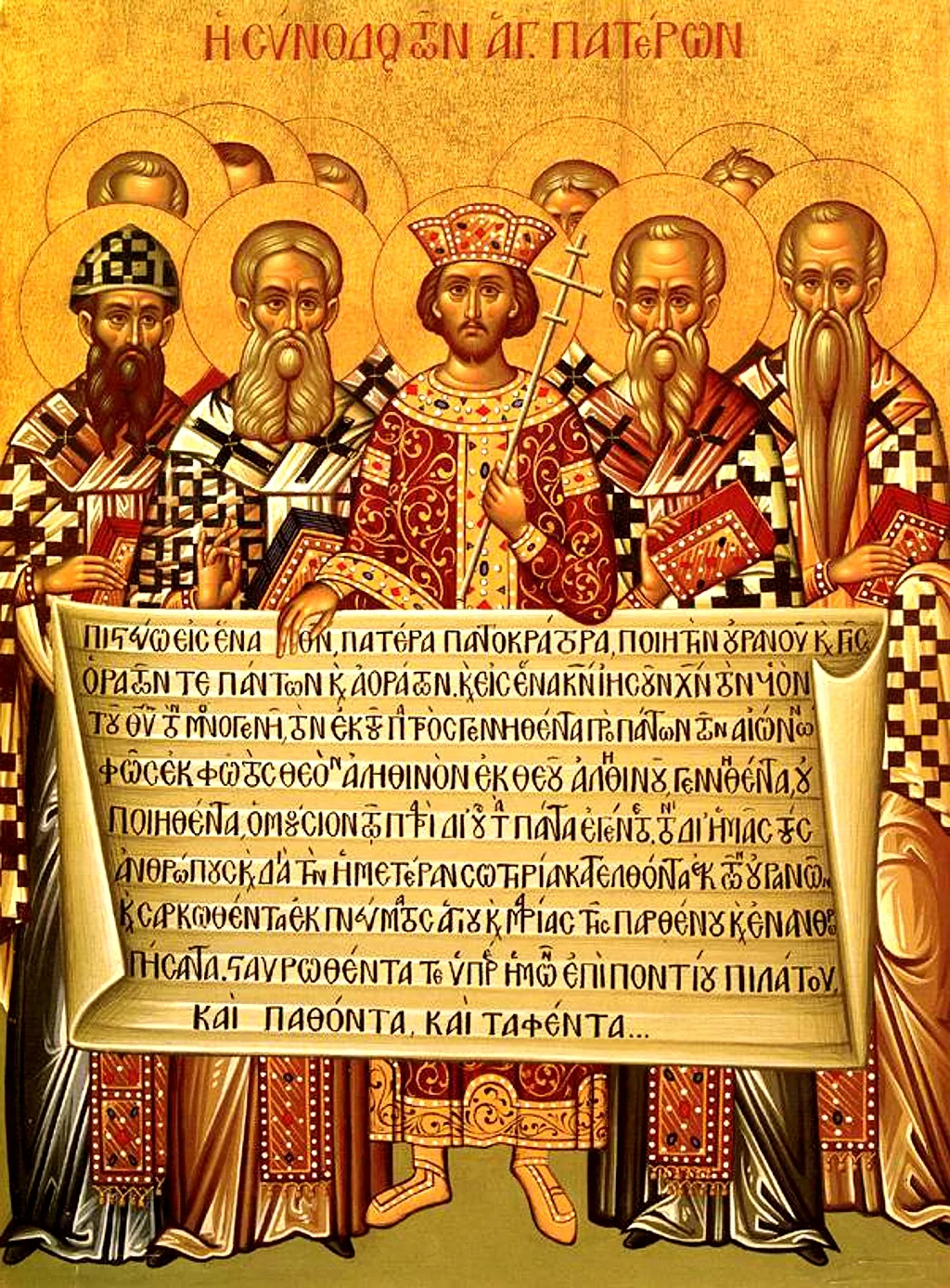
History, however, preserves an eloquent irony here. Constantine himself, who sponsored the condemnation of Arius, returned years later to receive the Arians at his court and recall Arius from exile. He was then baptised on his deathbed in 337 at the hands of an Arian bishop, Eusebius of Nicomedia. As for Arius, he died suddenly in Constantinople in 336, on the eve of his formal restoration to the church. A dramatic account of his death circulated, but its source is his bitter opponent Athanasius. Modern historians treat it with great caution, since it is the account of an adversary in the course of making his case.
The Arian century: when “the world groaned”
The common assumption is that Nicaea ended the matter. The reality is that the following five decades looked more like a victory for Arianism than a defeat. The emperor Constantius II, son of Constantine, inclined towards the Arian and semi-Arian formulas. Athanasius, the hero of Nicaea, was exiled from his see five times. And councils followed one another, framing and unframing: Antioch, Sirmium, Ariminum (Rimini) and Seleucia.
In the year 359 the twin councils of Rimini and Seleucia brought the bishops of East and West alike to sign a formula stating that the Son is “like the Father.” The Nicene word “substance” was deliberately dropped. Of that moment St Jerome wrote his famous line, which became the title of the whole era: that the world groaned and was astonished to find itself Arian. That is to say: the official majority of the church, at one moment in the fourth century, stood on something other than the faith of Nicaea.
A distinction is needed here that many writers miss: the “Arians” were not a single bloc. Among them were the hardliners, the Anomoeans, who said the Son was unlike the Father in substance. The semi-Arians said he was like the Father in substance but not equal to him. And the Homoians were content with the word “like” and forbade any discussion of substance at all. It became the custom for opponents to apply the label “Arian” to this entire spectrum as a slur, as the names of sects are applied in every religious quarrel, to widen the charge.
380–381: when did the Trinity become the common idea?
The precise answer to the essay's central question falls in these two years. In 380 the emperor Theodosius I issued the Edict of Thessalonica, declaring the Nicene faith the sole official religion of the state. Those who differed from it were described in the text of the edict itself as “demented and insane”; their assemblies were denied the name of “churches”; and they were threatened with the punishment of earthly power on top of the divine punishment awaiting them. Then the Council of Constantinople met in 381 and completed the structure. The full divinity of the Holy Spirit was declared, in answer to those who denied it, and with that the formula of the Trinity was complete: three hypostases equal in one divine substance.
If we want historical precision, then, we say this. The doctrine crystallised in its technical form between 325 and 381. But it did not become “the common idea” by the decision of councils alone; it became so by the force of imperial law after the year 380, when departing from it turned into a crime of state rather than a theological opinion. Thereafter the institutions of the empire — education, the courts, the episcopal sees — undertook to entrench it generation after generation. That is to say: between the appearance of Christianity and the becoming of the Trinity, in its final form, a binding official doctrine, there lie some three hundred and fifty years.
And there is a textual witness that supports this course. Only one verse in the New Testament mentions the Trinity in an explicit collected formula: the Johannine Comma, in the First Letter of John (5:7). Modern textual criticism has judged it unanimously, including by Christian textual scholars themselves, to be a late interpolation that entered the Latin text and then seeped into the later Greek manuscripts. For that reason the critical editions and the authoritative modern translations omit it. Isaac Newton, as will come, was among the first to treat this corruption in detail.
The Arianism of kingdoms: from the Goths to Spain
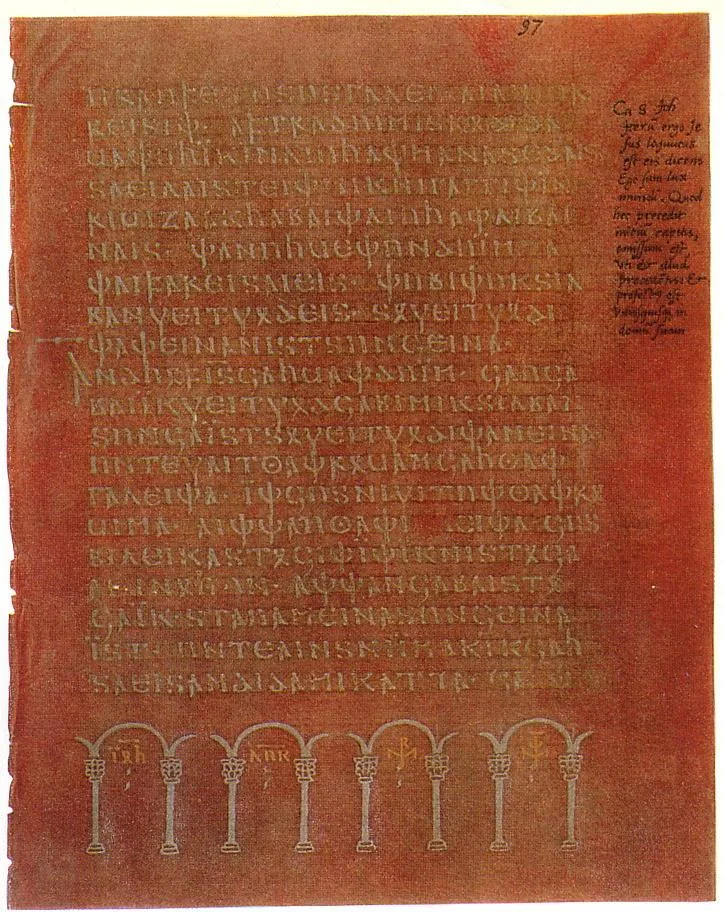
The Trinity triumphed within the borders of the empire, but Arianism did not die. It went out by the door and came back in through the window — the window of the Germanic peoples. In the middle of the fourth century, before the settlement of 381, the bishop Ulfilas (Wulfila) had preached to the Goths beyond the Danube a Christianity Arian in character. He also translated the Bible for them into their Gothic tongue, one of the oldest texts written in any Germanic language at all. And when these peoples overran the Western Empire and brought it down in 476, there arose on its ruins kingdoms Arian in confession: the Visigoths in Spain and southern Gaul, the Ostrogoths in Italy, the Vandals in North Africa, the Burgundians, and then the Lombards.
The great historical irony, then, is this: at the very time when Arianism was a hunted heresy in Constantinople, it was the religion of kings and of the state across half of Western Europe and North Africa. Indeed the Vandals in Carthage went so far as to invert the situation and persecute the adherents of the Nicene confession in a persecution long remembered. Nor was the page of political Arianism turned except gradually. The Franks converted to the Nicene confession directly; the Vandals and Ostrogoths fell to the swords of Justinian. As for Gothic Spain, it remained an Arian kingdom until King Reccared announced his conversion in 587, and the Third Council of Toledo then ratified the conversion of the whole kingdom in 589. The Lombards in Italy continued in their Arianism until the end of the seventh century.
The reader of our Andalusian series may pause here for a moment. The land that would become, a century and a bit later, an Islamic al-Andalus was until the year 589 a kingdom whose official confession was Arian, whose kings held that Christ was a creature below God. The Trinity, then, did not become “the common idea” across Western Europe in its full sense until roughly the beginning of the seventh century — one single generation before the appearance of Islam.
Who are the Nestorians and the Jacobites? A map of the next division
When the question of Arius was settled in 381 in favour of the Trinity, the church did not fall quiet. The conflict moved at once to a new question on an entirely different axis: if Christ is fully God and fully man, how do divinity and humanity meet in his person? Out of this second question, not out of the question of Arius, were born the Nestorians and the Jacobites, who would be the neighbours of the Arabs for centuries. The distinction between the two questions is necessary. The question of Arius was “is the Son equal to the Father?” The question of the fifth century was “how are the two natures united in Christ?” And all parties to the second question are Trinitarians who believe in the divinity of Christ.
The Nestorians are named for Nestorius, patriarch of Constantinople, who objected to calling Mary “Mother of God” and held that “Mother of Christ” was more fitting. The one who was born and grew and hungered and was crucified was the human nature, not the divine. He therefore inclined to emphasise the distinction between the divine and human natures in Christ, while they were united in a union of will and rank. The Council of Ephesus condemned him in 431, and he was deposed and exiled. But his theology flourished outside the borders of the empire in the “Church of the East,” centred in Persia. Its missions extended to India and China and reached their height in the Abbasid age, and its physicians and translators, such as the Bukhtishuʿ family and Hunayn ibn Ishaq, were pillars of the scientific renaissance in Baghdad.
The Jacobites stand opposite Nestorius, in the direction of insisting on unity. They said that Christ after the union has a single incarnate nature of divinity and humanity, not two distinct natures, and for this reason scholars call them Miaphysites (holders of the one united nature). They rejected the Council of Chalcedon of 451, which decided that Christ has two complete natures in one person. In its wake the churches of Egypt (the Copts), of Syria and of Armenia broke away. Their name comes from Jacob Baradaeus, the Syriac bishop who roamed the East in the sixth century disguised in worn rags. He secretly ordained priests and bishops, and so saved his church from dissolving under Byzantine pursuit. After him the Syriac Orthodox were called “Jacobites.”
This map bears directly on our subject. The Byzantine Empire persecuted the Miaphysites and the Nestorians at length as men standing outside Chalcedon. Many historians have held this persecution to be among the causes of the coolness of the people of Egypt and Syria in defending the empire against the Islamic conquest. Many of them found in the new rule, which did not interfere in their christological disputes, what they had not found among their brethren in religion.
And what of the Christians of the Arabian Peninsula?
It is common in some contemporary writing to link the Christians of the Arabian Peninsula to Arianism, as though the monotheism of Arius were the Christianity that neighboured the Arabs. For all its attractiveness, this link is not supported by strong historical evidence, and honesty requires that this be pointed out. What the sources do establish is that the Christians of Najran were in the main of the Jacobite, Miaphysite confession; that the Christians of Hira, the ʿIbād, were Nestorians belonging to the Church of the East; and that the Ghassanids in Syria were Miaphysites. As the previous section showed, these three groups differ sharply over the nature of Christ. But all three are Trinitarian groups affirming his divinity.
Yes: it is not to be ruled out that individuals and pockets held various monotheistic beliefs on the fringes of the Peninsula. The region was a refuge for those whom the provinces of the empire had squeezed out once doctrinal difference became a legal crime. But to move from this possibility to the claim that an organised Arianism was the principal presence in the Peninsula is a leap the documents will not bear. This is another instance of a rule that has accompanied us throughout this series: the beautiful, coherent account is not necessarily the true account, and missing evidence is not made good by a well-made plot.
Did Arianism ease the entry of the people of Iberia into Islam?
This is an old thesis repeated by some writers. Peoples in Gothic Spain and Vandal North Africa had long been accustomed to holding that Christ was a creature below God, and so found in Islam's doctrine of Christ something familiar, which made entering it easy for them. Some researchers formulated it explicitly in the middle of the twentieth century, with respect to North Africa in particular. Does it hold up under scrutiny?
Careful examination shows the thesis, in its strong form, to be weaker than it looks, for three considerations. The first is timing. Arianism was formally abolished in Spain in 589, one hundred and twenty-two years before the Islamic conquest of 711. That is five full generations in which the country grew up on the Nicene confession and under a strong church that held the successive councils of Toledo. The second is class. Arianism in Spain was in essence the confession of the ruling Gothic elite, a minority that remained for centuries distinct from the Hispano-Roman majority. That majority was Nicene from the start and never adopted Arianism at all. The third, and the most important, is the pace of conversion itself. Studies of the rates of conversion to Islam in al-Andalus, the most famous of which is Richard Bulliet's curve built on tracing genealogies and names, indicate that Islam did not become the religion of the majority of the population until around the middle of the fourth century of the Hijra, the tenth century of the common era. That is two and a half centuries after the conquest. Had Arian “doctrinal readiness” been the engine, we should have expected a rapid conversion in the first generation, not a slow march that historians explain by factors of social, economic and administrative integration.
But fairness requires recording an observation in the other direction. In the 770s, under Islamic rule itself, there appeared in Toledo the movement of “Spanish Adoptionism,” led by Elipandus, bishop of Toledo. It taught that Christ, according to his human nature, was a “son by adoption,” and the Frankish church condemned it at the Council of Frankfurt in 794. Some scholars have seen in the rise of this theology inside an Islamic environment the effect of the new doctrinal neighbourhood. Others have seen it as an extension of old local Spanish theological traditions, and the matter is still the subject of academic give and take. The disciplined conclusion is this. There is insufficient evidence that Arianism “eased” the Islamisation of Iberia, and the more likely picture is that the conversion was a slow social process with multiple causes. The effect of the Islamic neighbourhood in stirring christological questions among the Christians of al-Andalus is a documented phenomenon — but one that occurred after the conquest, not before it.
The “Unitarians”: the return of the question after a thousand years
The question of Arius did not die. It lay dormant beneath the ashes of the centuries, until the Protestant Reformation breathed on it from a quarter it did not expect. When the reformers raised the banner of “scripture alone” as the authority, they opened the door to anyone who reads scripture and does not find in it, as a text, the formula of Nicaea and Constantinople. And so there were born in the sixteenth century the movements of antitrinitarianism, which paid a heavy price from both sides at once: Catholic and Protestant.
The name that settled on this current in modern writing, the “Unitarians,” has a story worth recording. The Latin title unitarius first appeared in Transylvania at the end of the sixteenth century, describing the church that affirmed the oneness of God as against the “Trinitarians.” It passed into English at the end of the seventeenth century, and became from the eighteenth century onwards the official name of the Unitarian churches in England and America. So everyone who reads today about a “Unitarian Church” is reading about the descendants of this very current whose history we are writing here.
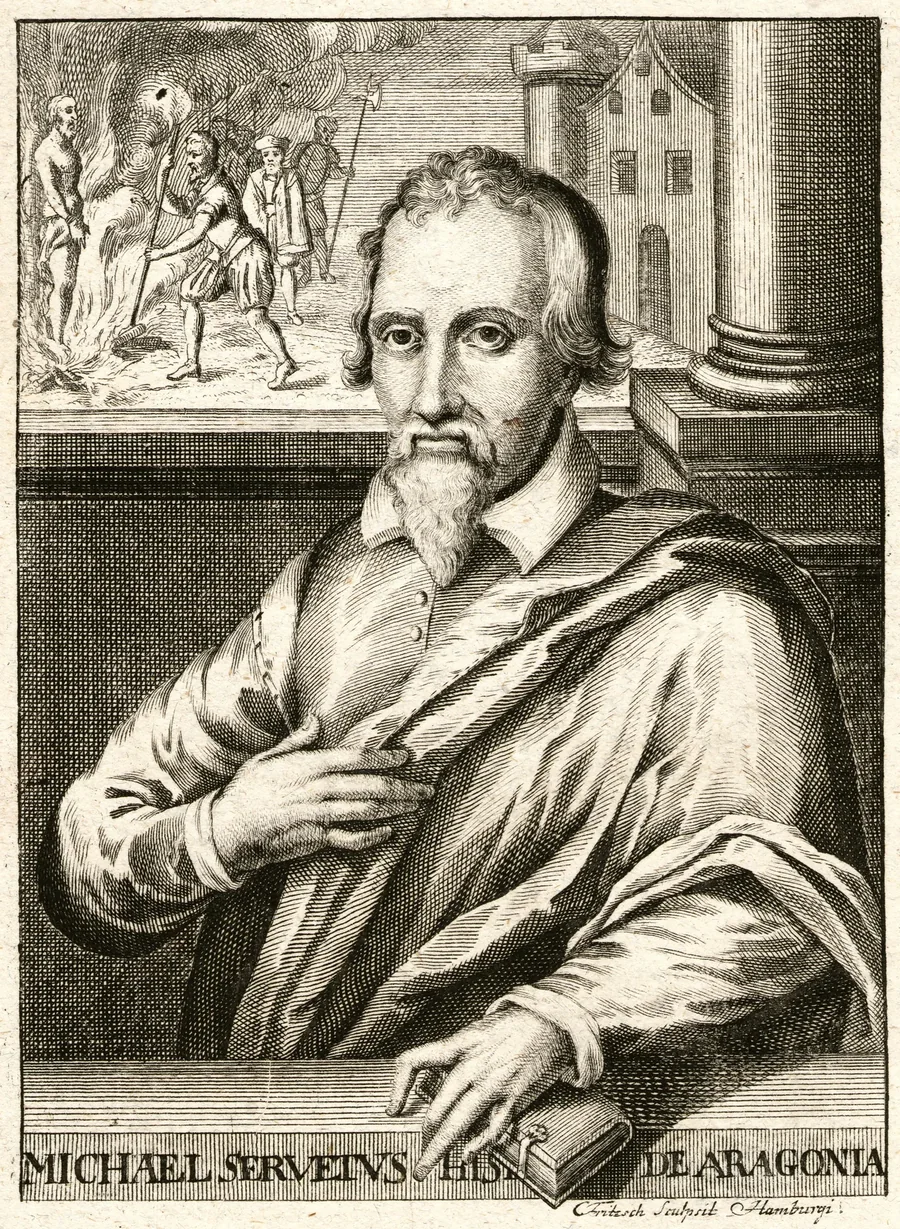
The most famous martyr of this current is the Spanish physician Michael Servetus. He was, incidentally, the first in Europe to describe the pulmonary circulation, which Ibn al-Nafīs had described before him, and here the two threads of our series meet. In 1531 he wrote his book On the Errors of the Trinity, and the Catholics hunted him. He was then seized in Geneva, which lay under Calvin's influence, and burned alive in 1553 with his book hung about his neck. And in Poland there arose the group of the “Polish Brethren,” later known as the Socinians after Fausto Sozzini. They issued the “Racovian Catechism” in 1605, the most mature Unitarian theological formulation of its age, before they were driven out of Poland altogether.
In Transylvania the matter reached a unique summit. King John Sigismund adopted the Unitarian confession under the influence of his preacher Ferenc Dávid and his physician Biandrata, which made him the only Unitarian king in the history of Europe. In his reign the Edict of Torda was issued in 1568, one of the oldest edicts of religious toleration in European history. It granted communities the freedom to choose their own preacher, and stipulated that “faith is a gift of God,” to which no one may be compelled. And the Unitarian Church still stands in Transylvania today, four and a half centuries on.
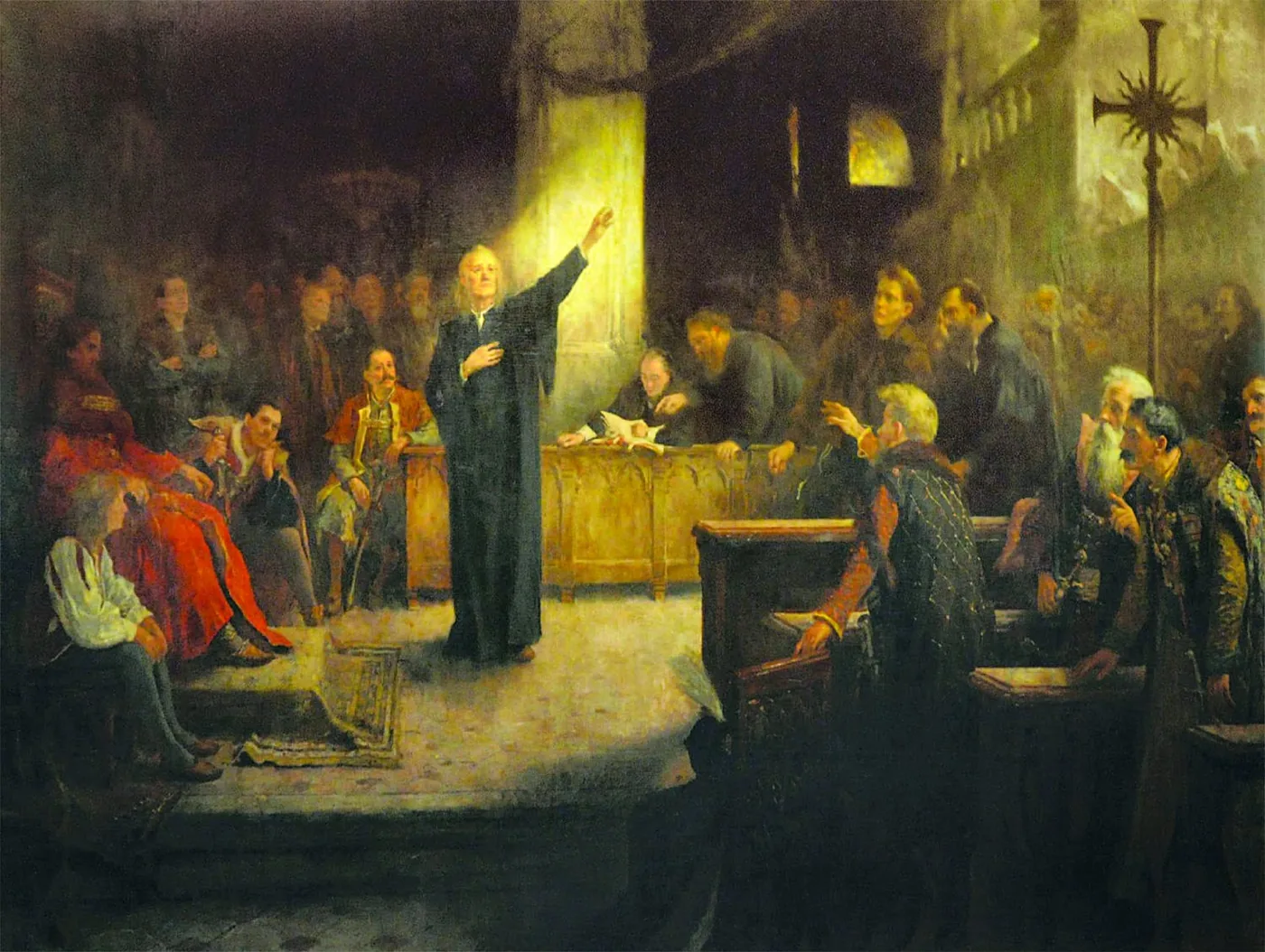
In England, John Biddle was repeatedly imprisoned in the seventeenth century for denying the Trinity; then Theophilus Lindsey founded, in 1774, the first church openly named Unitarian in London. And the most astonishing case of all is Isaac Newton himself, the greatest scientist of his age and holder of the chair of mathematics at Cambridge. He was secretly a Unitarian opposed to the Trinity. He wrote a study he did not dare publish in his lifetime, An Historical Account of Two Notable Corruptions of Scripture, in which he set out in detail the case of the Johannine Comma mentioned above. Had he declared his view he would have lost his post and his standing, for denying the Trinity was at that time a criminal offence in England. Then the banner was carried by the chemist Joseph Priestley, the discoverer of oxygen, who fled England for America after a mob burned his house and his laboratory. There the Unitarian churches grew at the hands of men such as William Ellery Channing in the nineteenth century.
In our own day, Unitarian christology is distributed across various denominations that differ among themselves. They run from the Jehovah's Witnesses, who hold to a created Christ in a manner recalling the formulas of Arius, to the Christadelphians, to the “Unitarian Universalists,” many of whom have evolved from a Unitarian theology into a loose pluralist body. Their following is small beside the great Trinitarian churches. But they are a living witness that the question sung by the sailors of Alexandria seventeen centuries ago is still being asked.
Islam and European Unitarianism: direct influence, or parallel?
Here a question imposes itself on the Muslim reader of history. All these European Unitarian movements arose centuries after Islam, and Islam is a religion of explicit monotheism neighbouring Europe and disputing with it. So did it have any effect upon them? The honest answer requires unpacking, because the influence ran through three channels differing in force and in evidence.
The first channel: Islam as a proof of possibility
The soundest thing that can be said is that the existence of a great world civilisation worshipping one God without a Trinity was in itself a permanent silent argument that pure monotheism is possible and actual. Some of the pioneers of the current stated this reasoning explicitly. Servetus, as his students record, read the Jewish scholars' critiques of the Trinity and looked into the Qur'an, in its Latin translation printed at Basel in 1543 with a preface by Luther himself. He held that the doctrine of the Trinity was the greatest barrier keeping Jews and Muslims from Christianity, and that a return to pre-Nicene monotheism would remove that barrier. That is to say: Islam was present in the consciousness of the founders of the current as a witness and an argument. It was not the direct source of a doctrine they built on their own reading of the New Testament itself.
The second channel: the Ottoman political umbrella
The best-documented influence is political. Transylvania was the cradle of the first official Unitarian church and of the first title “Unitarian.” It was a principality under the protection and suzerainty of the Ottoman state after the battle of Mohács (1526), far from the hand of the Catholic Inquisition and from the sword of Protestant Geneva alike. In this protected space alone was it possible for the Edict of Torda (1568) to be issued and for a European king to profess monotheism openly. The researcher Susan Ritchie, in her study “The Pasha of Buda and the Edict of Torda,” has held that the Ottoman model of tolerance towards confessional communities was a direct influence in shaping the Transylvanian experiment. The thesis is meeting increasing acceptance, though its extent remains under discussion. And the witness of furthest significance is that when Europe closed in on the Unitarian refugees, their destination was the land of Islam. Adam Neuser, the German Unitarian theologian of Heidelberg, ended by embracing Islam and settling in Istanbul, and he was not the only one.
The third channel: the charge of “Turkicising,” and the scholarly engagement
There is a third channel, running in the opposite direction but revealing. The opponents of the Unitarians themselves saw the kinship between the two creeds. The commonest thing thrown at the Unitarians in the sixteenth and seventeenth centuries was that they were “crypto-Muhammadans” and that their doctrine was a “Turkicising” of Christianity. The phrase “Socinian Islam” became a term in the polemical literature. Nor was the charge pure fabrication in its scholarly aspect. Modern researchers, among them Martin Mulsow in his study of Socinianism and Arabic scholarship, have documented the interest of certain leading figures of the current and their circle in Arabic orientalism and in Muslim texts criticising the Trinity. And in England, Henry Stubbe wrote in the seventeenth century an unprecedented defence of Islam and its Prophet as a restoration of the original monotheism, followed by John Toland in his book Nazarenus. Both men came from the orbit of the rationalist Unitarian current.
The disciplined conclusion, then: it is not correct to say that European Unitarianism “took” its doctrine from Islam, for its adherents built it upon an internal critique of the texts of the New Testament and of the history of the councils. But neither is it correct to overlook that Islam was present in the scene in a threefold presence: a living proof of possibility; a political umbrella that furnished the first Unitarian church with ground to stand on; and an intellectual kinship acknowledged by its enemies before its friends.
The auditor's question: is the Trinity “an inherited doctrine of power with no connection to Christ”?
All this brings us to the question the reader of this journey must put to himself: is it correct — by the standard of historical research — to say that the doctrine of the Trinity is an inherited doctrine of power with no connection to Christ? The honest answer requires separating the phrase into two halves, because their shares of evidence differ.
The first half — that there is in the doctrine an inherited dimension of power — is supported by history in specific respects a researcher can establish from the documents. The final formula of the Trinity is a late technical formula found nowhere in scripture as a text, and its key, homoousios, is a philosophical word inserted in the fourth century. Its general imposition was accomplished by a state edict and legal penalties in the year 380, not by free persuasion. Its transmission across the generations thereafter took place largely by social inheritance, within institutions that criminalised departure from it. And we have seen that denying the Trinity remained a crime for which Servetus was burned, and on account of which Newton hid his papers until after his death. Whoever says that “prevalence” here is the manufacture of power and of inheritance has said something for which he holds real historical evidence.
As for the second half — “with no connection to Christ” — here the historian must stop and distinguish his instruments. The historical method shows that the exalted veneration of Christ is older than Constantine by centuries. The letter of Pliny the Younger to the emperor Trajan (around 112) describes the Christians of Bithynia chanting “to Christ as to a god” — and it is a pagan Roman document whose author had no stake in the matter. The letters of Paul and the prologue of the Gospel of John carry a high christology whose extent scholars dispute, but not its existence. And the threefold baptismal formula occurs in Matthew. That is to say: the material of the dispute, in texts and in worship, is older than the councils. The councils did not invent it out of nothing; they chose one interpretation among its contested interpretations and imposed it. Indeed Arius himself worshipped the Son and prayed to him, while holding that he was created.
Then comes the last step in the phrase: what did Christ himself teach? This step lies outside what the historian can settle with his instruments. His earliest sources about Jesus are texts written decades after him, carrying layers of redaction, and reaching from them to “his own words” with documentary certainty is something the textual critics themselves acknowledge to be bounded. The Muslim is certain that Jesus, peace be upon him, called only to the oneness of God. But the source of that certainty is the Qur'an, which for him is revelation above history, not documentary excavation. And therefore the precise formulation that both methods can bear is this. The technical formula of the Trinity is a construction three and a half centuries later, settled by the power of the state and passed down by institutions, and there is no way to trace it to the direct teaching of Christ by the instruments of history. Asserting the denial of every connection, by contrast, is a doctrinal judgement. It is legitimate in its own domain, but it ought to be spoken in the language of creed rather than dressed in the garb of a neutral historical conclusion. And this very distinction is what makes historical writing worthy of the trust of readers of every faith.
Conclusion: doctrine, power, and time
What does the reader of history come away with from this journey? Three conclusions at least. The first: that “the common idea” is not necessarily the oldest idea. Prevalence is a historical manufacture in which texts and councils and emperors and laws and schools all conspire. We have seen that the final formula of the Trinity took three and a half centuries to crystallise, and that its general imposition required a state edict, legal penalties, and further centuries outside the borders of the empire.
The second: that the moment of Nicaea was a moment of transformation in the relation between religion and power, not in theology alone. From the moment the emperor entered the council chamber, doctrinal difference became an affair of state, and exile and confiscation and burning became instruments in theological argument. And everyone inherited this legacy: Nicenes and Arians, Catholics and Protestants, each persecuting his opponent when he came to power. The Unitarians found no safe refuge, in their earliest days, except in the shadow of a principality protected by the state of Islam.
The third — and this is the standing testament of this series — is that reading the history of ideas requires the patience of the historian, not the zeal of the adversary. The Arians were not demons as their opponents drew them, nor were their opponents mere instruments of power as some moderns draw them. They were all of them human beings contending over the greatest question that can be asked: who is God? And the echo of the songs of that old Alexandrian priest still resounds in academic halls and small churches alike — a witness that ideas may be exiled and their books burned, but they do not die by decree.
- 325Nicaea — Arius condemned; homoousios adopted
- 359Rimini & Seleucia — the word “substance” dropped from the formula
- 380Edict of Thessalonica — the Nicene faith made the religion of the state
- 381Constantinople — the Trinitarian formula completed
- 431Ephesus — Nestorius condemned
- 451Chalcedon — two natures; Egypt, Syria and Armenia break away
- 589Third Toledo — Gothic Spain abandons Arianism
- 1553Geneva — Michael Servetus burned
- 1568Torda — the first edict of toleration, and the first Unitarian church
- 1774London — Theophilus Lindsey opens the first avowedly Unitarian church
This essay is a historical review drawing on the academic literature in the history of doctrine. Its aim is to describe what happened, as the documents, the councils and the texts establish it — not to conduct sectarian polemic. Wherever historians have differed, or the evidence is thin, I have said so plainly; fidelity in reporting history comes before the beauty of the story. And at several points I have distinguished what the historical method can establish from what remains a theological judgement lying outside its instruments.
NEUTRAL FACT CHECKER
The factual claims in this essay were checked against their sources — the Nicene creed and the Edict of Thessalonica in their own words, the letters of Arius, Athanasius, Jerome and Gregory of Nyssa, and the studies of Hanson, Williams and Mulsow — together with a citation scan. The result is published as it came out, and the essay has not been edited to agree with it. The fact-check is in Arabic: read the neutral fact-check →
© 2026 Husain Alkhaldy — published in the site's essays. Translated from the Arabic.