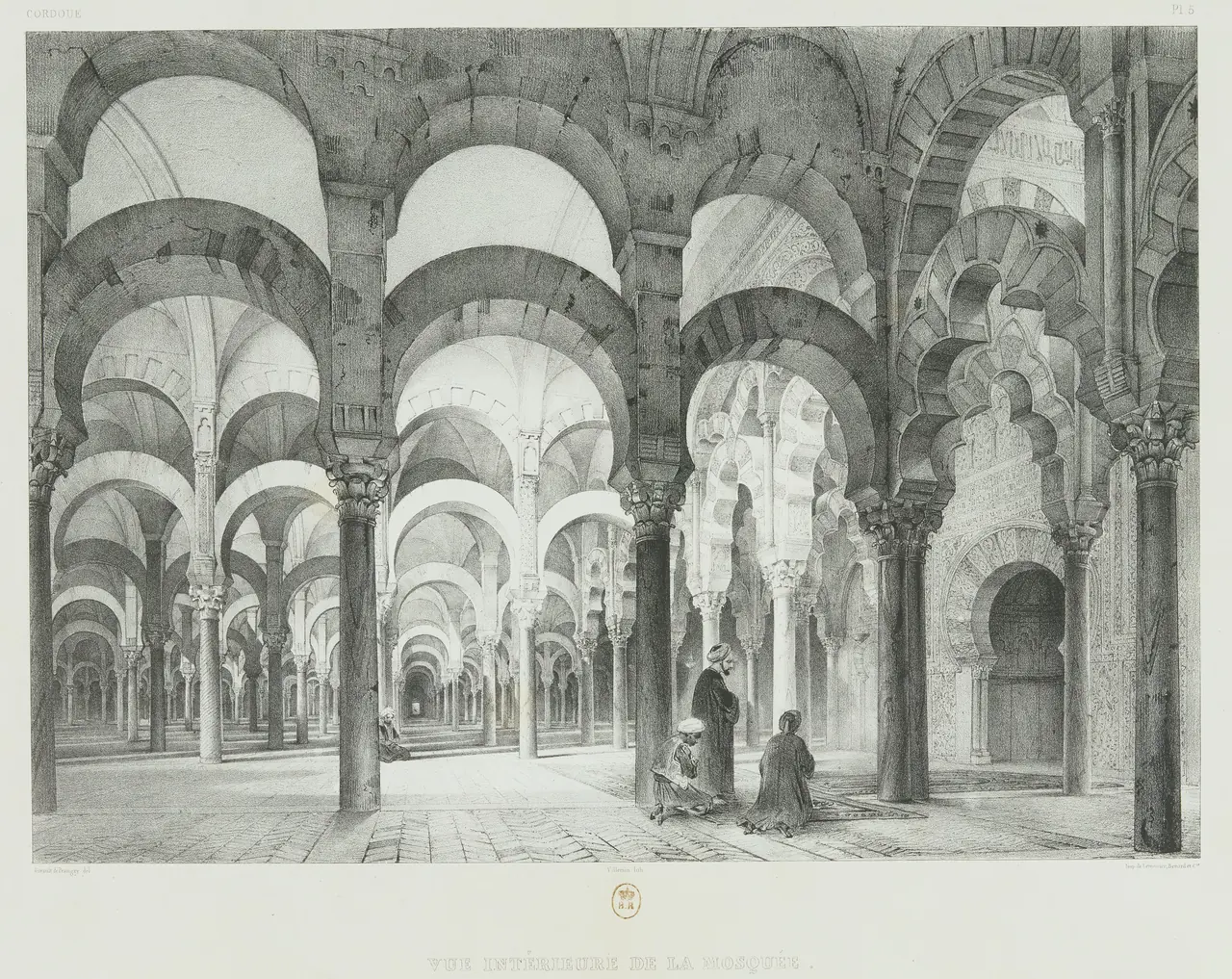
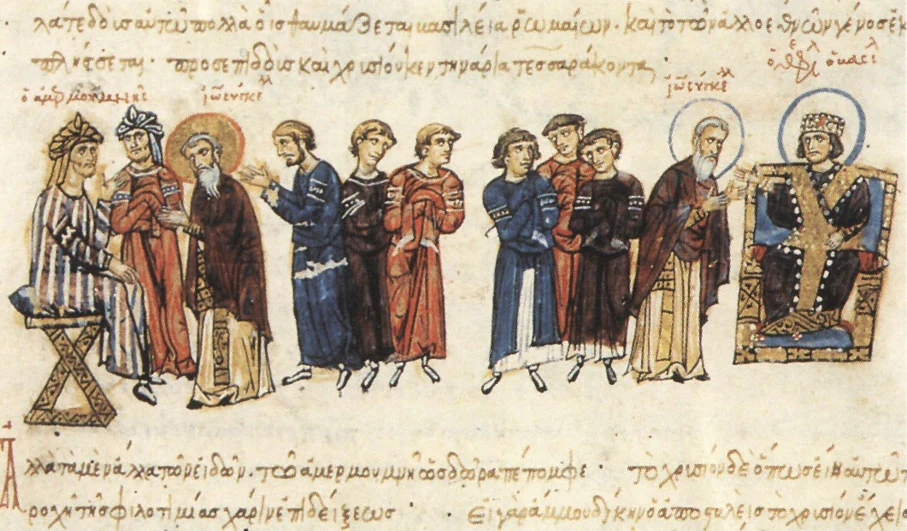
In the year 225 AH, corresponding to 840 CE, a Greek named Qartiyus entered the palace of Cordoba. He had a good command of Arabic. He came as an envoy from Constantinople, carrying costly gifts and a letter from Theophilos, emperor of the Byzantines, to Abd al-Rahman II, amir of al-Andalus.
The letter made three requests. The first was a military alliance against the Abbasids in Baghdad. The second was that the amir hold back from the Byzantine coasts those Muslim seafarers who were making their sea a misery. The third is the strange one: that the amir revive the caliphate of his Umayyad forefathers. A Christian emperor advising a Muslim amir to declare himself caliph.
Abd al-Rahman answered with an embassy of his own. He chose for it a man past seventy, a poet known for his quick wit and his light touch, named Yahya b. al-Hakam al-Bakri al-Jayyani. But nobody knows him by that name. People know him by his nickname: al-Ghazal (with a fatḥa; in al-Zirikli it is al-Ghazzāl, an exception that departs from the rest)
What has reached us from this embassy? Two stories. In the first, the emperor set up a low door so that he would have to enter on his knees, and he went through on his back. In the second, years later he travelled to the land of the Vikings as an envoy and made love poetry to their king's wife. Together the two stories are the worst attested thing in his life. What actually happened on that embassy, what Constantinople offered and how Cordoba answered, disappeared beneath the anecdote.
Who was Yahya al-Ghazal?
Yahya b. al-Hakam was born in Jaén, a city in the south of al-Andalus. He traced his descent to Bakr b. Wa'il, the well-known Arab tribe. The nickname came from his good looks and his elegance as a young man, and the Arabs call a handsome youth a gazelle just as they call a woman one.
When was he born? The Arabic sources say 156 AH (772 CE), and that he died in 250 (864 CE). That gives him a life of about ninety-four years, spanning five of the Umayyad amirs of al-Andalus. European scholarship puts his birth at around 790 CE. The difference is not a small detail. On the first reckoning, Abd al-Rahman sent a man of seventy to the greatest court in the world; on the second, he sent a man of fifty. I find nothing that settles the question, but the report of "five amirs" only holds with the earlier date.
Al-Ghazal was a poet before he was an envoy. He was shaped by Abu Nuwas and Abu Tammam, and he wrote love poetry, wisdom poetry and satire. His tongue in satire brought him as much enmity as it brought admiration. Ibn Hayyan al-Qurtubi, the most exact of the historians of al-Andalus, called him "the sage of al-Andalus". He knew something of astrology, so much so that one of the transmitters cited by Ibn Hayyan describes him as the amir's astrologer rather than his envoy. He has verses reproaching his nephew for being absorbed in chess, a game then new to Cordoba, brought there by Ziryab.
It is related that the amir once greeted him teasingly with half a line of verse, and al-Ghazal completed it on the spot:
The amir said, teasing, in his speech .. Here comes al-Ghazal, with his good looks and his beauty
What has beauty to do with a man whose years .. have run past the count of seventy
(And the reply runs on past this.) The report is told in the books of adab and is not free of the transmitters' craft, but it describes the kind of man the choice fell on: a man who answers the amir off the cuff and is not thrown.
Why did the emperor write to the amir of al-Andalus?
Because he was living through his worst years. Two years before, in 838 CE, the Abbasid caliph al-Mu'tasim marched on the city of Amorium, took it and destroyed it. Amorium was no ordinary city to the Byzantines. The ruling house itself had come out of it, the house of Theophilos. This is the battle that Abu Tammam made immortal in his famous bāʼiyya: "The sword is a truer teller than the books." In it he names the emperor: Tufilas.
Theophilos came out of Amorium looking for an ally. He looked at the map and found a state in the far west ruled by a house with an old score to settle with Baghdad: the Umayyads. The Abbasids had brought them down in the east, and they had set up a replacement state for themselves in al-Andalus. This was a sound political calculation.
The letter carried something more important than the alliance itself: recognition. Constantinople, which had negotiated and corresponded with the caliphs of Baghdad, was now writing to Cordoba the way one writes to a state, and the amirate of al-Andalus was still soft and new at the time. That is why Ibn Hayyan took care to record the report, and stated that this was the first time a Byzantine emperor had offered such an alliance to the amirs of al-Andalus. The man was not renewing an old covenant. He was creating a new alliance that had never existed.
Why did Abd al-Rahman refuse the offer?
The amir of al-Andalus refused the offer because it was impractical, according to Ibn Hayyan's account. Between Cordoba and Baghdad lay desert, sea, and states that would not let an army through. And the weightier reason? Al-Andalus had no fleet at the time. The amir said as much to the emperor outright: you are better able than we are to control piracy at sea, because you have the ships and we do not. Cordoba had no real fleet until four years later, when Viking ships landed at Lisbon and Seville in 844. Abd al-Rahman then built a dār al-ṣināʿa (a shipyard) and a fleet to protect his coasts.
The offer of the caliphate he answered in a different key. What he said amounted to this: the caliphate will return to our house by God's grace, not through an alliance with the Byzantines. This is the talk of a man who knows exactly the size of his state — and its future — and refuses to buy a title at a price he cannot pay.
His instinct proved right eighty-nine years later. In 929 CE Abd al-Rahman III proclaimed himself caliph in Cordoba. Not through a Byzantine alliance, and not with an army marching on Baghdad, but once al-Andalus had settled under him and his power at home was secure. This connects to what I said in an earlier article about al-Andalus: that the Umayyad caliphate was the thread holding the fabric of that society together, and that its strength came from within, not from allies.
The embassy, then, produced neither an alliance nor a treaty. We have no serious evidence for a Byzantine–Umayyad alliance in the ninth century CE, however often modern books repeat the claim. Al-Ghazal's embassy was a courteous reply to a courteous letter. It kept a line open with the Byzantines, and it announced that Cordoba knows how to answer whoever writes to it.
Some details of the embassy
Al-Ghazal travelled with another man who shared his name, Yahya. We know nothing about him except his epithet: ṣāḥib al-munayqila, "the man with the little clock". The clock was most likely one of the gifts carried to the emperor. It is a telling gift, because precision instruments were in that age a mark of how advanced the state that made them was. The two men accompanied Qartiyus back to Constantinople, carrying the amir's reply.
All we can fix by date is that the Byzantine embassy reached Cordoba, and that al-Ghazal set out on the return journey from Constantinople, in the same year: 225 AH. The whole trip, then — the outward leg, the stay, and the return — took place within a short span.
As for what happened in Constantinople itself, this is where the trouble begins. Ibn Hayyan does not report it in a single narration but in three different ones, and he does not conceal that they disagree:
- The first narration rests on al-Ghazal's own poetry and on the stories that attached themselves to it. It is the entertaining one, and it contains the low door and the description of the empress. It also carries an obvious chronological flaw. Michael, the son of Theophilos, appears in it as a man who speaks and is spoken to, when on the day of the embassy he was an infant.
- The second narration comes from Hasan b. Muhammad b. Mufarrij al-Qubbashi, and in it al-Ghazal concluded a pact of amity with the Byzantines.
- The third narration comes from ʿIsa al-Razi, and in it al-Ghazal is mentioned as an astrologer rather than an envoy.
Three narrations in one historian, and each of them has something to be said for it. That in itself is a lesson in the worth of the isnād: the historian passes on what reached him with its chains of transmission, and does not dissolve the disagreement into a single smooth account. Had Ibn Hayyan not done this, we would have supposed we had one report and no rival to it.
There is a further detail that the scholar Elsa Cardoso has pointed out: al-Ghazal's own poetry contains a reference to an envoy who went to Constantinople before him. If the reference holds, it contradicts Ibn Hayyan's statement that this was the first contact between the two states. Both possibilities stand. Either the poem points to an older embassy whose report never reached Ibn Hayyan, or the line is a later one attached to his verse.
Was there a low door?
The most famous story told about the man is that Theophilos learned that Muslims do not bow to a king. He ordered the door leading to his audience hall lowered, so that no one could enter it except on his knees. Al-Ghazal saw through the trick. He turned around and went in backwards, feet first, then stood up and greeted the emperor on his feet. The emperor admired his cleverness. Byzantine court protocol had a rite called proskynesis, a bow or prostration before the emperor to express submission to his authority. For the Byzantines it was state ceremonial and nothing more. For a Muslim it is a matter of doctrine, because prostration to anyone but God is forbidden, and bowing in reverence to a human being is prohibited.
The same collision recurred with other envoys who had nothing to do with al-Ghazal. ʿUmara b. Hamza, the envoy of Abu Jaʿfar al-Mansur, was brought before the emperor after being walked past terrifying displays of lions, swords and smoke, and was told outright that the purpose was to frighten those who came. Nasr b. al-Azhar, the envoy of al-Mutawakkil, was refused entry with his turban and his sword. He turned back at the door and did not go in until he had been appeased. The dispute over ceremonial is a repeated historical fact, not the invention of a storyteller.
As for the trick of the door in particular, my own view is that it is literary rather than documentary. A number of modern scholars have judged the same, among them Juan Signes Codoñer in his study of Theophilos. The internal evidence is strong: the story belongs to the very narration that turned an infant into a grown man. Anyone who rejects the opening of that narration for an evident flaw is bound to stop short at its close.
An important note: rejecting the anecdote does not mean rejecting what lies under it. Its substance is established by other routes, as we have seen: that a Muslim envoy refused to bow to a human being, and that the Byzantine court had to deal with that refusal. The anecdote is a literary shaping of an event of a kind that really did happen. That is not the same thing as being accurate in its details.
The Embassy That May Never Have Happened
That leaves the second story, which is better known than the first in modern writing. Five years later, it says, Abd al-Rahman sent al-Ghazal to the king of the Majus. Majus was the name the Andalusis gave the Vikings. He sailed to a great island in the ocean. He courted the king's wife in verse while the king watched. He came home by way of Santiago de Compostela.
The raid itself is beyond doubt. In 844 the Vikings landed at Lisbon, then at Cádiz. They went up the river to Seville and sacked it. Abd al-Rahman drove them off, and after that he built the fleet. All of this is history.
The embassy has one source only: Ibn Dihya al-Kalbi, in his book "al-Muṭrib min Ashʿār Ahl al-Maghrib". He writes four centuries after the event. He says he took the account from a book by Tammam b. ʿAlqama, a contemporary of al-Ghazal, but that book is lost and there is no way to check it. Ibn Dihya himself was criticized in his own day and accused of being lax.
The body of the report contains things that do not fit the chronology. In 845 Santiago de Compostela was not a destination of any consequence on a route home. The report says of the Vikings that they were pagans "and today they are Christians". Scandinavia was not Christianized until more than a century after that. That sentence points to a late pen writing from its own time.
So Évariste Lévi-Provençal, in a study published in 1937, concluded that the story was built on the model of the Constantinople embassy. It has the sea and the storm. It has the queen taken with the poet. It has the poetry recited before the king. W. E. D. Allen defended it in a book published in 1960, but his defence rested on circumstantial plausibility rather than on any new chain of transmission. Sarah Pons-Sanz took the question up after him in 2004, and Ann Christys, in her book on the Vikings in the south, came down on the side of doubt.
The position I hold is this: not established. I am not saying the story is certainly a lie. Absence is not proof of non-existence, and I set that out in the essay "The Absent Evidence". But a single late report, taken from a lost book, carrying things that do not fit the chronology, and resembling an earlier report to a striking degree, is not a foundation for history. The strange part is that this journey is precisely what al-Ghazal is best known for in modern writing.
Closing
Let us go back to that low door, granting that there may have been no door at all.
The door stayed in the memory, and what mattered more was lost. Lost is that the Byzantine emperor offered the amir of Cordoba an alliance and the caliphate together. Lost is that the emir reckoned up the interests of his state and said no. Lost is that al-Andalus at that time did not own a single warship, and that its amir said so to the emperor without evasion. As for the caliphate offered to him as a gift in 840, it came eighty-nine years later from within, not from the sea.
What drew me to write this brief essay is how far the subject resembles what I wrote in "The Sultan and the Queen" about Elizabeth I's alliance with the Ottomans and the Saadians. Politics across history has been governed by interests, not by religion. There the ruler crossed the confessional line and the alliance held. Here he was offered the crossing and refused. One thing settled the matter in both cases: ships, routes and interests, not creed.
As for al-Ghazal himself, I think that if he had been given the choice he would have chosen to be remembered for the door. He was a poet, and a poet knows which images stick in people's minds. But what sticks in people's minds is one thing. What actually happened is another.
Further Reading
- Ibn Hayyan al-Qurtubi, "al-Muqtabis", the section on the emirate of Abd al-Rahman II. — shamela.ws (full text, and this is the printed portion of the book)
- Ibn Dihya al-Kalbi, "al-Muṭrib min Ashʿār Ahl al-Maghrib". — shamela.ws (full text)
- Lévi-Provençal, É. (1937). Un échange d'ambassades entre Cordoue et Byzance au IXe siècle. Byzantion, 12, 1–24. — archive.org (scan, borrowable)
- Allen, W. E. D. (1960). The Poet and the Spae-Wife: An Attempt to Reconstruct al-Ghazal's Embassy. — vsnrweb-publications.org.uk (full text, free)
- Pons-Sanz, S. M. (2004). Whom Did al-Ghazal Meet? Saga-Book, 28, 5–28. — vsnrweb-publications.org.uk (full text, free)
- Signes Codoñer, J. (2014). The Emperor Theophilos and the East. Routledge, 316–320. — no free copy — print only
- Christys, A. (2015). Vikings in the South: Voyages to Iberia and the Mediterranean. Bloomsbury, 25–27. — no free copy — print only
- Cardoso, E. (2015). The Poetics of the Scenography of Power: The Embassy of Yaḥya al-Ghazāl to Constantinople. Hamsa, 2, 54–64. — journals.openedition.org (full text, free)
- Hermes, N. F. (2014). The Moor's First Sight: An Arab Poet in a Ninth-Century Viking Court. — doi.org/10.1057/9781137405029_3 (subscription)
All of these links were checked before publication. The portion of "al-Muqtabis" available free begins with the events of the year 232 AH, so it does not contain the account of the embassy itself. That account is in the portion edited by Mahmud Ali Makki (Riyadh, 1424 AH), and there is no free copy of it. The books by Signes Codoñer and Christys are in print and under copyright.
This is a translation of an essay written in Arabic. Quotations from the Qurʾān are rendered for sense; the Arabic page carries them in the original.
NEUTRAL FACT CHECKER
The factual claims in this essay were checked independently — its dates, names, narrations and the studies it cites. The result is published as it came out, and the essay was not edited to agree with it. The fact-check is written in Arabic: read the neutral fact-check →
© 2026 Husain Alkhaldy — published in the site's essays.