Essay seven: the necessary and the contingent
al-Kindī, al-Fārābī and Ibn Sīnā, and the critiques of al-Ghazālī and Ibn Rushd
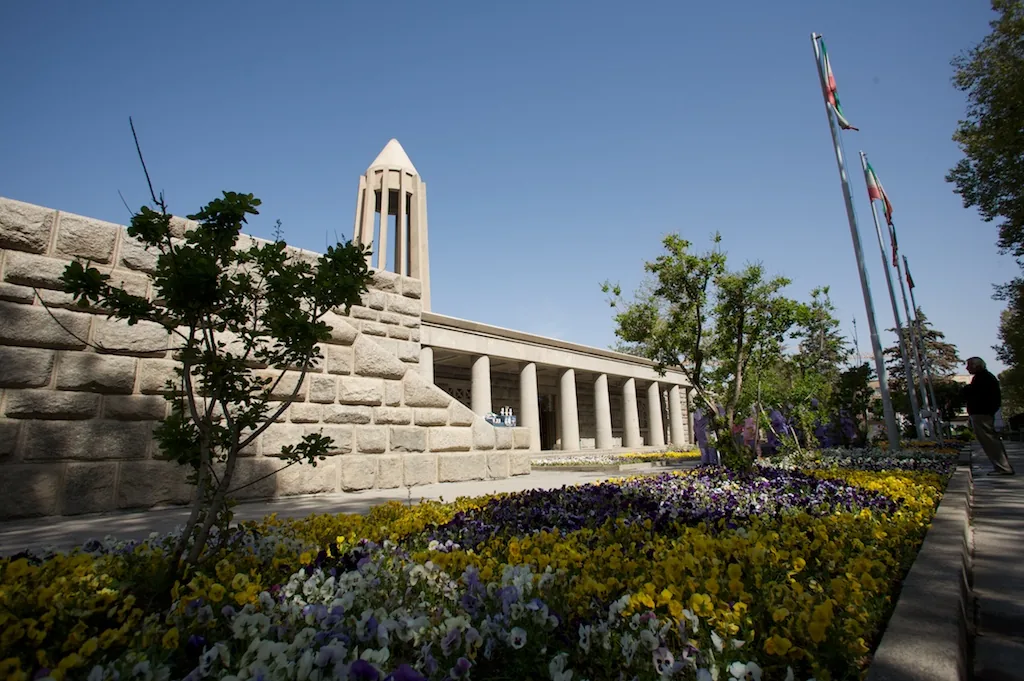
Ibn Sīnā takes leave of himself
In Hamadhān, in the year 428 AH, the most famous physician in the world lay dying of a disease in his own specialty. He had treated princes and his name had filled the horizons. He had written The Canon of Medicine, which the universities of East and West would teach for seven centuries. Now colic in his own body had defeated him. He was riding in the retinue of the emir ʿAlāʾ al-Dawla on the road to Hamadhān when the illness grew severe, and he turned on himself with the violence of a confident healer. He ordered enemas several times in a single day, until parts of his bowel ulcerated. He prescribed for himself what no physician would dare prescribe for a man in that state. Then some of his servants made it worse. They mixed lethal quantities into his medicine, by mistake according to some and by treachery according to others, out of fear that he would call them to account for money they had stolen from him. So his student reports. He suffered his last relapse.
When the Chief Master knew that he had reached the final stages, he did something fit to close the life of a philosopher of being. He stopped treating himself and spoke the words history has kept. Their sense: the governor within my body has failed to govern, so treatment is now of no use. Then he washed himself and repented. He gave away what he had to the poor, restored what he had wrongfully held to those of them he knew, and freed his servants, among them perhaps the men who had mixed his medicine. He had the whole Qurʾān recited to him every three days, and he died during one of those recitations at the age of fifty-eight. Consider the scene. The physician who declared the governor in his own body incapable is the same man who built the deepest thing Muslims have said about the Governor who is never incapable. He died with the essential poverty that he had made the ground of his proof running visibly in his veins: a contingent going out, in the hands of a necessary that never goes out. This is the door by which we enter the most exacting essays of our series.
The philosopher of the Arabs: truth is nothing to be ashamed of
The story begins a century and a half before Ibn Sīnā, in the Baghdad whose bridge of translation we saw at the end of the last essay (see the essay “Thinking vs. Tafakkur”). There Abū Yūsuf al-Kindī, an ʿAbbāsid prince by descent and the first man to carry the title “philosopher of the Arabs”, oversaw the putting of philosophy into Arabic and wrote in it himself. In his treatise On First Philosophy he set down the sentence that could serve as a motto for this whole series. Its sense: we should not be ashamed to approve the truth and to acquire it wherever it comes from, even if it comes from races far off from us and nations unlike our own; for nothing is worthier of a seeker of truth than the truth.
Yet al-Kindī was no passive transmitter. He broke with Aristotle on the gravest of his questions: the eternity of the world. He set up a demonstration that time and body are finite, and that the world came into being in time, out of nothing, by the power of God. The conclusion of his demonstration agreed with the plain sense of revelation. The point deserves recording before we go further into the story. The first of the philosophers of Islam made demonstration the arbiter and used it to refute the master of demonstration, and it will become clear that the error entered with those who came after him by the opposite route.
The Second Teacher and the architecture of emanation
Then came Abū Naṣr al-Fārābī (d. 339 AH), a Turk by origin and an ascetic in his manner of life. He mastered the craft of logic so completely that he was called the Second Teacher, the first being none but Aristotle. He ordered logic and taught it, wrote on the classification of the sciences, on music and on the virtuous city, and built the first complete and systematic philosophical school in Islam. He is the author of the small treatise On the Aims of the Metaphysics, which Ibn Sīnā bought as a young man from a hawker for three dirhams. It unlocked Aristotle's book for him after he had read it forty times and memorised it without understanding it. There is nothing surprising in the aim of that book being closed even to a man of his calibre. You learned in the last essay that the “Aristotle” these men had in hand had two books ascribed to him with contradictory aims, one of them by Plotinus. At the heart of his system stands the architecture of emanation, whose source we now know. From the First, exalted be He, the first intellect emanates, since from the one only one proceeds. The first intellect then thinks its own principle and itself, and from it a second intellect and a sphere emanate, and so on downward through ten intellects. The last of them is the Active Intellect, which borders on our world and pours forms and knowledge onto souls.
He also wrote The Harmonisation of the Opinions of the Two Sages, Plato and Aristotle, holding that the two agreed in their principles even where their expressions differed. Part of his excuse is clear to us today. Among his proofs of the reconciliation are texts from the Theology that he takes for Aristotle's and that are in fact Plotinus'. He was reconciling Plato with a later Platonist while believing that he was reconciling him with his opponent. So a mistaken title steered a mighty intellect.
Ibn Sīnā: essence and existence
Then the structure reached its summit with the Chief Master. His breakthrough, which nobody had reached before him, was a question that looks simple. If you know what a triangle is, a figure bounded by three sides, do you know from its definition that there is a triangle in the house? You do not. Conceiving the essence of a thing is one matter, and knowing that it exists is another. Essence answers the question “what is it?”, and existence answers the question “is it?”, and the second does not follow from the first. Existence, then, is not a part of the essences of things. It is something that attaches to them from outside. This distinction between essence and existence is the foundation of the question, and no Greek ever laid it down. Centuries of theology would be built upon it.
Once the distinction was settled, existing things divided according to what their essences require. The impossible is that whose essence refuses existence, like a partner to the Creator. The contingent is that whose relation to existence and to non-existence is equal, like this world and everything in it. The necessary is that whose reality requires existence in a way that cannot be detached from it. The contingent, and here is the nerve of the proof, does not move from the balance of the two pans over to the pan of existence by itself; if it did, it was never balanced. It must have something to tip it. If what tips it is contingent like itself, then it is in need in its turn. The sum of contingents, however many they are, is contingent just as its single members are. The need is cut off only at a being that is necessary in itself, that has no essence besides its very existence, and that is one and simple in every respect. Ibn Sīnā called this path of his burhān al-ṣiddīqīn, the proof of the veracious, because it calls no creature to witness for God and no motion of a sphere. It looks at existence itself and finds it declaring its need of a necessary being. He said: so it bears witness to Him by Him, and not by anything else.
That is the strength of his proof. Its weakness is that the Chief Master mounted his new demonstration on the inherited Greek architecture of emanation, so the consequences of that architecture bound him too. The world for him is eternal and without beginning, because emanation from the necessary is necessary and perpetual and is never withheld. God knows things in a universal way and not in their changing particulars, in order, as he claimed, to guard His knowledge from change. The return is a return of souls and not of bodies, since the coming back of bodies cannot be fitted into the geometry of the spheres and the intellects. These three propositions were to set off the most famous intellectual battle in the history of Islam.
A man from Ṭūs
About half a century after Ibn Sīnā's death, Abū Ḥāmid al-Ghazālī took the chair of the Niẓāmiyya of Baghdad, not yet thirty-four years old and the sharpest mind of his age. He saw that the doctrine of the philosophers had become a temptation for the half-learned. Men who could not handle it imitated it, and men who wanted to slough off the religion wore it as a costume. So he did what no opponent had done before him. He spent years mastering the doctrine of his opponents, until he wrote The Aims of the Philosophers, a bare exposition so honest that when the Latins later translated it they took “Algazel” for a Peripatetic philosopher setting out his own school. The reason was that the preface, in which he explains that he is expounding in order to refute, had dropped out of some copies. He stated his methodological rule in The Deliverer from Error: to refute a doctrine before understanding it and exhausting it is to shoot in the dark, and no refutation is to be trusted from a man who has not grasped the doctrine as well as its own adherents.
Then he released The Incoherence of the Philosophers: twenty questions in which he pulled down the structure of al-Fārābī and Ibn Sīnā as a man does who knows every way into a building and out of it. He did not do it by abuse or by shouting, but by meeting demonstration with demonstration. He grants their premises for the sake of argument, then shows them that the premises do not yield their claims, and that their supposed certainty in theology consists of conjectures dressed in the clothes of geometry. He ruled seventeen of the questions to be innovation, and three of them something graver: the doctrine that the world is eternal, their saying that God does not know particulars, and their denial of the resurrection of bodies.
Fairness requires that we record two things about the man that his opponents and his admirers alike overlook. The first is that he did not attack mathematics, logic, or demonstrated natural science. He warned in the strongest terms against a defender of religion who denies a conclusive science, so that people come to think the religion is built on denying it. Such a man does the religion more harm than those who attack it. He also brought logic into the sciences of the religion and wrote on it for the scholars of legal theory. The second is his well-known question on causation. He examined the claim that the connection between what is counted a cause and what is counted its effect, fire and burning, is a connection of rational necessity that could not be otherwise. He held that no rational necessity is perceived here, and that this is the regular course of a custom set going by an agent who chooses, and who is able to break it. In this way he opened a rational path for the miracle. Centuries later students would find in the Scottish philosopher Hume a critique of causal necessity that resembles this in its structure. We hold to our rule: a resemblance of critiques does not mean an identity of purpose. al-Ghazālī pulled necessity down in order to establish an agent who chooses above the custom; Hume pulled it down and put nothing in its place.
Córdoba replies: the incoherence of the incoherence
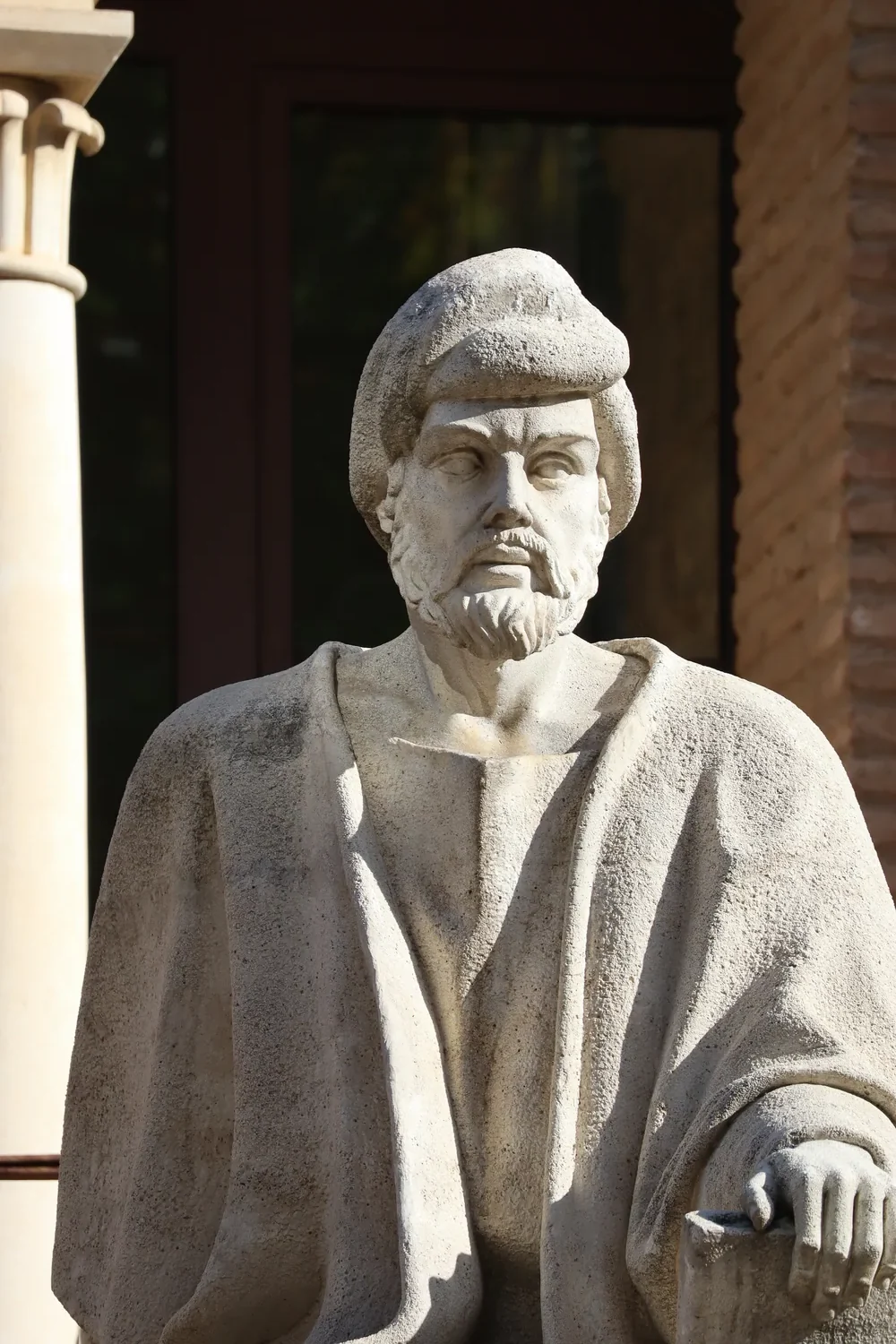
About a century after al-Ghazālī, the judge of Córdoba, its physician and jurist, Abū al-Walīd ibn Rushd, rose to answer. He was the greatest commentator on Aristotle in any nation. He had also noticed a great deal of the Plotinian material smuggled into Aristotle, which is the part of him that serves us here, and it made him the most tenacious of men in holding to Aristotle himself. He wrote The Incoherence of the Incoherence, taking al-Ghazālī question by question, and The Decisive Treatise, in which he held that the Law itself obliges demonstrative inquiry into existing things, by such words of God as “Take heed, you who have eyes”. Wisdom is the sister of the Law and not its adversary, and the two were set against each other only at the hands of pretenders on both sides. He reproached al-Ghazālī for publishing the fine points of these questions in books meant for the public, when in his view their place was in books of demonstration, among the people of demonstration.
Then came his known ordeal. He fell out of favour at the end of his life, his books were burned in Córdoba, and he was banished to Lucena. He was restored to favour shortly before his death in Marrakesh in 595 AH. After him there followed one of the strange reversals in the history of ideas. His voice grew faint in the lands of Islam and rose in Europe, until he became for them the Commentator, with the definite article. A school of Latin Averroism arose in their universities, and it went so far astray that some of its members were charged with holding two contradictory truths that are both valid, one for religion and one for philosophy. Ibn Rushd never said any such thing. It was the fruit of their reading him out of his context, and in Paris in 1277 the church issued condemnations of Averroist propositions. Consider it: a man whose books his own people burn, who is condemned in Paris for what he did not say, and who remains, between the two burnings, the teacher of both parties.
The bridge of Toledo
By this door we can settle in one paragraph the debt of a whole essay that the plan of our series passed over. From Toledo after its fall the Europeans translated Ibn Sīnā, al-Ghazālī and Ibn Rushd, and out of that there arose in Europe the renaissance of the scholastic schools. Its greatest pillar, Thomas Aquinas, built his theology on Ibn Sīnā's distinction between essence and existence. He put into his five ways of proving God the proofs from motion and from contingency, whose lineage you now know, and he fought the Averroism of Paris at the same time. The Muslims in this story are not a link of transmission between the Greeks and Europe, as is commonly said. They are the men who turned the question of being from “what is the origin of the world?” into “why does the contingent exist at all?”, and it was this stock of theirs that the Latin schools took over and built upon.
Weighed against revelation
A reader of this essay may think that its weighing is spread through it already, since revelation was a party to the whole battle. Some words still remain. The first is fairness to the three philosophers: al-Kindī, al-Fārābī and Ibn Sīnā were praying Muslims who intended no demolition of the religion. Their breakthroughs, the distinction between essence and existence and the proof from contingency, are among the most precious things a Muslim mind has produced, and the verifying scholars of the Sunnis themselves received them, refined them and used them. Their grave error did not come to them from demonstration. It came from an inheritance they never sifted. From Aristotle and Plotinus, fused into a single Theology, they inherited a necessary god who does not choose and does not know particulars, and a world following from him from eternity. They laboured to fit this Greek frame with the turban of monotheism, and the cloth tore at the three places where al-Ghazālī put his finger.
Only al-Kindī took the straight road at the parting of the ways. He made sound demonstration the arbiter, and so agreed with revelation on the origination of the world and differed from Aristotle. This is what the verse of our series lays down: “and He sent down with them the Book with the truth, to judge between people in what they differed over”. The Book was sent down as a judge between those who differ, not as a defendant to be tried before the antiquity of the Greeks. When that order is kept, a believer finds nothing in a sound demonstration to alarm him. Truth does not contradict truth, as Ibn Rushd himself said, but on his condition: that it be a real demonstration, and not a Greek inheritance dressed in the clothes of demonstration.
As for the jewel of this essay, the necessary being and the poor contingent, the Qurʾān sent it down before the philosophers in one comprehensive sentence: “O people, you are the poor before God, and God is the Rich, the Praiseworthy” [Fāṭir: 15]. The essential poverty of the contingent, its need of something to tip it into being, is exactly the meaning of “the poor before God”, and the self-sufficiency of the necessary in itself is the meaning of “the Rich”. We are not forcing a comparison here between a text and a doctrine foreign to it. What we have is a single meaning, which revelation expressed in the comprehensive language of the fiṭra and which demonstration cast in the terms of the craft. Revelation added what no demonstration reaches: that this Rich one is “the Praiseworthy”, who is praised and loved and worshipped, and not a necessary at which the chain stops and after which there is no news.
On to the next essay
Yet Ibn Sīnā's own proof carries the seed of the next question. If existence is predicated of the necessary and predicated of the contingent, what is this “existence” that is predicated of them both? Is it a shared word with nothing common between its two senses, or one reality that varies in strength and weakness, as light does in the sun and in the lamp? And if it is one reality, what share of it belongs to the poor contingent, which owns nothing of itself? This thread will be taken up by a man from Murcia in al-Andalus, who travels the earth until he settles in Damascus. He writes that true existence is one and that everything else is appearance and manifestation, and the nation divides over him between those who exalt him as the seal of the saints and those who impugn him as a man in grave danger. Then, centuries later, comes the sage of Isfahan and Shiraz, who casts the question in demonstrative form under the name aṣālat al-wujūd, the primacy of existence. On to the most delicate essay in the series, and the one where the footing is narrowest: the unity of existence and its primacy.
The “Mankind Was One Community” series — Essay Seven
The “Mankind Was One Community” series — on the philosophy of being
Essay eight: the unity of existence and its primacy
Ibn ʿArabī and the transcendent wisdom
Introduction
In Córdoba, at some point in the 580s AH, the judge and philosopher of the city, Abū al-Walīd ibn Rushd, whom we left in the last essay, asked to meet a young man. Word had gone round among the elite that God had opened to the boy in his seclusion what He had not opened to men who had spent a lifetime in study. The young man tells the story decades later, and the sum of what he says is this. When I came in to him he rose to me in love and respect, embraced me, and said to me: yes? I said: yes. His delight in me increased, because I had understood him. Then I sensed what had pleased him in this, so I said to him: no. He drew back, his colour changed, and he began to doubt what he held. He said: how have you found the matter in unveiling and in the divine outpouring? Is it what speculation gives us? I said to him: yes and no; and between the yes and the no spirits fly out of their matter and heads out of their bodies. His colour turned yellow and he sat there saying, there is no power save in God.
The same young man tells of the end of the two men. When Ibn Rushd's body was carried from Marrakesh to Córdoba in 595 AH, the coffin was set on one side of the beast and his writings were set on the other to balance it. He said: I stood watching, with two companions, and one of them said, do you not see what balances the imam? This is the imam and these are his works. I said: my boy, what a fine lesson that is. Then he spoke the two verses that travelled everywhere: this is the imam and these are his works; would that I knew whether his hopes were fulfilled. The young man was Muḥyī al-Dīn ibn ʿArabī. The nation is divided over him to this day as it is over very few men, between those who call him the Greatest Master and the seal of the saints, and those who count him the author of the most dangerous doctrine of being ever stated in an Islamic tongue.
From al-Andalus to Qāsiyūn
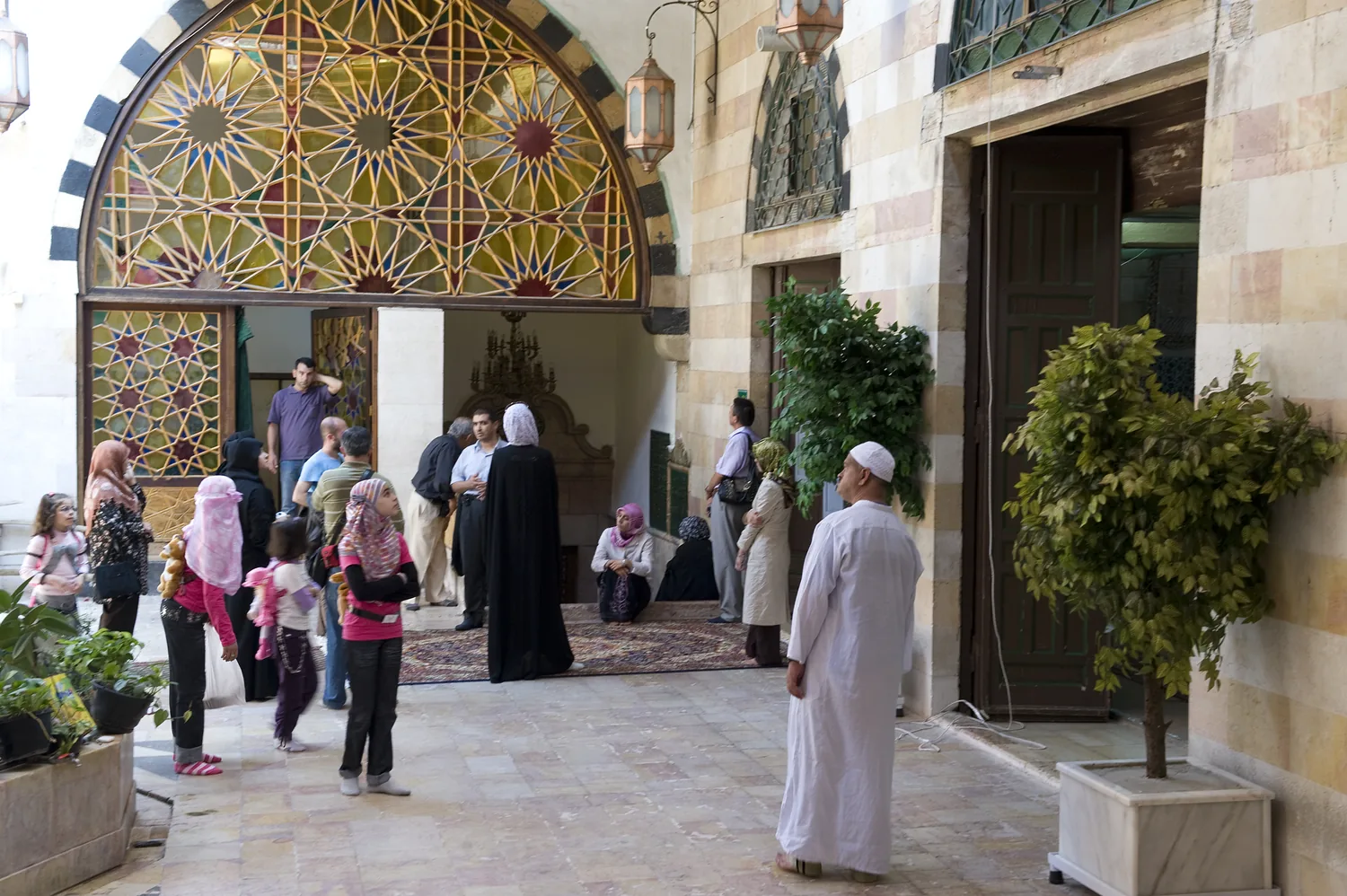
Muḥammad ibn ʿAlī ibn ʿArabī al-Ṭāʾī was born in Murcia in 560 AH and grew up in Seville among the notables of the Almohad state. As a youth he turned away from a secure career in the chancery to seclusion and spiritual struggle. He travelled beyond counting: al-Andalus, the Maghrib, Tunis and Egypt, then Mecca, where he stayed and began his mother book, The Meccan Openings. It is an ocean running to thousands of pages in print, which he made the register of his sciences and his unveilings. Then came Anatolia, Baghdad and Aleppo, until he settled in Damascus and died there in 638 AH. He was buried at the foot of Mount Qāsiyūn, where his tomb stands today. His most famous and most disputed book is The Bezels of Wisdom, a few pages only. In its preface he claimed that he saw the Messenger of God ﷺ in a dream of glad tidings in Damascus, with a book in his hand. He said to me: this is the book of the Bezels of Wisdom; take it and go out with it to the people, that they may profit by it. This is his claim, and we set it down as he made it. The reader should know that a dream is not a legal path for establishing a creed or confirming a ruling.
The doctrine: one existence and its manifestations
Before setting out the doctrine, a point about sources, as this series does. The term “unity of existence” itself hardly appears in Ibn ʿArabī's books as the name of a doctrine. His scattered expressions were organised by his students and commentators, foremost among them his stepson Ṣadr al-Dīn al-Qūnawī. The label then spread in the following century on the tongues of commentators and critics alike, until it became the proper name of the doctrine. So we are describing a doctrine as it settled among its adherents and its opponents, and not a title its author chose.
The sum of the doctrine, as the commentators laid it down, is this. True existence is one and does not multiply, and it is the existence of God. Contingent things in themselves are only fixed entities in the divine knowledge, al-aʿyān al-thābita, which own nothing of existence. The one existence appeared in them, and so they showed as multiplicity. The world for them is the manifestations and disclosures of God's names and attributes, like forms in mirrors: the mirrors are many and the face is one. Or like the sea and its waves: the waves are passing shapes and the water is what it is. Multiplicity for them lies in the manifestations and the considerations, and unity in the entity and the reality. The holders of this view disown the words “indwelling” and “union” and denounce whoever holds them, since indwelling requires two, one that dwells and one that is dwelt in, and their doctrine is that there are not two in existence at all for one to dwell in the other.
If someone asks where the danger lies, when the substance of the claim is that nothing truly exists but God, the answer is that in their books, and in the Bezels above all, there are consequences stated openly in texts that have troubled the nation for centuries. There is language about the people of Noah and about the worshippers of the calf which makes the worship of the manifestations, in one respect, a hitting upon the very reality of the one existence. There is language about the faith of Pharaoh. There are statements that come down to this, that the knower witnesses the Real in every object of worship. Some of those who revere him have pleaded that these passages were interpolated into the master's work. What the study of the manuscripts has established is that most of these passages are found in the oldest copies read back to his own students. The plea of interpolation does not hold for the general run of them, and the dispute remains over how they are to be interpreted. That is the point of contention stated plainly, and we shall come back to weigh it.
Unity of existence and unity of witnessing: a claim and a state
The most useful distinction a reader can carry away from this whole essay is that when a man says “I witness nothing in the universe but God”, this can bear two meanings, and between them lies the distance between heaven and earth. The first is that the power of presence so overwhelms the heart of the one who remembers God that he becomes absent from the sight of everything but the one he remembers, as a lover lost in love becomes absent from everything but his beloved. He does not believe that things have ceased to exist; he has become absent from them. This is a state, which those people called “annihilation” and “unity of witnessing”: a unity in the eye of the witness and not in what exists. The second is that a man believes, while sober, and lays down in writing, that there is no other at all, and that the existence of the creation is the very existence of the Real. That is a doctrine about existence and not a state of witnessing.
The early masters of Sufism drew this distinction in the plainest words. Al-Junayd defines monotheism as “the setting apart of the Eternal from the originated”. He made the distinction between Lord and servant the first thing in monotheism, not its opposite. Centuries after Ibn ʿArabī came Imām al-Sirhindī the renewer, who spoke the decisive word about the end of his own path. Its sense: in the overwhelming of the state I used to say “everything is He”; then when the ascent was complete I knew that “everything is from Him”. The universe is not He. It is the trace of His making and the outpouring of His bringing into being. As for the ecstatic utterances of men overcome in the intoxication of a state, the rule for them was given in the essay on al-Ghazālī in the other series: they are reported and not imitated, the man overcome is excused, and no doctrine is founded on his utterance. The decisive point here is plain. Ibn ʿArabī was not a man overcome and uttering ecstatically. He was an author laying down principles in his sobriety, and so his words are weighed as doctrines are weighed and not as states are.
How the nation divided over him
The scholars of the nation divided into three parties over the man, and the three still stand. Among the critics, the harshest and the widest read in his books was Shaykh al-Islām Ibn Taymiyya, who read the Openings and the Bezels closely. He said that he had been one of those who thought well of the man, for the good things in his books on the spiritual path, until he came to see the reality of the doctrine of existence. He then held that the distinction between Creator and creature is the foundation of the whole religion, and that this doctrine pulls it down from its base, and he was extremely severe about it. He always distinguished the early masters of Sufism, al-Fuḍayl and al-Junayd and their like, whom he praises, from the holders of this doctrine. He was followed in the criticism by al-Dhahabī and by a body of jurists from the schools. A number of scholars gave fatwas forbidding the circulation of the Bezels, and Ibn Khaldūn is reported in his fatwas to have held that books of this kind should be destroyed.
Those who revere him include al-Fīrūzābādī, the author of the Qāmūs, al-Suyūṭī, who wrote a defence of him under the title Informing the Ignorant, and al-Shaʿrānī. Their rule is that these people have a technical vocabulary that nobody who has not walked the path understands, that his expressions are to be given constructions that agree with the Law, and that thinking well of the friends of God is an obligation. The third party took a middle position. They thought well of the man's state and his religion, forbade the reading of his books to any but the firmly grounded, and granted that the outward sense of much of his language is not something the scale of the Law can pass, whatever its interpretation may be. In this series we are not judges over hearts, for what is hidden belongs to God. But our series is a series of statements about existence, and recorded statements are weighed on the proper scale. That is what we come to.
The sage of Shiraz: the primacy of existence
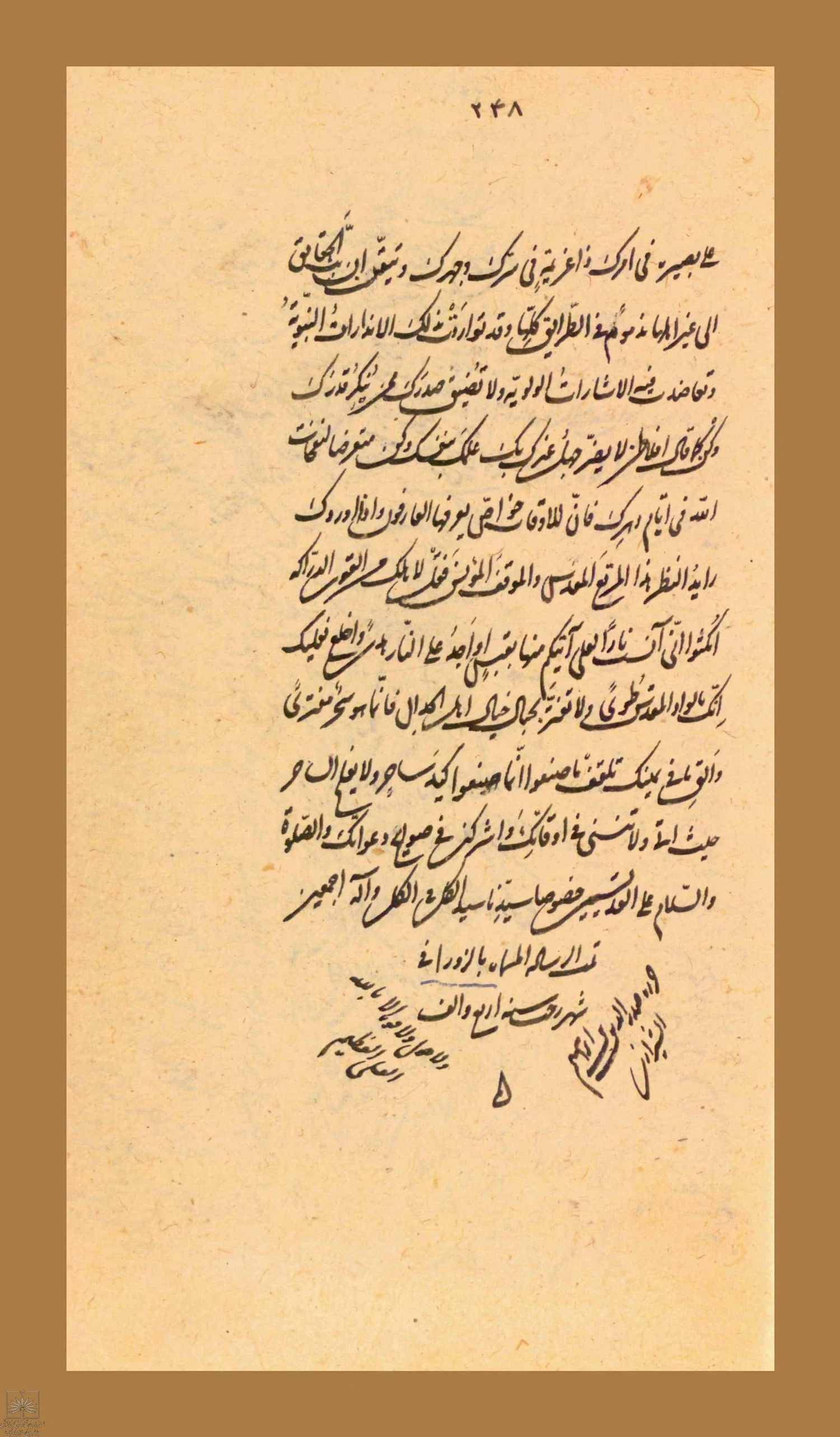
The bridging question with which we closed the last essay, what this “existence” predicated of the necessary and of the contingent is, found its ripest answer four centuries after Ibn ʿArabī, in Safavid Persia, with Ṣadr al-Dīn al-Shīrāzī, known as Mullā Ṣadrā (d. around 1050 AH). In The Four Journeys he brought together three approaches that had long pushed against one another: the demonstration of the Peripatetics, the tasting of the gnostics, and the texts of revelation as he reads them. He called his school the transcendent wisdom. Early on the jurists of his age rejected him, and that drove him into seclusion for years in the village of Kahak. He then returned and taught in Shiraz, and his wisdom is to this day the backbone of philosophical instruction in the seminaries.
His central reversal touches the heart of our series. The philosophers before him, among them al-Suhrawardī, the master of illumination, mostly held that what is primary in the external world is the essences, and that existence is an abstracted notion that attaches to them in the mind. Ṣadrā turned the matter over. Existence is the one primary reality in the external world, and essences are limits and moulds that the mind abstracts from its degrees. This is aṣālat al-wujūd, the primacy of existence, with essence as a mental construct. Then he answered the bridging question with his famous answer. Existence is one reality that admits of gradation, that is, it has degrees varying in strength and weakness, as light does. The light of the sun and the light of the lamp are one in reality and different in degree. The highest degree is the self-sufficient necessary, and below it come the degrees of the poor contingents. Multiplicity for him is a real multiplicity of degrees, and not the appearances of a single reality as it is with the extremists of the unity of existence. Even so, in his later writing there is material that some of his commentators brought close to their doctrine.
He has another breakthrough that will stop a reader of our science series: substantial motion. The Peripatetics confined change to the accidents of a thing, its quantity, its quality and its place, and said that the substance stays fixed under the changes. Ṣadrā argued that motion in the accidents is a branch of a motion in the substance itself. The whole natural world is renewed in its very being at every instant. Its substance flows and does not hold to one state for two moments, and its apparent fixity is like the fixity of a flame that is renewed while you take it for one thing. Consider the return of Heraclitus' river after two thousand years, but between two new banks. The flowing is in the substance of the whole world, and what holds that world and pours existence upon it instant after instant is a fixed necessary being over which no change passes.
What did this chapter add to the question of being?
It added three things. The first is that it took Ibn Sīnā's breakthrough, the distinction of existence from essence, to its limit. Existence was no longer an attachment that comes to essences; it became the whole reality and the whole subject of the question. With the tool of gradation an answer was given to the problem of shared predication: how “existent” can be said of God and of an atom without emptying out the difference and without likening. The second is substantial motion, the boldest thing said about change since Heraclitus and Aristotle, and a view of the world as a renewed coming-into-being rather than a machine wound up once. The third is the one that calls for examination: it moved the source of knowledge about existence from demonstration to unveiling. The greatest claims of this chapter rest on tasted experiences reported by the men who had them. Here one end of the thread meets the end we tied at Plotinus. If the tasting of two knowers can contradict, and we have seen al-Sirhindī describe the summit of what he witnessed contrary to what Ibn ʿArabī laid down, then unveiling has ceased to be a judge. It has come to need a judge above itself.
Weighed against revelation
Let us first state the point of agreement, so as not to be unjust. That God is one, with no partner in His essence, His names and His acts, is agreed. The contingent owns of itself neither existence nor subsistence, and at every instant it is poor before the one who holds it. That is a truth we established in the last essay with the verse “you are the poor before God”. Revelation states it in such words as “and among His signs is that the heaven and the earth stand fast by His command” [al-Rūm: 25]. The dispute is not about the completeness of the servant's poverty, nor about the completeness of the Lord's sufficiency. The dispute is about what these people added: that the existence of the creation is the very existence of the Real, and that the distinction between them is a consideration and not a reality.
Weighed against the Book, that addition does not stand. The Qurʾān from its opening to its close is built on a real distinction between a Creator and a created thing: address and calling, command and prohibition, sending of messengers and worship, promise and meeting. All of these require a real twoness and not a notional one. “You alone we worship, and You alone we ask for help”: the “you” is an address to one worshipped who is distinct from the one worshipping, and worship cannot be conceived except between two. If existence were a single reality, the truths of moral responsibility, of reward and punishment, and of the sending of messengers would collapse from their foundations. Sent by whom, and to whom? The very thing revelation came to abolish, the worship of manifestations, would become correct in one respect. That is a demolition of the purpose of the messages and not a completion of it. For this reason the verifying scholars counted this doctrine further from the scale of revelation than the doctrine of emanation that we weighed at Plotinus. That one kept the distinction and erred about the manner of procession; this one lifts the distinction itself.
There remains the point of fairness without which the reading is not complete. Ṣadrā's inquiry into the primacy of existence and its gradation is a legitimate rational inquiry in its own field. It is weighed by demonstration, as Ibn Sīnā's inquiries were weighed, and it is not to be held to account for some of the consequences drawn by his school. As for unveiling, its measure is what the Sunnis agreed upon. It is no proof against anyone but the man who has it, and only if nothing contradicts it. What preserves us when unveilings contradict is the infallible text. Here the circle of our series closes again on its verse: “and He sent down with them the Book with the truth, to judge between people in what they differed over”. Even the disagreement of the people of tasting at their highest stations is referred back to the Book, for God has given no creature, gnostic or philosopher, a scale above His own.
On to the next essay
In the very years when Mullā Ṣadrā was writing his journeys between Kahak and Shiraz, on the other side of the world, in the German winter of 1619, a young French soldier of twenty-three was shut in by the cold in a room warmed by a stove. He spent his day alone and thinking, and that night he had three dreams which he took as an annunciation that he must pull down the whole structure of knowledge and raise it again on a foundation that admits no doubt. The man would doubt his senses, and the world, and his own body, until nothing was left in his hand but a single certainty, cast in three Latin words that became the most famous sentence in modern philosophy. A reader of our series may smile here. We saw al-Ghazālī five centuries before him walk the road of methodical doubt until God brought him out of it. The resemblance between the two men was weighed by our rule in the essay on al-Ghazālī in the series on the meaning of life, and we do not repeat it. This Frenchman would build on his one certainty an entirely new world: a world split in two, thought on one side and extension on the other, and philosophy would spend three centuries repairing the two halves. On to the next essay: I think, therefore I am.
The “Mankind Was One Community” series — Essay Eight
The “Mankind Was One Community” series — on the philosophy of being
Essay nine: I think, therefore I am
Descartes and the rationalists: doubt as a road to certainty
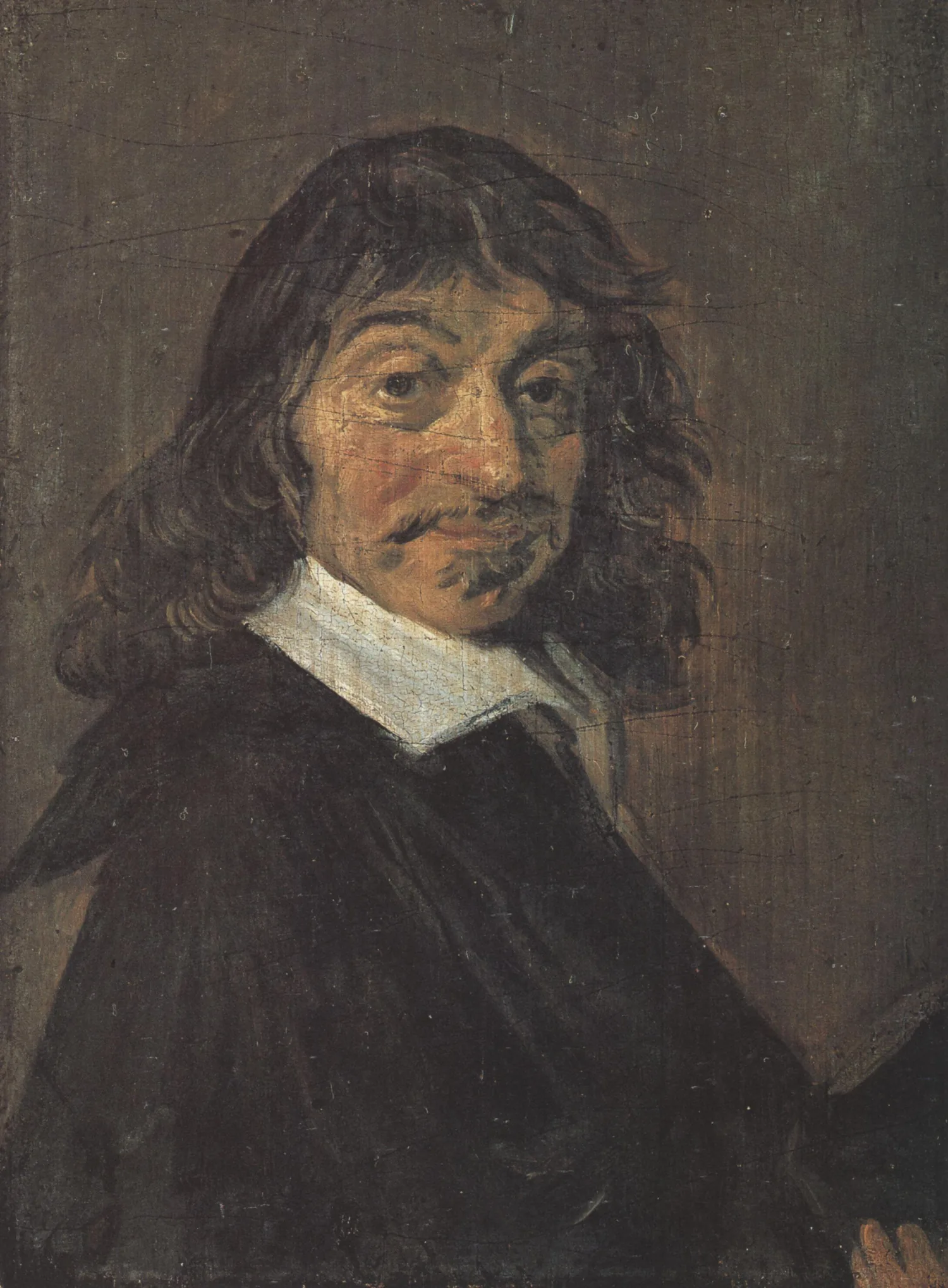
The night of the three dreams
A French soldier of twenty-three, on the tenth of November 1619, in a small town on the Danube near Ulm: the hard German winter had kept the army from moving. Europe had just entered the war that would eat thirty years. The soldier had nothing to occupy him that day, so he shut himself into a room warmed by a large tiled stove and spent the whole day alone with his thoughts. In that room, as he wrote later, the thought came to him that would overturn philosophy. A building that many architects have worked on in succession never reaches the beauty and soundness of a building raised by one architect. The sciences of men were inherited by one generation from another and another before it, and so they came out a mixture with no foundation. What is needed is to pull them all down and build them again on one foundation that admits no doubt, laid by a single mind.
That night he had three stormy dreams. A whirling wind blew against him as he dragged his foot towards a church. Then a clap of thunder woke him to find his room full of sparks. Then a quiet dream in which he found on his table a dictionary and a book of poems open at a question: what road in life shall I take? The young man woke certain that the divine spirit, in his own phrase, was charging him to found a marvellous science that would unify all knowledge. He even vowed that if it came about he would walk on pilgrimage to the shrine of the Virgin at Loreto in Italy. This soldier's name was René Descartes, and the history books would stop at him as the father of modern philosophy. Consider the irony that time does not erase. The father of European rationalism entered his project through two doors his own doctrine had no room for: a dream in the night, and a vow to visit a shrine.
An age whose authorities had fallen
The thought of demolition was no young man's whim. It was the echo of a whole age that had lost its authorities. The Reformation had split Europe in two, each half declaring the other outside the faith, and the war raging around the young soldier was the fruit of that split. Copernicus and Galileo had shaken the Aristotelian cosmos that the centuries had rested in, a shaking we set out in detail in the essay “From observation to the scientific revolution”. When the news of Galileo's trial reached Descartes in 1633, he held back his own book on the world and shelved it. A generation earlier Montaigne had spread among educated men an elegant scepticism whose motto was: and what do I know? If the senses deceive, and nations contradict one another, and the authorities are falling, on what ground does certainty stand? That is the question Descartes carried out of the room with the stove.
Doubt as a pickaxe
His answer was this: I will not repair the cracked building; I will finish pulling it down with my own hands until I reach rock that does not shift. He decided to doubt once in his life, radically, everything that any doubt could touch. He did not do it in order to stay in doubt, but to see what would resist it. The senses? They have deceived me about what is far away and what is small, and a man who has deceived you once is not to be trusted. There is something deeper still. How often have I seen in a dream that I am sitting by the fire in my clothes, while I am asleep and naked in my bed? What assures me that this waking of mine is not another dream? Then he pushed the doubt to its limit with a supposition nobody before him had dared. Suppose a cunning and powerful demon has set himself to deceive me, showing me a sky and an earth and bodies that do not exist, and deluding me even about two and two. What then is left?
One thing is left that the demon's own hand cannot reach: that I am being deceived. A deceived man is something deceived, and a doubter is something doubting. Let me doubt as much as I like: my doubting is thinking, and my thinking stands only in a thinker, who is I. So he cast the sentence that became the most famous thing modern philosophy has said: I think, therefore I am. Doubt cannot swallow the one who doubts. The harder the doubt presses, the firmer the doubter's certainty of his own existence. This was the rock he was after: one first certainty that survives the fiercest supposition of deceit.
Here occurred the reversal that concerns us in a series about being. Everyone who has passed before us, from Thales to Mullā Ṣadrā, began from the world and asked: what exists, and what is its origin? Descartes came and turned the river the other way. He began from the knowing self and asked: what can I know with a knowledge that admits no doubt? The door to being became knowledge, and the question “how do we know?” took precedence over the question “what exists?”. That precedence is the distinguishing mark of the whole of modern philosophy, and in the next essay we shall see how far it takes philosophy.
Rebuilding: God as the guarantor of knowledge
Certainty about the existence of the self does not by itself build a world. I exist, and then what of the heaven and the earth and my own body? Here Descartes needed a bridge from the inside of his consciousness to the outside, and he found it in God. He said: I find in myself the idea of a perfect and infinite being, knowing and powerful, with no defect in Him, while I am defective and finite and I doubt and am ignorant. A defective being does not invent out of itself the idea of absolute perfection, any more than a sun proceeds from a shadow. So the one who planted it in me must be the perfect being Himself. God exists. On His existence he then built the decisive step. The perfect does not lie and does not deceive, since deceit is a defect. If God is truthful, He did not create me such that I am led astray in everything that appears clearly and distinctly to my mind. The external world, to which the self-evidence of my mind bears witness, therefore exists, and the cunning demon is dismissed. In this way the whole world was recovered, but in an order the history of thought had not known: the self first, then God, then the world.
His contemporaries objected at once with the famous circle. You establish God by the clarity of your ideas, and then you validate the clarity of your ideas by the truthfulness of God, so which of the two did you establish by the other? He answered as he answered, and the Cartesian circle is still a well-worn topic in philosophical teaching. What concerns us here is the place of God in the structure. For Descartes He is a creator who wills and is truthful, nearer to the God of religion than Aristotle's mover or Plotinus' One. But He entered the system through the door of function, as a guarantor of the soundness of knowledge and a nail in its structure. We shall weigh this place on the proper scale, for it is one of the gravest points in the essay.
The split world: thought and extension
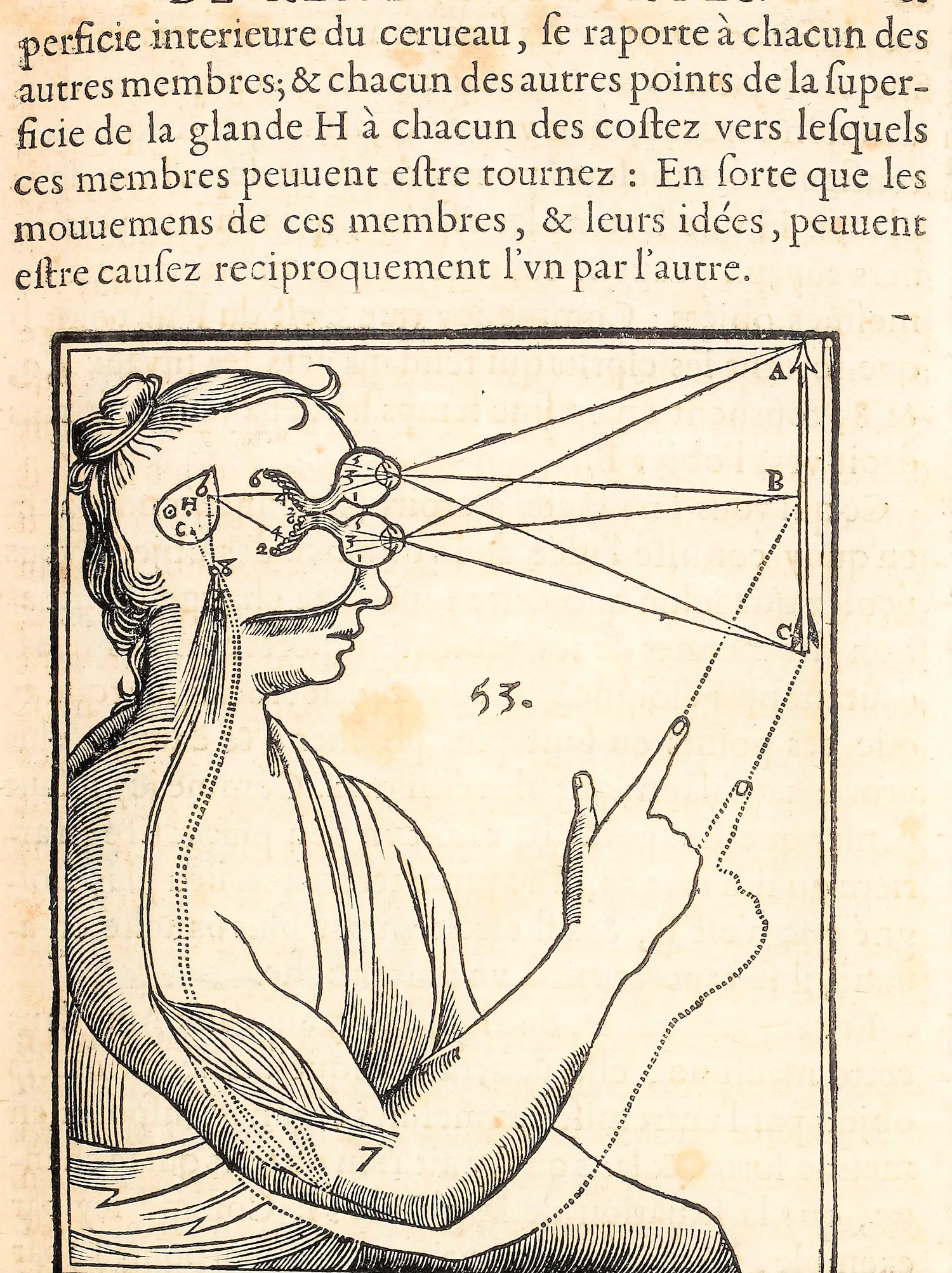
Descartes then divided all created being into two parts and no third. There is a substance whose essence is thinking, with no extension and no place, and that is the soul. And there is a substance whose essence is extension in length, breadth and depth, with no thought in it, and that is matter. By this division the body became a machine. The human body for him is pumps and pipes and cords; the circulation of its blood, and he welcomed Harvey's discovery warmly, is a mechanical motion like the motion of clocks. Animals for him are pure machines with no soul and no feeling, and they cry out as a rusty hinge creaks. In the human being alone the two substances meet, and he assigned their meeting a place that kept physicians busy after him: the pineal gland, because it is single in the middle of the brain and has no pair.
This division left two legacies that we still live on. The first is a gift to science beyond price. If matter is pure extension, then it is solid geometry, and Descartes with his own hand laid down the tool that turns geometry into numbers: the coordinates that carry his name to this day, on which rest every curve and every vital trace on every monitor in every hospital. It was nature made mechanical and geometrical that opened the door to a comprehensive mathematical physics. The second legacy is an open problem. How does the unextended move the extended? How does a will with no place shake a muscle that has a place, and how does the vibration of a nerve become a felt pain? This is the mind and body problem. It was born in this chapter of our story, and under the name of the hard problem of consciousness it still stands in the literature of neuroscience as of this morning.
Spinoza and Leibniz: the palace is completed and cracks
Two men inherited the method after him and finished the palace of rationalism with it. The first was Baruch Spinoza, the lens grinder of Amsterdam, who saw a flaw in Descartes' dualism: two substances utterly distinct from each other could never meet at all. So he concluded that substance, on Descartes' own definition of it as what subsists in itself and needs nothing else, can only be one and infinite. He named it God, or nature. Thought and extension are two attributes of that one substance, two out of attributes beyond counting that we know of. Persons and things are only states and modes within it, and all of them run by a geometrical necessity with no freedom in it and no purpose. He even composed his book, the Ethics, in the manner of Euclid: definitions, axioms, and propositions to be demonstrated. His own people closed ranks against him. In 1656 a writ of excommunication was read out against him in the synagogue of Amsterdam, among the harshest the records have kept. He lived on alone and abstemious, polishing glass and writing, and it has been said that the dust of the lenses had a share in the shortness of his life.
A control is needed here, and a reader of our eighth essay will think of the question at once. Is this not the doctrine of the unity of existence come back in a Latin tongue? The resemblance in the frame of the claim, one substance and multiplicity as its states, is real. So much so that the European term for pantheism was itself coined in the controversy over Spinoza. But the essential difference must not be blurred, by our usual rule about resemblance. The One of Ibn ʿArabī is a Real with names and manifestations, whom His people turn to in love and in worship. Spinoza's substance is a nature that does not hear, does not love, does not will and is not worshipped, and its necessity is nearer to the necessity of Democritus than to the sustaining of the Sustainer. This is a unity that stripped the world of its personal God; the other, whatever is in it, wanted to see God in everything. Two doctrines that resemble each other in form and part company entirely in spirit.
The second was Gottfried Leibniz, the German who shared with Newton the discovery of the calculus, and who answered Spinoza with a world of substances beyond counting which he called monads: spiritual atoms with no extension, which do not interact with one another. God arranged among them from eternity a pre-established harmony, like clocks set together so that their striking agrees with no message passing between them. He is the author of the saying that Voltaire mocked at length: that our world is the best of possible worlds, since the Wise chose it out of an infinity of possibilities. But the most binding thing Leibniz said, for our series, is the question he made the first question of reason: why is there something rather than nothing? Possible things do not carry within themselves the reason for their own existence, a meaning you learned in the essay on the necessary being, so there must be a sufficient reason outside the chain of possibles. It is Ibn Sīnā's proof speaking French and Latin, and his question stands to this day as the title of the deepest question about being.
So what did the rationalists do?
They changed three things, and philosophy was never the same afterwards. The first is the turn to the self. Knowing consciousness became the zero point from which everything is built, and philosophy entered the house of knowledge before the house of being. The second is the mechanising and mathematising of nature: dumb extended matter running by mathematical laws. That is the picture on which the edifice of modern science with all its achievements was raised, and with it came its insistent question. If the world is a machine, where is the place of free man, of meaning and of value, in a machine? The third is the slipping of the deity's position. He remained, exalted be He, at the heart of all their systems: a guarantor with Descartes, a universal substance with Spinoza, an engineer of harmony with Leibniz. But in the hands of their systems He became a building stone the system needs, and not a Lord that hearts need. By this door the cold deism entered Europe, with its watchmaker god who set the machine going and withdrew. Then came the day when the astronomer Laplace was asked about the place of God in his system of the heavens, and is reported, though the wording is not established, to have answered: I had no need of that hypothesis. From a guarantor of knowledge to a hypothesis one can do without. This is a slope whose beginning must be seen.
Weighed against revelation
The cogito itself is a truth no rational man disputes. But our scale asks whether it needed a proof at all. A living thing's awareness of itself is a necessary, innate knowledge in which the philosopher and the shepherd are equal, and Descartes himself pointed out in his replies to his objectors that his proposition is not a syllogism used as evidence, but a direct witnessing of the self. The Qurʾān never addressed people to establish that they exist. It made the self a sign to be crossed over from, not a problem to halt at: “and in yourselves. Do you not see?” [al-Dhāriyāt: 21]. We established in the essay “The end of atheism” that when a man demands of you a proof of what is present and witnessed, you have been spared the trouble of him. The cogito for us is a sound door, but a door that was already open.
As for the method of doubt, a distinction must be drawn between doubt as a bridge and doubt as a dwelling. The first is legitimate and praiseworthy if it carries its owner across to certainty. Abraham asked his Lord to show him how He gives life to the dead, and he was a believer: “but so that my heart may be at rest” [al-Baqara: 260]. The second is a disease, which al-Ghazālī treated five centuries before Descartes, as we weighed it in its place in the series on the meaning of life, and we do not repeat it. Yet in Descartes' order there is an inversion that stops us. He made knowledge of the self the first certainty, and knowledge of God a result extracted from it. The fiṭra with which we opened this series, in which every child is born inclining to the truth, is the opposite. In it knowledge of the Lord is the first and firmest of all knowledge, and not the last link in a chain of demonstration. That is why the question of revelation comes as a rebuke to anyone who makes God a place of doubt: “Is there doubt about God, the Originator of the heavens and the earth?” [Ibrāhīm: 10]. It is as though doubting the Originator were stranger, to the fiṭra, than doubting the self.
The functional place of God in these systems we have weighed twice, in Aristotle's mover and in Plotinus' One, and here it returns a third time in its finest form: a creator who wills and is truthful, but who is summoned to guarantee knowledge and then left. A witness from inside their own house testified about this, a man whose intellect is not in question. Blaise Pascal, Descartes' contemporary, was one of the geniuses of mathematics in any age. He lived through a night in November 1654 that changed him, and wrote of it afterwards on a scrap of paper that he kept sewing into the lining of his coat wherever he went. It was found only after his death, when his servant came upon it. At the top of it stands a single word: fire. And in it: the God of Abraham, Isaac and Jacob, not the God of the philosophers and the scholars. Pascal was not attacking demonstration; he was one of its champions. He was testifying that a God who is inferred is not a God who is worshipped and called upon and wept before, and that the fiṭra is not fed by a guarantor of knowledge or an engineer of harmony. It is the testimony of a just witness from inside the civilisation itself, on the very case our series has been weaving from its beginning.
There remains the splitting of the human being. Descartes' dualism established for man what materialism denies, that there is in him something that is not matter, and it erred in making the body a dumb machine and the animal an inanimate thing that creaks. Revelation established both the spirit and the body, and withheld the manner of their attachment, with the reticence of One who knows the limits of His servants' minds: “And they ask you about the spirit. Say: the spirit is of the affair of my Lord, and you have been given only a little knowledge” [al-Isrāʾ: 85]. Four centuries after the pineal gland, how consciousness is connected to the brain is still the hard problem at conferences of neuroscience. How fitting it is for a student of knowledge to keep the manners of this verse: to inquire where room has been made for him, and to stop where he has been given only a little.
On to the next essay
The rationalists built their palaces out of pure demonstration: one substance here, monads beyond counting there, and each man raising proof after proof. But a people in the British Isles were eyeing these palaces with suspicion and asking where the mind got all this material from. John Locke said that the mind is born a blank page, and that nothing is in it that did not come in by the door of sense and experience. Then the Scotsman David Hume drove the pickaxe down to the root. He searched experience for the causation on which sensible men and scientists build everything, and found in sense nothing but succession and conjunction. Necessity no eye ever fell upon. You will recall here al-Ghazālī's words on conjunction, which we weighed in the essay on the Incoherence, together with the essential difference between the two. Hume's doubts ended in a small Prussian town on the Baltic, where they fell into the hands of a university professor so exact in his appointments that the people of Königsberg were said to set their clocks by his daily walk. He wrote later that Hume had woken him from his dogmatic slumber. When that most monotonous of men woke, he brought about in philosophy what he himself called a Copernican revolution. Instead of knowledge turning about things, he made things, as they appear to us, turn about the moulds of our minds, and he ruled that the thing in itself lies behind a curtain that is never lifted. On to the next essay: the limits of reason and the absolute.
The “Mankind Was One Community” series — Essay Nine
The “Mankind Was One Community” series — on the philosophy of being
Essay ten: the limits of reason and the absolute
Kant, Hegel and German idealism
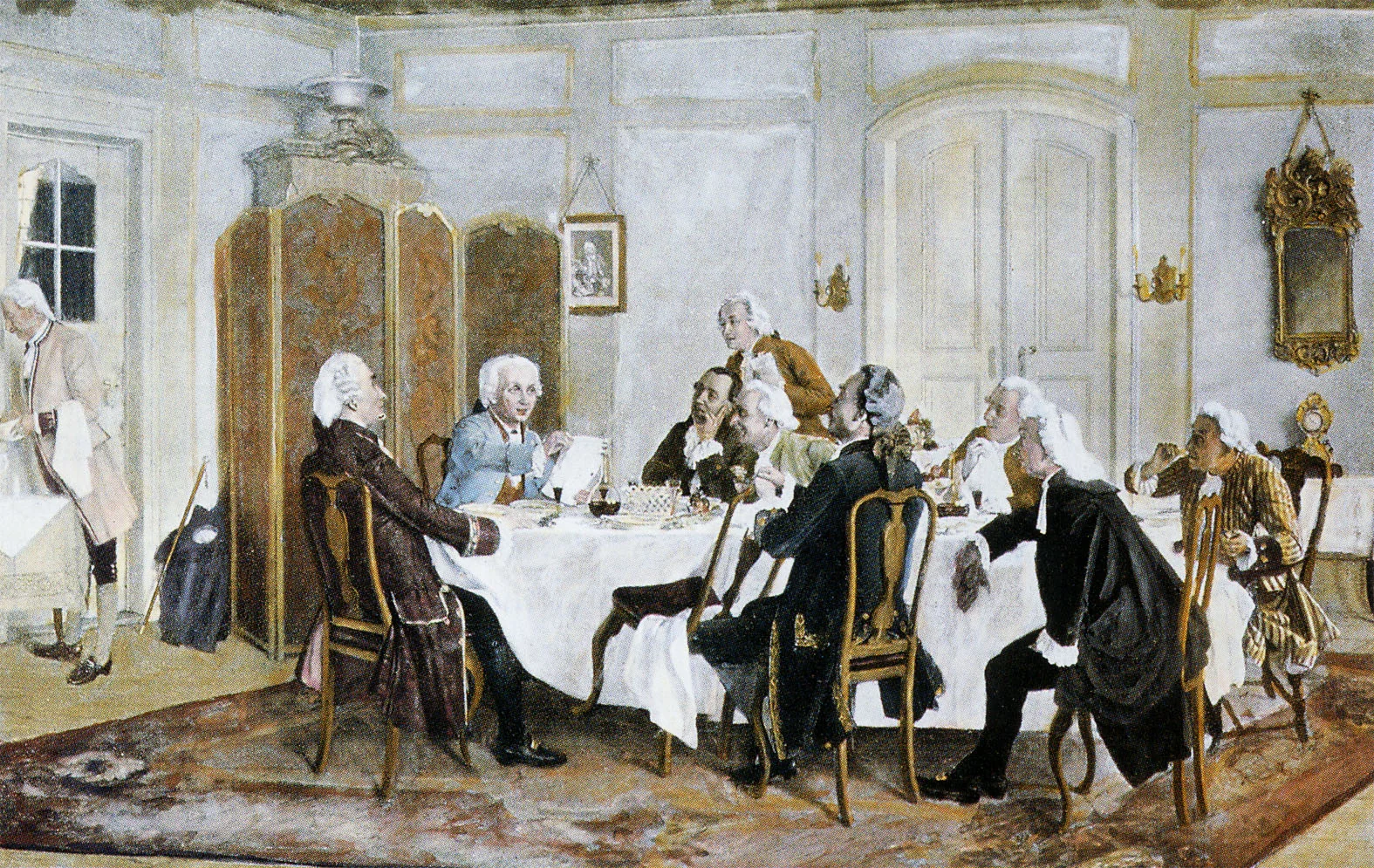
The man the clocks were set by
In Prussian Königsberg on the Baltic, in the second half of the eighteenth century, the townspeople had an appointment that never failed. A small university professor, barely over a metre and a half tall, came out of his house at the same minute every day. He walked the same road, out and back, eight times. The neighbours, as the poet Heine wrote a generation later, set their clocks by him. He never married. In eighty years he never went more than a few miles from his city. He ordered his day like a machine: up at five minutes to five, then the lecture, then writing, then a long lunch with his friends, which was his one place for laughter and open talk, then the walk, then reading until ten.
This intensely monotonous man, who saw nothing of the world but his own city, changed thought more than the armies of his age that saw all of it. He called what he had done with his own hand a “Copernican revolution”, and philosophy granted him the name. He was Immanuel Kant, and his story is the story of a man who drew the boundaries of human reason on the map, the way a surveyor marks out a field that had been thought to have no end.
The voice that woke him
Kant grew up in a rationalist milieu that had inherited Descartes and Leibniz. In its lecture halls God, the soul and the world were demonstrated with the rigour of engineers, and he was at ease with it for decades. Then Hume fell into his hands. We left Hume at the closing bridge of the last essay, searching experience for the bond of causation and finding only conjunction and succession. We saw the fire and then the burning, and no eye ever saw the “necessity” that ties the two together. Causation, then, is nothing but a habit of mind bred by repetition. Kant wrote his famous sentence: it was Hume's warning that broke in upon my dogmatic slumber years ago.
Kant saw that the matter was graver than a quarrel between two schools. If Hume was right, science collapsed at its foundation. The whole edifice of Newton rests on causal laws that are universal and necessary. If causation is only a habit of mind, there is no universality and no necessity, and physics is tidy guesswork. And if we went back to the old rationalism, we went back to castles of demonstration with no experience to hold them up. One man builds a single substance, another builds monads, and there is no judge between them. What was needed was a third road, one that would save the certainty of science from Hume's pick without going back to the slumber of the dogmatists. Kant spent eleven years looking for it. In 1781 he brought out the Critique of Pure Reason, reckoned by common consent the heaviest and most difficult book in modern philosophy.
The Copernican revolution: the world turns around the mind
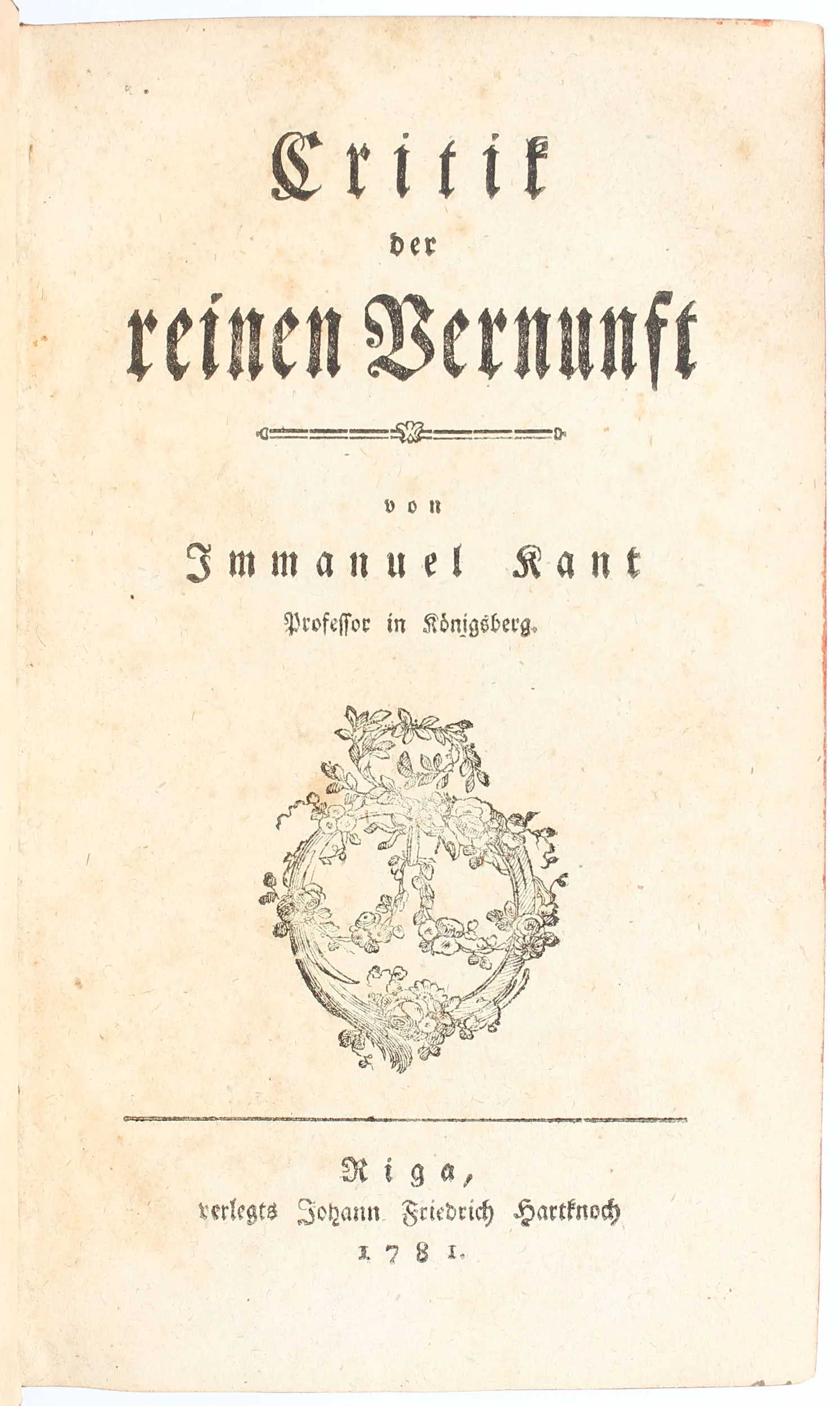
The gist of Kant's answer is this. Everyone had assumed that our knowledge must conform to things, and every attempt had stumbled. Let us try the reverse, as Copernicus did when the motions of the heavens around the earth defeated him and he set the observer moving instead. Let us assume that things, as they appear to us, are what conform to the structure of our knowledge. The mind is not a passive mirror that receives the world. It is an active workshop that casts everything reaching it in moulds of its own. Space and time are not two things out there for us to pick up. They are the forms of our own sensibility, spectacles we cannot take off, and everything we see we see through them. Causation and substance and the rest of the “categories” are not in things for us to observe. They are the moulds of our understanding, and nothing enters the mind except already poured into them.
With this conception Kant achieved two ends. He rescued science from Hume. Causation really is universal and necessary, not because we observed it in things, but because our minds cannot experience the world without it. Everything that will ever appear to us will appear caused, and Newton's certainty is safe. But the price was crushing. All this certainty goes no further than the world of “appearances”, things as they show themselves to our moulds. Things in themselves, stripped of our spectacles, lie behind a curtain that is never lifted. We know the world our cognitive apparatus makes out of a material we never see as it truly is.
In the essays on Heraclitus and Plato we promised that Plato's cave would look in on us again at Kant. Here it is, and inverted in a way that has its own grandeur. In Plato the shadows on the wall fall short of the truth, but the cave has a door, and the prisoner who climbs can get out into the sun. In Kant the shadows stay and the door is shut for ever. The cave is not walls of rock. The cave is our own eyes.
Demolishing the proofs, opening another door
Kant then drew out the conclusion that shook the continent. If the moulds of the mind work only on the material of the senses, then every use of them beyond experience, on God or the soul or the universe as a whole, is running the workshop with no material in it. It yields nothing but orderly illusions. He demonstrated this by an affliction of reason he called the “antinomies”. Take the question of whether the world is eternal or originated, which is the very battle of al-Ghazālī and the philosophers that we watched in the seventh essay. Theoretical reason builds an apparently airtight proof that the world began, and builds another as good that it is eternal, and the two cannot stand together. Whatever is in that condition has strayed beyond its competence. He then took up the three proofs of God's existence current in the schools of his day and undid them one by one. The most famous of his refutations is his line on the ontological argument. Existence is not an attribute added to the concept of a thing to complete it. A hundred dirhams imagined in my mind gain not one dirham in their concept if they turn up in my pocket; what changes is my own situation.
Was Kant, then, a destroyer of faith? He wrote his own decisive sentence in the preface to the second edition: I had to set aside the claims of knowledge to make room for faith. What he destroyed was God as the object of a theoretical proof on the model of geometry, not God as a truth that is believed. He then brought back the three great questions, God and freedom and the immortality of the soul, through another door that he called practical reason. The moral law I find at my core, the categorical imperative of duty that does not bargain, requires, if it is to mean anything, that I be free. It requires a justice that pays virtue its happiness beyond this world, and so it requires immortality and a God who judges. The old man summed up his whole philosophy at the end of his second critique, in words carved on his grave after his death: two things fill the soul with wonder and awe, and they renew themselves the longer thought dwells on them, the starry heaven above me and the moral law within me.
Hegel: the absolute unveils itself in history
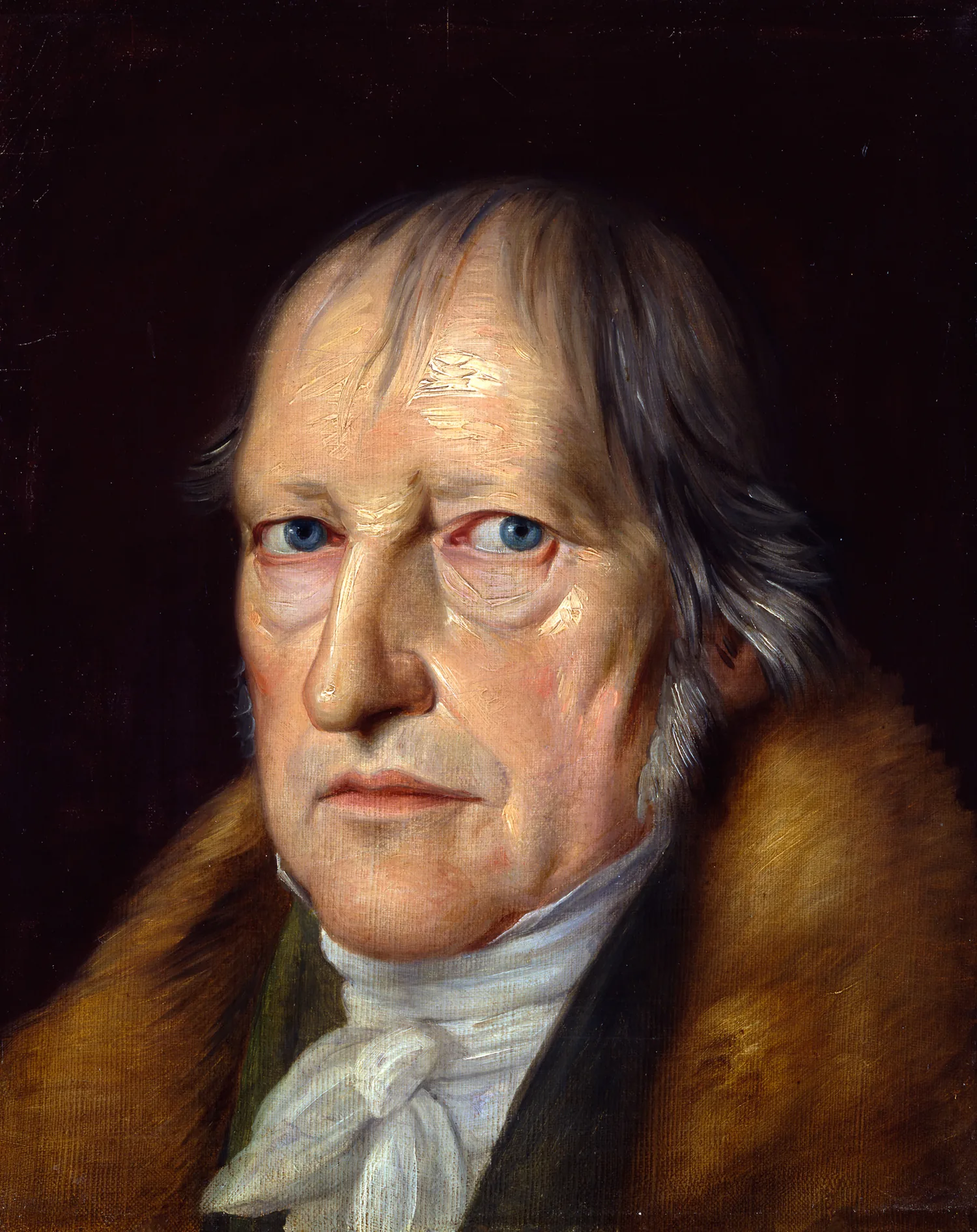
The next generation, however, could not put up with that “thing in itself” sitting behind the curtain. What is this unknown that has been ruled unknowable and then described as “affecting” our senses? Is causation not a mould that never reaches beyond appearances, by the terms of your own doctrine? Out of that crack in Kant's wall came German idealism. Gottlieb Fichte dropped the thing in itself and made the I posit the world. Schelling united nature and spirit in a single identity. Then came the man who gathered all of it into the largest system modern philosophy has built: Georg Wilhelm Friedrich Hegel, the Berlin professor whose hall was packed, and whose doctrine became something close to the official philosophy of Prussia.
Hegel turned Kant's sorrow into joy. You say reason cannot reach the absolute? Reason is the absolute. Being is not deaf matter, nor a veiled thing in itself. Being is “spirit”, a universal mind, but not as a static and finished substance. It is a process that unveils itself and becomes. The idea posits itself. It finds within itself its own deficiency and its own opposite. It rises out of the opposition into a richer composite that keeps both sides and goes past them, and then the composite begins its cycle again, one step above the last. This is the “dialectic” that has been tied to his name ever since. A small footnote, in fairness to history: the schoolroom formula of thesis, antithesis and synthesis, taught in his name, spread mostly from the expositions of his commentators, and Hegel himself rarely used those words.
If being is the becoming of a mind, then history is not a heap of events. It is the march of spirit towards consciousness of its own freedom. Every civilisation is a step, every conflict is the labour of a higher step, and the real is rational and the rational is real. A reader of this series may smile here. Heraclitus's river is back for the third time, after its return in Ṣadrā's substantial motion, and it has become a river that knows where it is running. Hegel acknowledged the old debt and wrote in his Logic, in effect, that there is no proposition of Heraclitus he has not taken up into his own logic. The heaviest thing in the system, though, is what follows from it in divine matters. For Hegel the absolute completes its consciousness only through history and in human minds. It is as though God becomes, and perfects himself by his creation. This is a parting of ways we shall dwell on at length in the weighing. His word on the modesty of philosophy, by contrast, is immortal: the owl of Minerva flies only at dusk. Understanding arrives after the event, and philosophy explains the world once it has already become what it is.
The legacy explodes
Hegel died of cholera in 1831 at the height of his fame, and his heirs split in two at once. A right wing saw in his system a rationalising of religion and of the standing state. A left wing pulled a pickaxe out of it. Feuerbach said that “absolute spirit” is a mask, and that God is an idea man made out of his own wished-for perfections and projected onto the sky. God is not the creator of man; man is the creator of the idea of God. Then came the most famous student of the left, Karl Marx, who said that Hegel's method stands on its head and must be set on its feet. He took the dialectic and threw out the spirit. He made the engine of history the struggle of classes over matter and production, and religion, in his system, a sedative that drugs the wronged. So out of the coat of the conservative Berlin professor came the largest atheist doctrine of the twentieth century. Out of the same coat came its exact opposite: an angry young Dane whom we shall meet shortly, who saw in the all-embracing “system” an erasure of the living individual, and who lit in the name of the individual what would be called existentialism. Marvel at one doctrine that fathered both Marxism and existentialism, both collective determinism and the individual's revolt against it.
So what changed in the question of being?
This chapter did three things. The first is Kant's map. For the first time the question was not only “what exists?” or “how do we know?”, but “what can reason know at all, and where does its power stop?” Whatever has since been refuted in that map, it remains the greatest lesson in the modesty of theoretical reason any philosopher has written. The second is that his boundary is a two-edged sword. He meant to protect faith from the overreach of proof, and he bequeathed a strict separation between the kingdom of science and the kingdom of religion that became the stamp of Western modernity: a science with no God in its equations, and a faith shut up in feeling that says nothing about the world. The third is Hegel's gamble. He brought metaphysics back after Kant had executed it, but in a form that made the absolute itself a historical process. That opened the door to the sanctifying of history, of the state and of the inevitabilities, and the twentieth century would pay for that sanctification in blood.
Weighed against revelation
As for Kant's project of fixing the limits of reason, its root is a truth that revelation stated first. Theoretical reason cannot on its own grasp the unseen, nor encompass the Truth, glorified be He: “no vision comprehends Him, and He comprehends all vision” [al-Anʿām: 103], “and they do not encompass Him in knowledge” [Ṭā Hā: 110]. His antinomies are honest evidence that bare theoretical proofs balance out and fall together in these narrow passes. We have watched mighty minds fight over the eternity of the world for centuries. But here the two roads part, and the parting is the heart of this series. When Kant took reason to its limit, he stood man on the wall and said that no report can be had from beyond it. He shut both doors at once, the door of independence and the door of report. Revelation shut the door of independence and opened the door of truthful report. What reason could not reach by its own looking came to it as news from above. This is exactly where the verse of our series comes down, as though it were an answer prepared for the gap in Kant's map: “then God sent the prophets as bearers of good news and as warners, and sent down with them the Book with the truth”. Once the most exacting philosopher of reason had testified against reason that it has limits, the wisdom of the divine post appeared, the post for which Kant left no place on his map. Prophecy is not a competitor to reason on reason's own ground. It is truthful news reaching it from beyond its wall.
As for the moral law by which Kant brought his Lord back through the door of conscience, after shutting the door of theory on Him, what witness to the fiṭra could speak more plainly? Faith was driven out of the theoretical window and came back through the door of a duty that “fills the soul with wonder and awe”. That is the echo we read in the Book of God: “and by a soul and what proportioned it, and inspired it with its wickedness and its piety” [al-Shams: 7–8], and in the hadith of the “upright nature” on which the series is built. We add the qualification our test of resemblance requires. Kant made ethics stand on their own and God a postulate for their sake, while revelation made wickedness and piety the inspiration of the One who originated the soul, known before it is proved. The witness is shared and the order is different. His critique of the proofs is weighed on the same scale we have used before. He may be right about a scholastic syllogism, and there is a force in his refutation of the ontological argument that many have granted. But the Qurʾān's evidence is not a syllogism of that kind, so the antinomies do not touch it. It is the testimony of sense and of fiṭra to a neediness plainly on view: “Is there doubt about God, the Originator of the heavens and the earth?” We settled in “The end of atheism” that the picks of theory cannot reach evidence of the senses that is present.
As for Hegel's absolute, which becomes and completes its own consciousness by its creation, the scale here is that divine perfection is eternal and entire and admits of no completing. Whatever is completed by another was deficient before it and in need of it. The Lord, glorified be He, is “God, the Eternal Refuge”: the perfect and self-sufficient, to whom everything turns and who turns to nothing, “and He has no protector out of weakness” [al-Isrāʾ: 111]. Then there is what follows from making history the body of the absolute and its march, which is the very thing we warned of. Once history is made infallible, its state or its class or its race stands above the scale. The twentieth century tasted enough of the inevitabilities of Hegel's heirs, of right and left alike, for the mass graves to testify to it. As for the dialectic as a tool for reading the push and pull of ideas and states, there is no harm in profiting by it so long as it stays a tool of understanding under the scale, and is not raised into an infallible law of the universe. The Qurʾān affirms the practice of mutual pushing back without any inevitability: “and those days We alternate between the people” [Āl ʿImrān: 140]. It is an alternation by the wisdom of a free agent, not a mill of necessity grinding up God's servants on its way.
On to the next essay
While the hall in Berlin was filling with listeners to the “system”, there was in Copenhagen a hunchbacked young man with a sharp pen, watching the Hegelian edifice with a painful irony. The gist of what he wrote in his journals is this: a thinker who raises an enormous palace of ideas and then lives himself in a shed beside it is like a man who does not live in what he thinks. And what sort of system of being is this, which explains everything except my own existence, my anxiety, my choice, and the death I shall die alone? This Dane would turn the question from “what is being?” to “how do I come to exist in earnest?” His torch would pass, two generations and a world war later, to a German in a black forest who put the forgotten question of being again in plain words, and to a Frenchman in the cafés of Paris who announced that man's existence precedes his essence and that he is condemned to be free. On to the next essay: the question of being once more.
The “Mankind Was One Community” series — Essay Ten
The “Mankind Was One Community” series — on the philosophy of being
Essay eleven: the question of being once more
Existentialism: Kierkegaard, Heidegger and Sartre
The ring sent back
In Copenhagen, in the autumn of 1841, an eighteen-year-old girl named Regine Olsen received a small parcel from her fiancé. It held her engagement ring, sent back, and a short letter asking her to forget the man who wrote it, since he was not a man fit to make her happy. The girl did not know that the man breaking off the engagement loved her with a love that would fill his notebooks for thirteen years, until his death. She and her family tried every way of winning him back. He deliberately showed himself to the whole city as a selfish rake, so that she would hate him and be quit of her wound. In his journals he wrote that his nights in those days closed over him in weeping. Why? That is the riddle on which scholars have spent ink beyond counting: a melancholy inherited from his father, a secret in the house that he thought he could not lay on an innocent girl, and an obscure certainty that he was set aside for a task with no room in it for a house and a wife.
As for the secret of the house, he set it down in his journals in broken hints. His father Michael was rich, pious and gloomy. As a boy he had been a small shepherd, hungry and half frozen, on the salt flats of Jutland. One day he climbed a hill and stood cursing the deity who had written this misery for him. Afterwards he grew strangely wealthy, and he lived out his life certain that the wealth was the punishment of the curse and not its blessing, and that the deity would take his seven children before they reached the age of Christ. Five of them did in fact die. In this house, haunted by its secret, the youngest son Søren grew up. Out of the ring sent back he went straight into a fever of writing. Within a few years there appeared Either/Or, Fear and Trembling, The Concept of Anxiety and others, under pen names that argued with one another. Then he died at forty-two, dropping in the street at the height of his violent campaign against the official church of his country. He willed what was left of his money to Regine, who was by then another man's wife. This hunchbacked and sardonic Dane is the man the twentieth century would call the father of existentialism.
The individual who will not go into a system
We saw at the closing bridge of the last essay his mockery of the builders of intellectual palaces who live in the sheds beside them. Behind the mockery lies one definite complaint. Hegel's doctrine explains the whole of being, history and the state and art and religion, as steps in the march of spirit, and then says not one word about the only matter that keeps me awake. I, this living individual, how am I to live? What am I to choose? And how shall I meet my death? Human existence is not known from a spectator's seat, the way problems in geometry are known. Existence is lived from the inside, hung between possibilities I have to choose among now. No system chooses in my place, and neither does history, nor “people”. Hence the phrase of his that has been so badly misread, “subjectivity is truth”. He did not mean that all opinions are equal. He meant that the truth which concerns me is not what I set down on paper and then live as though it had never been. It is what I take in until it becomes my blood and my decision. There is a difference between the man who knows everything about faith and the man who believes.
In The Concept of Anxiety he put his finger on a feeling that would become the key to the whole doctrine: anxiety, and not fear. Fear is fear of some definite thing; anxiety has no object at all. It is “the dizziness of freedom”, the tremor of a man standing at the edge of his open possibilities as he grasps that the matter is his and that nobody will choose in his place. He then set out human existence in stages. There is an aesthetic life that chases pleasure and novelty until it reaches boredom and despair, then an ethical life that chooses duty and commitment, then a religious life that is not crossed into by the ladder of proof but by what he called the leap of faith, the trembling individual's vault over the chasm of uncertainty into the hands of God. He was himself a believer of burning faith. Yet he spent the end of his life in a savage war on the comfortable “official Christianity” of his country, saying in effect that where everybody is a Christian by inheritance and habit, there is not one Christian. Faith is the decision of a trembling individual, not membership in a herd.
A stop between the two men: Nietzsche's lantern
Kierkegaard died obscure outside his own country, and his torch slept for forty years. In the meantime a thundering German voice rose, and our story has to pass through it: Friedrich Nietzsche, who wrote his terrifying parable in The Gay Science. A madman lights a lantern in broad daylight and runs into the marketplace shouting, where is God? The bystanders, who do not believe, laugh at him. He stares at them and says, in substance: God is dead, and we have killed him, you and I. But the greatness of this deed is beyond us. Where shall we take our light from, now that we have put out the sun? Are we not falling in every direction? Then he falls silent and says, I have come too early; the news has not reached men's ears yet. Nietzsche was not celebrating. He was diagnosing. Europe had put faith out of its practical life and was still living on a morality and a stock of meanings borrowed from that same faith. The coming century would pay the bill when it discovered that the ground its values stood on had been pulled out. The man died in 1900, on the doorstep of the century he had foretold. We have weighed his own doctrine in another place. We pass by him here because the whole of existentialism, believing and unbelieving alike, writes under the question of his lantern: how is man to exist once, for a whole people, the sky has been emptied of its God?
Heidegger: the forgetting of being
Then came the man who gave the question of our series its plain name again. In 1927 Martin Heidegger, son of the sexton of the church in a Black Forest town, brought out Being and Time. Its opening is an indictment of the whole tradition. Philosophy since Plato asks about beings, what God is, what the soul is, what matter is, and supposes that it is asking about being. It forgot the original question: what does it mean for a thing “to be” in the first place? What is this “being” that we utter in every sentence, and understand dimly, and cannot define? Everyone was busy with the furniture and forgot the house.
His way into the question is the only creature that asks it, man, whom he named with a word that has become his signature: “Dasein”, the being-there. He analysed its existence in a way that left its mark on philosophy and psychology alike. Dasein is not a Cartesian subject hung in a void, looking out at the world through a window. From the first moment it is “being-in-the-world”, thrown into a time and a place and a language and a people it did not choose. On most of its days it has fallen under the sway of what he called “the They”: people, the anonymous public that thinks for us and tastes for us and decides for us. We say what “is said”, we approve what “is approved”, and we live a life in the third person. Until something comes that wakes us.
The great waker, for him, is death. Everything in my life can be done for me by somebody else, except my dying. It is my ownmost possibility, not to be borrowed and not to be delegated, and it is coming without fail at an unknown hour. The They know this and invent a thousand devices to cover it: “death is a certainty, we shall all die”, in the plural form that means nobody. When the individual faces his death honestly, in “being towards death”, the authority of the They collapses. The important is told apart from the trivial. Life is recovered from chatter and given back to seriousness, and existence becomes “authentic”: my own life, not the public's copy of me. Heidegger then closed his path by reviving the question we heard from Leibniz in the ninth essay, and raising it to the front rank of thought: why is there something rather than nothing?
Our account will not stand without two dark lines from his life, on the rule of honesty these series keep. In 1933 the philosopher of authenticity joined the Nazi party and took the rectorship of Freiburg University in its shadow, and after the war he never apologised in a way that satisfied. Consider the painful lesson. The man who taught the century that being lost means dissolving into the herd dissolved himself, for a time at least, into the darkest herd of his century. Whoever said that knowing the medicine is not drinking it spoke truly. As for his last word to the world, it came in an interview he directed should not be published until after his death, and it has been translated into every language: only a god can save us now. We shall stop at it in the weighing.
Sartre: condemned to be free
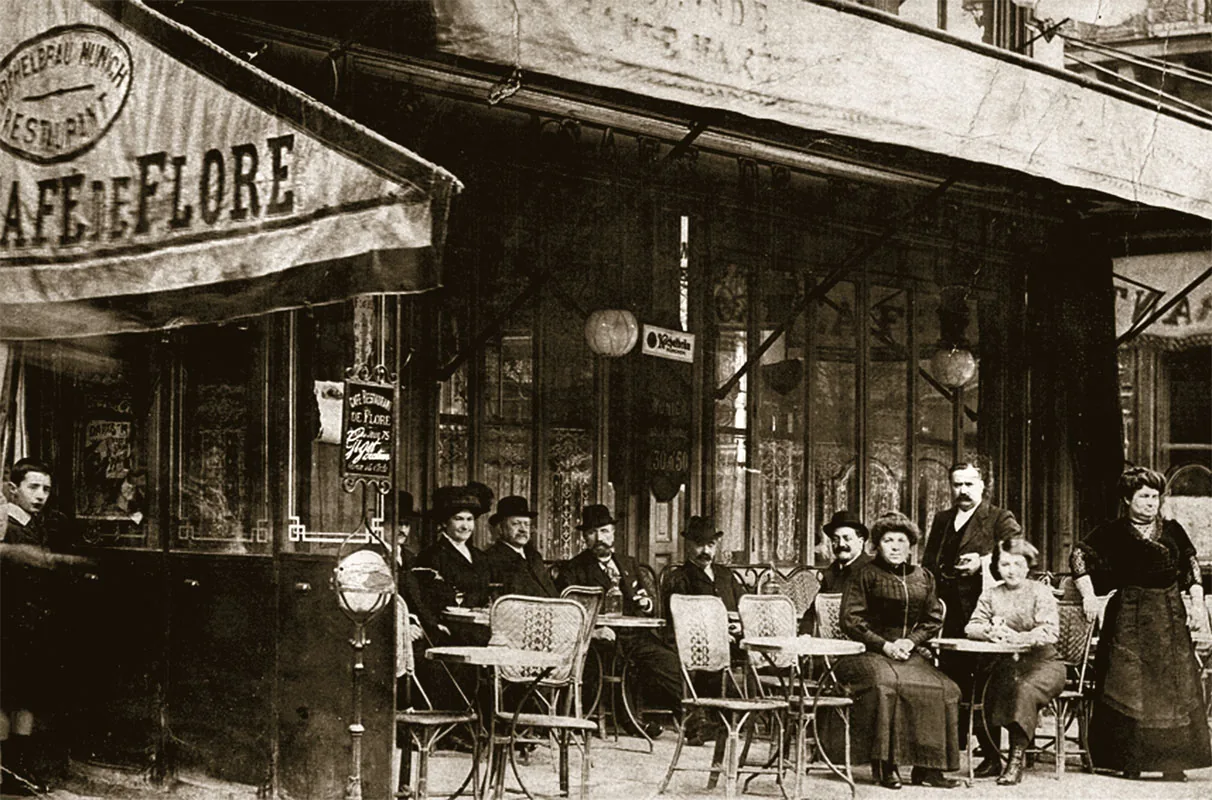
From the Black Forest to the smoky cafés of Paris, where Jean-Paul Sartre turned these heavy inquiries into a doctrine that shook the street. He was novelist and philosopher, a returned prisoner of war, the star of Saint-Germain. In his celebrated lecture Existentialism is a Humanism in 1945, given in a hall so crowded it could hardly breathe, he cast the doctrine in its famous law: existence precedes essence. A knife was made by a maker on a model in his mind, so its essence came before its existence. Man, on Sartre's atheist premise, has no maker and no model before him. He exists first, thrown into the world with no definition, and then makes his essence by the sum of his choices. There is no “human nature” that precedes you and no fate that writes you. You are what you do, no less and no more.
Hence his second saying: man is condemned to be free. Condemned, because he did not choose to be thrown into existence; free, because after the throw he is answerable for everything, and there is no escape. Even “I cannot choose” is a choice. Shirking freedom is the one sin in his vocabulary, and he called it “bad faith”: disowning your freedom and playing the part of a thing. His famous café waiter performs “the role of waiter” with an exquisite mechanical precision, fleeing the weight of being a free man behind the tray. Sartre, it must be said, was among the most honest of atheists about what his doctrine entails. He declared in the lecture that the true starting point of existentialism is Dostoevsky's sentence, if God does not exist then everything is permitted. He said that God's absence is not an administrative rearrangement to be patched by putting “human ethics” in his place. It is a predicament that leaves us with no ready standards and no excuses. We are abandoned, and we have to invent the road and bear it. He tried himself to fill the emptiness with revolutionary commitment and threw himself for an age into the arms of Marxism. He refused the Nobel Prize in 1964, keeping faith with his image as a free man whom no institution could buy. Beside him his friend and later opponent Albert Camus answered the same question in the language of the absurd and the rock of Sisyphus: a deaf universe with no meaning written into it, and a man who goes on rolling his rock in defiance. Those are the banks of the doctrine at the height of the wave that flooded the century's literature and theatre.
What did existentialism restore, and where did it fail?
It gave philosophy back three things it had almost lost. The first is the question of being itself, after a century in which it wandered among theories of knowledge and method. The question came back in a new form: not “what is the world?” but “how does this individual man exist in a way that deserves the name?” The second is seriousness. The great systems had made the individual an atom in a structure, a moment in Hegel's dialectic or a cell in Marx's class. Existentialism gave him back his anxiety, his death, his choice and his responsibility, and told him that nobody stands in for him. The third is a bitter honesty that counts in favour of its atheists. Nietzsche and Sartre grasped what a comfortable and naive atheism did not. Striking out the Creator is not deleting an item from a list. It is an earthquake that swallows the foundation of standards and of meaning along with it. Whoever thought he could keep “human values” standing in mid-air after blowing up their base is deluded, and lives on a loan he has not repaid.
The failure lies at the heart of the doctrine: a freedom with no compass. If man has no essence and no intended purpose, by what scale do I tell an “authentic” choice from a base one? Authenticity is a criterion of form and not of content. A tyrant may be perfectly “authentic”, wholly faithful to his own choice. We have seen the philosopher of authenticity himself fall into the lap of the vilest herd of his age, and we have seen the philosopher of freedom spend years justifying the inevitabilities of a camp that crushed individuals by the million. The doctrine that woke the individual had nothing with which to direct him. It woke him in a dark room.
Weighed against revelation
The first thing to be weighed is the diagnosis, and to our mind it is true to a great extent. What Heidegger called falling into “the They” was described by revelation before him, in its censure of blind imitation and of the life of the herd: “we found our fathers upon a way, and we are following in their footsteps” [al-Zukhruf: 23]. What they described as an organised distraction from one's destiny had already come in briefer and stronger words: “rivalry in worldly increase distracted you, until you visited the graves”. Even “being towards death”, which Heidegger made the individual's release from the herd, has a plain counterpart in the guidance of prophecy: the Prophet's command, God bless him and grant him peace, to remember often the destroyer of pleasures, and his making the visiting of graves a means of waking. But we weigh by the usual test of resemblance. Heidegger's death is a wall that existence strikes and rebounds from into this world, “authentic”, and then nothing. The death of revelation is a door onto meeting the Living who does not die, so remembering it is preparation and not merely waking. The instrument is alike; the direction is as far apart as heaven and earth.
As for Sartre's law, that existence precedes essence, it follows correctly from a premise he never proved: if there is no creator there is no prior model. But the premise is the very point in dispute, and every chapter of this series has given testimony about it. Revelation joins what existentialism tore apart. With his Creator man has an intended essence and a written purpose, “I did not create jinn and men except to worship Me” [al-Dhāriyāt: 56], and he has along with that a real choice and a full responsibility, “We guided him to the way, whether he be grateful or ungrateful” [al-Insān: 3]. A purpose without compulsion, and a freedom without absurdity: this is the joining that broke both doctrines, the determinism of the great systems on one side and Sartre's freedom of the void on the other. By it “the dizziness of freedom” is dissolved. The anxiety Kierkegaard described is true of a man standing at the edge with no guide. As for the man who has received guidance from his Lord, he has a promise: “whoever follows My guidance, no fear shall come upon them, nor shall they grieve” [al-Baqara: 38]. Not because his choice has been taken from him, but because the road has been lit for him.
Two testimonies from inside their own camp remain, and with them we close the reading. Kierkegaard's leap is the testimony of a believer of genuine ardour that proof alone does not give birth to a living faith. It is a sister to Pascal's sewn-in scrap of paper, which we read earlier. Yet faith on the scale of revelation is not a blind vault over a chasm of unreason. It is the acceptance of news whose bearer's truthfulness the evidence has established, so that it lies above the capacity of independent reason and not against it, as we set out in the essay on Kant. As for Heidegger, his last word, that only a god can save us now, is the strangest testimony in the whole series. The deepest questioner of being in his century, after a lifetime with the question, found no rescue in the whole of philosophy, and announced that if help comes it comes from above. We read it and hear behind it the verse of our series answering across the centuries: “then God sent the prophets as bearers of good news and as warners”. The rescue came, man of the shed, before you asked. But the people had lost the postal address.
On to the last essay
Existentialism was not the last voice of the twentieth century. On its other bank analytic philosophy rose in Vienna and Cambridge to declare that the question of being is wholly a mistake of language. Carnap mocked Heidegger's sentences and counted them talk with no meaning, whose falsity the rules of logic expose, and the positivists confined meaning to what experience can verify. Then their own rule turned on itself, since it is not itself among the things experience can verify, and metaphysics crept back into their corridors late in the century in the inquiries into necessity, possibility and identity. That is a continent we point to only in passing, for it is time our ship came into port. We sailed from the shore of Miletus after Thales's question. We passed the river and the solid sphere, the atom and the Form, the mover and the emanation, the necessary and the contingent, the unity of existence and its primacy, the cogito and the moulds, the absolute and the anxiety. Nothing is left but to spread the whole prize on one table, and to weigh the journey from beginning to end on the scale that has kept us company. What did the fiṭra get right as it felt its way with no post from heaven? Where did it repeat its strange stumble in the same places? And what does the hadith «I created My servants with an upright nature» say about all of it? On to the close of the series: the harvest of the series, a comprehensive reading weighed against revelation.
The “Mankind Was One Community” series — Essay Eleven
The “Mankind Was One Community” series — on the philosophy of being
Essay twelve, the last: the harvest of the series
A comprehensive reading weighed against revelation

Back to the bank of the river
We opened the series with a scene on the banks of the river Halys. Soldiers threw down their weapons in terror when the sun went dark at the top of the sky, and one man in that generation was not taken by surprise, because he had looked at a calculation and expected it. We said then that between the terrified soldier and the man who did the sum stands a watershed in the history of the mind. Now that the ship has reached its mooring, let us take our last stand on the same bank and ask two things. What has humanity made of that moment in twenty-six centuries? And what does the scale that has kept us company since the first mile say about the journey as a whole?
The men of Miletus asked about the single origin behind multiplicity. Thales answered water, and Anaximander the boundless. The question then broke open into a deadlock between the running river of Heraclitus and the solid, frozen sphere of Parmenides. Democritus solved it with atoms in a void that have no agent and no purpose. Plato turned it over into Forms above the sensible world and a wise craftsman. Aristotle brought it down into things as forms, with four causes that climb to a mover that does not move. Then Plotinus closed Greek wisdom with a One above being that overflows in emanation. The Muslims inherited the estate, and with it a book going about under a name not its author's. They opened the field of essence and existence, and of the necessary and the contingent. The battle of the Incoherence and the Incoherence of the Incoherence was fought among them. Then the thread of spiritual tasting reached its end in the unity of existence and its weighing, and in the primacy of existence in Ṣadrā. Descartes reversed the course of the river and began from the doubting I, and the rationalists raised their castles. Then Kant drew the limits of reason and Hegel set up his self-unveiling absolute, and the legacy exploded into Marxism and existentialism. Kierkegaard cried out in the name of the individual, Heidegger put the question of being back in plain words, and Sartre proclaimed the freedom of the abandoned. This is the prize, laid out on the table. Let us weigh it.
The first harvest: the pull towards monotheism is native to the mind
The most striking thing in the whole journey is a fact so obvious that it nearly disappears. Not one major school, in twenty-six centuries, settled on a plurality of quarrelling gods. All of them, for all the distance between their lands and their ages and their temperaments, sought the one. It was a single origin for the men of Miletus, a single logos for Heraclitus, a single being for Parmenides, a highest Form of the good for Plato, a first mover for Aristotle, a One above being for Plotinus, a necessary being for Ibn Sīnā, a single substance for Spinoza, a single absolute for Hegel. Most of them grew up in pagan nations that worshipped gods who fought and bred. Their minds would not accept that as an explanation of being for a single hour of the day, and they went looking for the one behind the idols. If this is what minds do while they feel their way in the dark with no revelation, then the report on which this series was founded could hardly be truer: «I created all My servants with an upright nature. Then the devils came to them and turned them away from their religion.» Monotheism is the disposition of the first creation, and idolatry is the later thing that turned men away from it. The whole history of philosophy, without meaning to, is a just witness for this hadith. It is the record of a fiṭra trying to come home by the rough road.
The second harvest: reason reaches the door and has no news
But the fiṭra, feeling its way, kept stumbling in the same spot, until its repeated stumble became the plainest pattern of the journey. Everyone who established the first principle by his own proof established it poor in attributes and cold in presence. Aristotle's mover does not know what it has moved. Plotinus's One does not hear the man who calls on it. Plato's craftsman inherited a matter and a set of Forms that he did not make. Descartes's guarantor is summoned to authenticate knowledge and then left. Spinoza's substance is a nature that is not prayed to. Hegel's absolute perfects itself by its creation. Nobody has ever worshipped a philosopher's god, and no one pleading in the depth of the night ever raised his hands to it. Pascal, himself one of the knights of demonstration, put his finger on the wound in the scrap of paper sewn into his coat: the God of Abraham, not the God of the philosophers.
As the essays went on it became clear that this is not a failing in exceptional men. It is the limit of the instrument itself. Demonstration establishes for you that being has a necessary and self-sufficient principle, and that is the most it gives. But who is he? What does he love and what does he hate? Why did he create you, and where are you going? That is news, and it is not deduced from premises. It comes only from Him, glorified be He. Reason takes you as far as the door and can do nothing beyond it. So when the most honest travellers of the road reached its end, they spoke their need without realising it. Kant said theoretical reason stops at the wall. Heidegger said in his testament that only a god can save us now. This is exactly the place of prophecy on the map of being: “then God sent the prophets as bearers of good news and as warners, and sent down with them the Book with the truth”. Prophecy is not a competitor to reason on reason's own ground. It is the truthful post from beyond its wall. It tells reason the name of the one at whose door it stood, and opens for it what it could never have opened.
The third harvest: the great dilemmas left the proofs evenly matched, and revelation came and gathered them
On the journey we stopped at great pairs that pulled minds apart and were never settled: the fixed and the changing, the one and the many, compulsion and choice, reason and sense, purpose and mechanism, soul and body, and the eternity or origination of the world, over which the proofs fought for centuries until Kant made it the witness for his antinomies. Twenty-six centuries settled none of them in a way all reasonable men agreed on. That is not for any dullness in them, since some of the sharpest of the sons of Adam have passed before us here. It is because these are narrow passes in which the proofs of bare theory balance out. What arrests a Muslim observer is that revelation did not enter these battles as one party trading syllogism for syllogism. It came from above them with a report that joins, and gives every side its due. There is a perishing and changing world and an abiding Lord who does not change: “everyone upon it will perish, and there remains the Face of your Lord”. There is a transcendence that goes together with affirmation: “There is nothing like Him, and He is the Hearing, the Seeing”. There is an intended purpose together with a real choice, and an affirmed soul together with a refusal to speak of a manner we were given no knowledge of. What the schools tore to pieces, each holding one end and destroying the rest, revelation gathered into a single right measure. That is the sign that it is not one more doctrine of the same order, jostling the rest in their own market. It is a scale set up above the market: “to judge between people in what they differed over”.
The fourth harvest: the habit of criticism is their most precious legacy, and sanctifying is their undoing
The most precious thing philosophy has to give a student is not any particular doctrine. It is the character we watched being born in Miletus. Anaximander objects to his teacher with an argument, Anaximenes objects to him with an argument, and no priest stands between them. We then watched it reach its height in Plato, who published with his own hand the harshest objections to his own doctrine, and in al-Ghazālī's rule that no refutation is to be trusted from a man who has not mastered the doctrine as its own people master it. This character is not foreign to our scale; it belongs to its core. The Qurʾān is the book of a religion that demands proof, “say, bring your proof”, and censure of blind imitation and of inheriting the fathers runs through its suras the way blood runs. We saw, on the other side, that the undoing of philosophy came on the day it broke with its own character. When the followers of Aristotle sanctified him, they froze the method of observation for two thousand years in the name of the man of observation. The lesson comes in three parts. Take the truth from whoever says it, whoever he may be, which is al-Kindī's counsel. Weigh every speaker, and sanctify none but the infallible. And refuse no statement before you understand it as its own people understand it.
The fifth harvest: chains of manuscripts overturn civilisations
There is a fifth harvest whose size we did not expect on the day we set sail: some of the greatest turns in this story were made by accidents of copying and of titles. Plotinus's book goes about under the name The Theology of Aristotle, so al-Fārābī and Ibn Sīnā build on an Aristotle who said nothing of the sort. Al-Ghazālī's Aims of the Philosophers loses its preface in translation, and the man who refuted them becomes a Peripatetic philosopher in Europe. Ibn Rushd is read in Paris out of his own context, and “two truths” that he never taught are condemned in his name. Lucretius's poem sleeps in a remote monastery for centuries and then wakes the rebirth of modern materialism. Whoever wants to know why the hadith scholars are so severe about transmission and attribution and verification should read the history of philosophy. The nation of the isnād is the only one that made “where did you get this from?” the first question put to the transmitter of any report. Had the copyist of the Theology been asked it, the face of an entire history would have changed.
The gathering harvest: the verse reads history
Now lift your head out of the details of the journey and look at it from above. Read the verse of the series as though you were reading it for the first time: “Mankind was one community” — upon the innate disposition of monotheism, whose longing we have seen in every school — “then God sent the prophets as bearers of good news and as warners, and sent down with them the Book with the truth, to judge between people in what they differed over”. And we have seen the differing: twenty-six centuries of doctrines pushing against one another. We have seen the need of those who differ for a judge above both theory and spiritual tasting. The verse we made our title was not an ornament for the opening. It was the truest summary of the history of human thought ever written in two lines. By it the Muslim's stance towards this whole inheritance is set straight. It is neither the contempt of the ignorant nor the dazzlement of the defeated, but the stand of an heir with the scale in his hand. He thanks these men for the honesty of their questions and for their endurance in them. He accepts what agrees with the truth from wherever it comes, and refuses what contradicts it from whoever brings it. And he knows that what he was handed free of charge in a truthful report is the thing that minds spent their lifetimes feeling for.
The question has not died, to be embalmed and set in a museum. Books asking why there is something rather than nothing are printed in the capitals of the West to this day. The physics of the universe stands baffled before the fine tuning of its constants. The “hard problem” of consciousness fills the conferences of neuroscience. And the fiṭra asks Thales's question afresh in every generation. So if one of our children asks, he is not to be scolded. You have seen that the question is a noble one and that those who asked it were the pick of human minds. He is to be taken by the hand from the bank of the river where the terrified soldier and the calculating sage stood, to the third bank that neither of them reached: the bank of those who received the certain news and fell down in prostration.
Closing
We said in the opening of the series that this survey is a matter of knowing a thing and not of its importance, and that a reader who finds no interest in it may turn away without blame. As for the reader who has kept us company to this last mile, we hope he comes away with what we came away with. A certainty grown firmer that the blessing of revelation is the greatest of blessings, for he has seen with his own eyes where the feet of genius end without it. A wider excuse for the perplexity of those who ask. And a gratitude to God that fills the chest, that He made us of the nation of the truthful report and not of the nations feeling their way in the dark. “O people, an admonition has come to you from your Lord, a healing for what is in the breasts, and guidance and mercy for the believers”. Praise belongs to God, before and after, and our last call is that praise belongs to God, Lord of the worlds.
Here ends the “Mankind Was One Community” series — on the philosophy of being
This is a translation of an essay written in Arabic. Quotations from the Qurʾān are rendered for sense; the Arabic page carries them in the original.
NEUTRAL FACT CHECKER
A neutral checker went through the factual claims in these six essays — the dates, the reports, the attributions, and the quotations put in the mouths of al-Juzjani, Ibn Khallikan, Heine, Baillet and others — without touching the argument. The result is published as it came out, and the essay was not edited to agree with it. The fact-check is written in Arabic: read the neutral fact-check →
© 2026 Husain Alkhaldy — published in the site's essays.