Introduction to the series
“Mankind was one community. Then God sent the prophets as bearers of good news and as warners, and sent down with them the Book with the truth, to judge between people in what they differed over. Only those who had been given it differed about it, after the clear proofs had come to them, out of envy among themselves. Then God guided those who believed to the truth about which they had differed, by His leave. God guides whom He wills to a straight path” [al-Baqara: 213]
In Ṣaḥīḥ Muslim, from the hadith of ʿIyāḍ ibn Ḥimār, may God be pleased with him: the Messenger of God ﷺ said, reporting from his Lord, Mighty and Majestic: «I created all My servants with an upright nature. Then the devils came to them and turned them away from their religion, and forbade them what I had made lawful for them.»
God settled Adam, peace be upon him, and his offspring on the earth, and planted His oneness in their hearts as a pure creed: “And when your Lord took from the children of Adam, from their loins, their offspring, and made them bear witness about themselves: am I not your Lord? They said: yes, we bear witness. Lest you say on the Day of Resurrection: we were unaware of this” [al-Aʿrāf: 172]. Then the ages stretched on, the devils turned them away, and the roads of idolatry and the crooked doctrines were made to look fair to them: “I will surely take his offspring in hand, all but a few” [al-Isrāʾ: 62].
This series takes up the philosophical schools that set out to explain the philosophy of being. To my mind they are part of that same turning away by the devils. The survey is a matter of knowing a thing, not of its importance, and any reader who finds no interest in it is free to turn away. Praise belongs to God for the blessing of pure monotheism, before and after: “O people, an admonition has come to you from your Lord, a healing for what is in the breasts, and guidance and mercy for the believers” [Yūnus: 57].
In these essays I will use the same method as before: start with a story. A thing you can picture, an essay that plays out like a scene on film, is easier to grasp and easier to go back over.
The series contains (in order)
- 1. The question of the first matter: the earliest natural philosophers, Thales and the men of water and air
- 2. The fixed and the changing: Parmenides and Heraclitus. Is being at rest, or does everything flow?
- 3. The atom and the void: Democritus and atomism
- 4. The world of Forms: Plato and true being behind the shadows
- 5. Being as being: Aristotle and the birth of metaphysics
- 6. The One and emanation: Plotinus and Neoplatonism
- 7. The necessary and the contingent: al-Kindī, al-Fārābī and Ibn Sīnā, and the critique of al-Ghazālī and Ibn Rushd Part two
- 8. The unity of being and its primacy: Ibn ʿArabī and the Transcendent Wisdom Part two
- 9. I think, therefore I am: Descartes and the rationalists, doubt as a road to certainty Part two
- 10. The limits of reason and the absolute: Kant, Hegel and German idealism Part two
- 11. The question of being once more: existentialism in Kierkegaard, Heidegger and Sartre Part two
- 12. The harvest of the series: a comprehensive reading weighed against revelation Part two
Essay one: the question of the first matter
The earliest natural philosophers: Thales and the men of water and air
When the day went dark
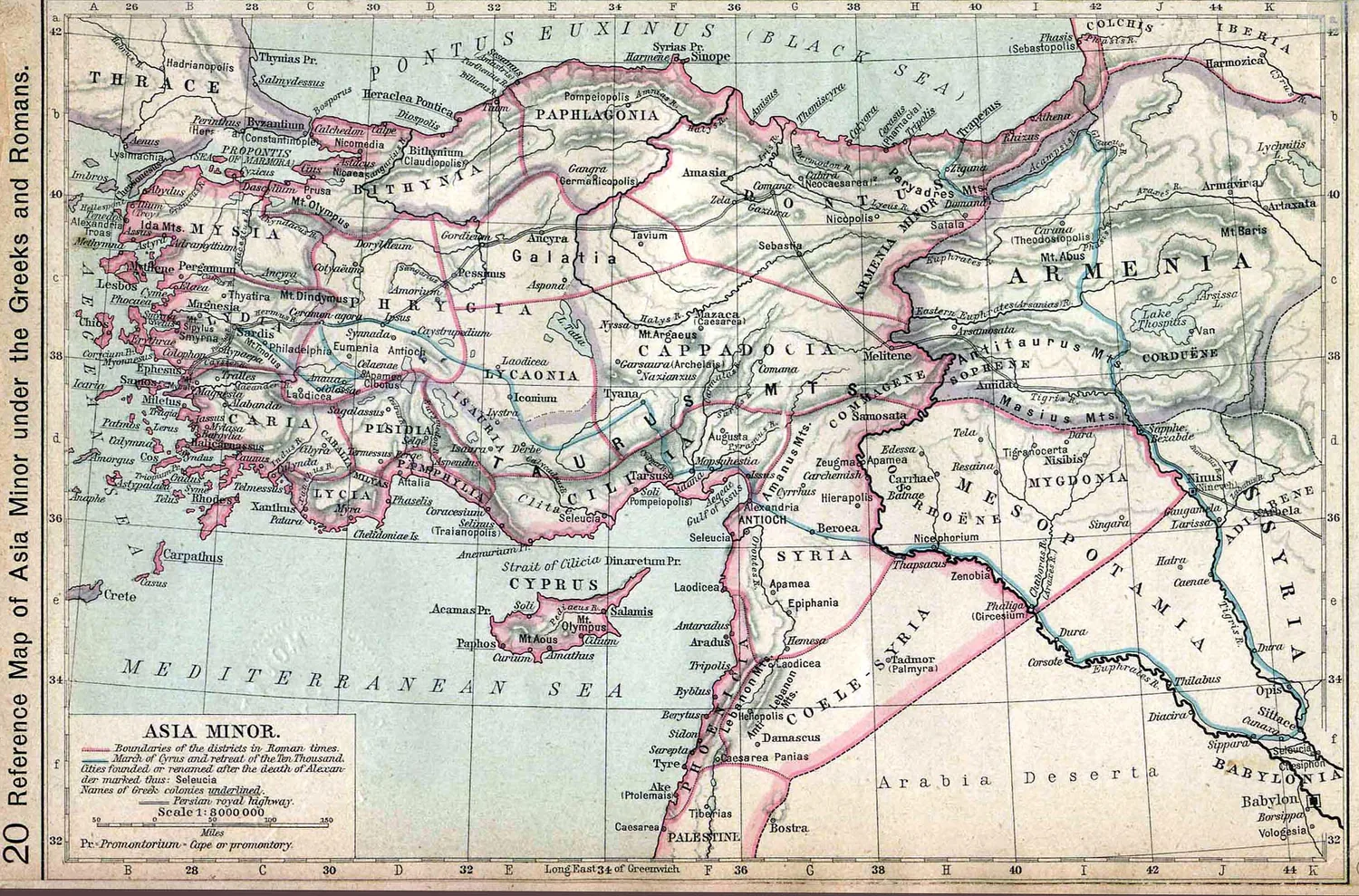
On the twenty-eighth of May in the year 585 BC, on the banks of the river Halys in Asia Minor, two armies faced each other in a grinding war that had already run six years: the Lydians under their king Alyattes, and the Medes under Cyaxares. It was a war that drained money and men without tipping the scale either way.
At the height of the fighting, something no soldier had ever imagined happened: the daylight began to fade, the sun went dark at the top of the sky, and day turned into night. The soldiers threw down their weapons in terror at what they saw, for both sides understood that heaven was angry and that the gods were ordering an end to the war. And that is how it ended. The two kings were reconciled, a peace was made, and the daughter of Alyattes was married to the son of Cyaxares to seal the pact.
But one man in that age was not taken by surprise. The historian Herodotus reports that Thales of Miletus had told the Greeks a solar eclipse would fall in that year. Thales did not say that heaven was angry, and he did not read the event in the entrails of a sacrifice. He looked at a calculation and foretold it. Between the soldiers who threw down their weapons in terror and the man who did the sum and knew what was coming stands a watershed in the history of the human mind.
A city on the edge of two worlds
This shift was not born in Athens but in Miletus, a coastal city on the rim of Asia Minor and, in those days, one of the richest ports of the Greek world. The caravans of the East and the ships of the West met in its markets, and Babylonian astronomical records and the practical geometry of the Egyptians reached it along with the merchants' goods. Wealth supplied leisure, trade supplied acquaintance with other nations, and a position on the edge between civilizations freed its people from the grip of any single tradition.
Before this generation, the Greek answer to the question of being was a story you were told. In the Theogony of Hesiod, earth and sky and sea come out of a chain of divine births, and behind every phenomenon stands a god. Myth answered one question: who fathered whom? Then the men of Miletus came and changed the question itself. What is everything made of? What is the single origin to which this vast multiplicity of things goes back?
This origin they later called the archē: the first principle. With that question, what we now call natural philosophy was born, and the history this series follows begins.
Thales: everything comes from water
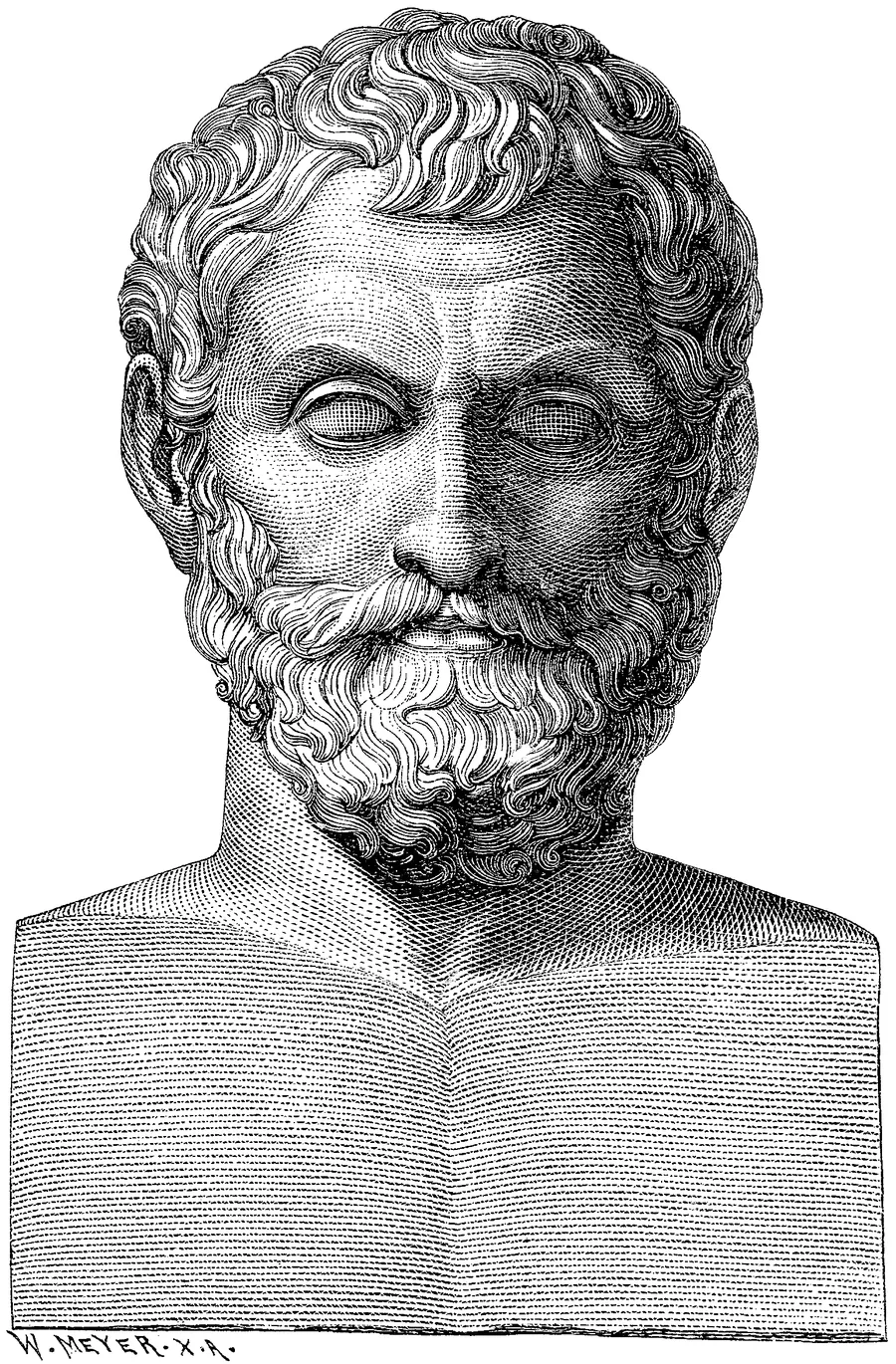
Thales (c. 624–546 BC) answered that the origin is water. From water everything is formed, and to it everything returns. He left no book that we know of, and his saying reached us by way of Aristotle, who took some trouble to justify the choice: all food is moist, seeds are moist, heat itself is born of moisture and lives by it, and water alone is seen by the eye as water, as vapour and as ice, changing in front of you from one state to another without ever losing itself. Perhaps Thales saw on his travels how the Nile gives Egypt its life, and the conviction settled in him that water is the secret of everything that is.
The answer may look naive today, but its value lies not in its content but in its method. For the first time the question of being was answered with a natural element open to observation rather than a personal god, and with an argument open to challenge rather than a story received in submission. An answer that admits objection is science beginning; an answer that does not is myth carrying on.
Thales was not a materialist in the modern sense. One of his preserved sayings is "everything is full of gods", and he held that the magnet has a soul because it moves iron. The man took the explanation of nature out of myth, but he did not take the mystery out of the world.
The books of anecdote preserve two stories about him that complete the picture. One night he fell into a well with his eyes fixed on the stars, and a Thracian servant girl laughed at him: he wants to know what is in the sky and cannot see what is under his feet. When his townsmen taunted him that philosophy brings no material return, he read the weather, predicted an abundant olive season, and rented every press in the city before the harvest for a trifling price, then hired them out at whatever he liked when they were wanted. A wise man, he was showing them, is perfectly able to get rich; he simply wants something higher.
Anaximander: the boundless
Then came his student Anaximander (c. 610–546 BC), who did something unfamiliar in every tradition of the ancient East: he contradicted his teacher. His argument ran roughly like this. If water is the origin of everything, where did fire come from, the opposite that destroys it and is destroyed by it? The first origin cannot be one of the warring elements. It must be something neutral, with no limit and no determination, from which all the opposites issue. He called it the apeiron: the boundless.
By this move the answer rose from a sensible element to an abstract principle that no eye can see, a decisive turn in thought that everyone after him built on. From Anaximander we also have the oldest philosophical sentence preserved in its own wording in the Western tradition, in which he says that things pay one another the penalty of their injustice according to the ordering of time. Opposites succeed one another in the world as summer succeeds winter, and the world is governed by order and justice, not by the whims of quarrelling gods.
His contributions did not stop there, and two of his views stand out. He said that the earth hangs at the centre of the world with nothing holding it up, since there is no reason for it to lean one way rather than another when it stands at equal distance from everything, and that is the first purely rational proof in the history of astronomy. He also said that man must at first have grown inside water-dwelling creatures resembling fish, since a human born as helpless as we see him today could not have survived. The observation shows a mind reasoning from what it sees, whatever the fate of its conclusion. The first map of the inhabited world drawn by a Greek is ascribed to him as well.
Anaximenes: air and the mechanism of change
Then came the third of them, Anaximenes (d. c. 528 BC), who objected in his turn. The boundless is a vague answer, he said, with nothing in it to take hold of. He went back to a sensible element and said that the origin is air. That may look like a step backwards, but his real contribution lay elsewhere: he was the first to offer a mechanism explaining how a single origin turns into many things, which is rarefaction and condensation. When air thins and grows fine it becomes fire; when it thickens it becomes wind, then cloud, then water, then mud, then stone.
Here is a firm principle that later became one of the pillars of science: differences in kind between things may go back to differences in quantity and density. Quality is reduced to quantity. The question was no longer only "what is the origin?" A second question had joined it: "and how did the origin become a world?"
What did these three achieve?
Looking at all these views together, we find that the school of Miletus accomplished three things in three generations that changed the course of thought.
First, they traced multiplicity back to a single origin. They were convinced that behind this enormous variety of things lies one origin to which it returns, even though they disagreed about what it was. That conviction, prior to any particular answer, is the seed from which every later inquiry into being grew.
Second, they relied on proof and evidence. Anaximander contradicted his teacher with an argument, and Anaximenes contradicted him with an argument, with no appeal to the text of a poet or a priest. These men founded the tradition of mutual criticism which, as we saw in the essay "From observation to the scientific revolution", is still the spirit of scientific method today.
Third, they made nature a subject of study in its own right. Phenomena came to be explained by causes sought inside nature itself, not by the moods of capricious gods.
Their achievement was not without a grave flaw. They asked about the matter that things are made of and neglected two greater questions: who is the agent that brought an ordered world out of this origin, and to what end? They asked from what. They did not ask who, or why. We will see in later essays how those two gaps went on haunting philosophy century after century, until Aristotle took them up with an incomplete answer and the philosophers of Islam placed them at the centre of the inquiry.
Weighed against revelation
The series opened with the hadith «I created all My servants with an upright nature», and the story of Miletus bears a remarkable witness to it. These men were sunk in the paganism of their peoples, yet their innate nature would not let them accept a crowd of quarrelling gods as an explanation of the world, so they set out in search of the one from which the many issue. Their leaning towards the oneness of God is authentic, an echo of the fiṭra, the disposition on which people were created. But when the devils turned people away from their religion they left these men no clear road to the answer, so they looked for the one in matter itself: in water, in air, in the boundless. They never reached the truth that the One is the creator of water and air, standing above matter and not inside it.
Some readers may compare what Thales said with the words of God: “and We made from water every living thing” [al-Anbiyāʾ: 30]. Here we must be careful and exact, as we set out in the essay "They imitate the saying of those who disbelieved before them". The two claims are different. Thales claims that water is the origin of all being, of its heaven and its earth and its stars, while the verse states that life was made from water, which the senses attest and science confirms. So we do not raise Thales to the rank of those who profess God's oneness, we do not lower the noble verse to the level of human opinions, and we do not force a resemblance that neither text will bear.
What remains is that their leaning towards reducing multiplicity to one, and their appeal to reason and argument, is a sound inheritance in its origin that lost its way because prophecy was absent from their lands. That is exactly what the verse of the series states: people were one community upon a foundation of truth, and when they differed and the devils turned them away, God sent the prophets and sent down the Book to judge between them in what they differed over.
On to the next essay
The men of Miletus agreed that being has a single origin and disagreed about what it is. But a deeper question was taking shape beneath that disagreement. This constant change we see in things, from water to vapour and from air to stone, is it the reality of being or only its surface? At one end of the question stands a man from Ephesus who says: you do not step into the same river twice, for everything flows and nothing stays. At the other stands a man from Elea who says: motion is a deceiving illusion, and being is one and fixed and does not change. Between the flowing river and the frozen being lies the subject of the next essay, the fixed and the changing.
The "Mankind Was One Community" series — Essay One
The "Mankind Was One Community" series — on the philosophy of being.
Essay two: the fixed and the changing
Parmenides and Heraclitus: is being at rest, or does everything flow?
The man who left his book in the temple
In Ephesus, on the same coast that produced the men of Miletus and only a few days' journey from them, there lived around the year 500 BC a man of one of the city's oldest houses. The title of royal priest came to him by right of inheritance, and he handed it to his brother and withdrew from people's company. One day some of them saw him playing with the boys by the temple of Artemis, and when he was reproached for it he answered: is this not better than running the affairs of the city with you?
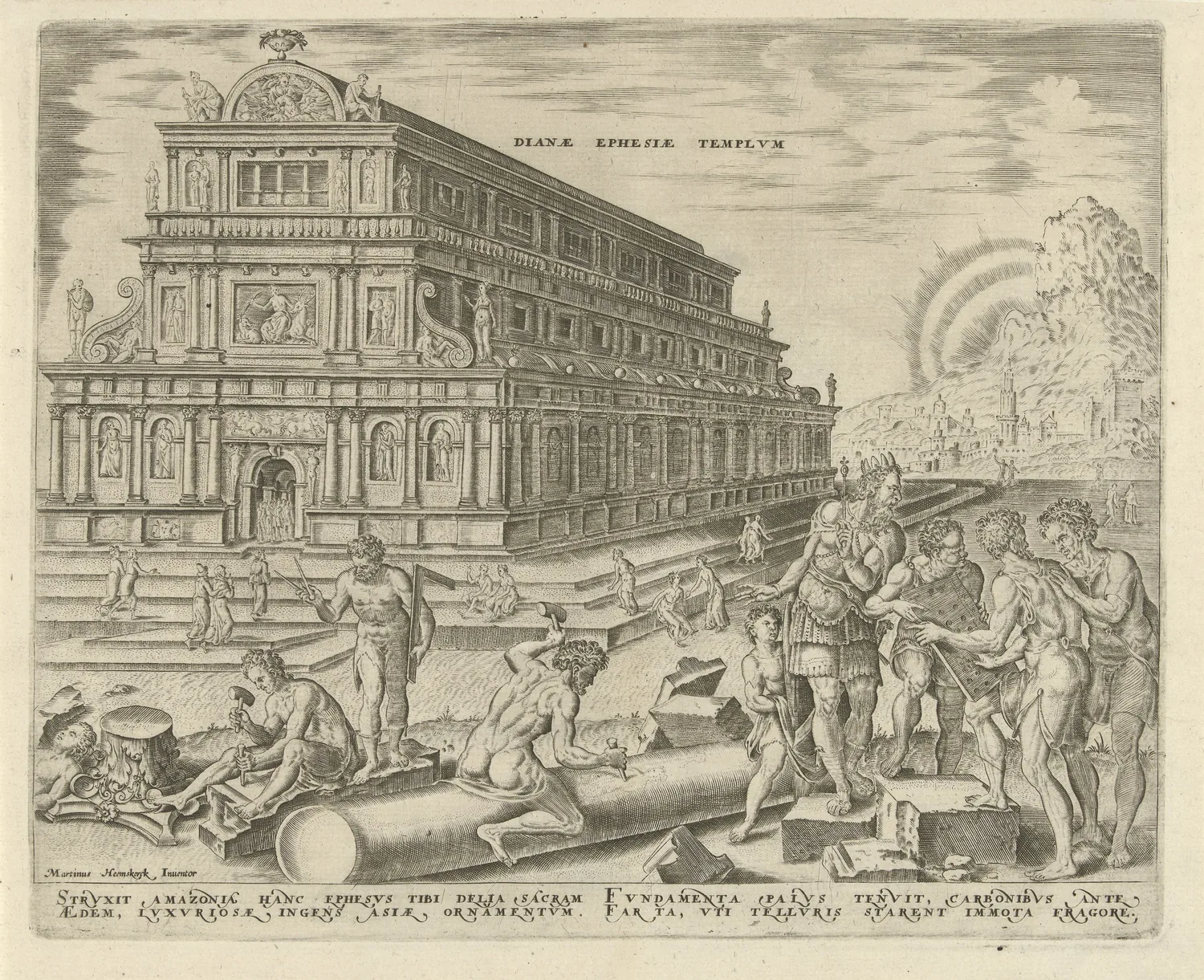
The man wrote one book, on nature, and never put it into circulation. He carried it up to the temple of Artemis, one of the seven wonders of the world in those days, and left it there. He wrote it deliberately in a terse, closed style resembling the sayings of oracles, which is why the ancients nicknamed him the Obscure. His name is Heraclitus. His book is lost, and no more than about a hundred and thirty fragments have reached us, scattered through the works of those who quoted him. Those few fragments were enough to set alight philosophy's second great question.
Heraclitus: everything flows

The best-known saying attributed to Heraclitus is that you cannot step into the same river twice, and that is in fact Plato's formulation of his doctrine. The fragment preserved in his own words is finer and more exact: "upon those who step into the same rivers, other and still other waters flow". The river you call by a single name is not one thing at two moments; the name stays fixed and the water changes. Everything is like that for him. The sun is new every day, the soul is a rising vapour, and you yourself are not in the evening the man you were in the morning. Everything flows and nothing stays.
Heraclitus made the origin of things neither water nor air but fire: the element that never rests, and that turns everything it touches into its own nature. Fire for him is closer to a symbol than to a material. In one of the deepest fragments he wrote, he says that this world was made by no god and no man, but always was and still is a living everlasting fire, kindling in measures and going out in measures. That phrase, "in measures", is the key to his whole doctrine, and we will come back to it.
To flux he added a second idea, stranger still: the unity of opposites. The road up and the road down are one road. Sea water is the purest water and the foulest, life for fish and poison for man. Sickness is what makes health sweet, and hunger is what makes a full stomach a blessing. Neither opposite stands without the other, and the strife between them is not a defect in the world but its very fabric. Hence his shocking saying: war is the father of all things.
Is the world for him, then, a chaos tossed about by opposites? Here comes his great word, the one with the long history ahead of it: the logos. Behind all this flowing there is a hidden, fixed law that governs the measures. The opposites contend in accordance with it as night and day succeed one another, and fire kindles and goes out by its measures and does not exceed them. People, for him, are asleep to this logos. They hear it and do not understand it, and had they understood it they would have seen that all things are one. Constant change, for Heraclitus, is not the opposite of order; change is the order.
Parmenides: being is one and does not change
At the other end of the Greek world, in the city of Elea in southern Italy, a generation later a man arose who said the exact opposite. Parmenides (c. 515–450 BC) cast his doctrine as a poem, and it opens on a solemn scene. A chariot drawn by knowing horses and driven by the daughters of the Sun carries the poet through the gate of night and day to a goddess who receives him with welcome and promises to teach him the whole truth: the way of truth, which no opinion clouds, and the way of human opinions, in which there is no certainty.
The way of truth rests on a proposition that looks too simple to state. Being is; non-being is not, and cannot be known or spoken. When you think, you think only of something, and sheer nothingness can be neither conceived nor said. On this single proposition he then built, with iron logic, conclusions that demolish the whole visible world.
Nothing can come to be. Whatever comes to be either comes from something existent, in which case it existed already and did not come to be, or it comes from nothing, and nothing yields nothing. Nor can anything perish. Where would it go? Into nothing, and nothing is not a somewhere to go to. There is no motion, because motion needs a void for the moving thing to move into, and a void is nothing, and nothing does not exist. There is no multiplicity, because two existing things can be separated only by something non-existent between them. Being, therefore, is one, eternal, unmoving, unchanging and indivisible, complete and finished on every side like a solid sphere. As for this world in which we see birth and death and motion and multiplicity, it is the opinion of human beings whose senses have deceived them.
A reader may laugh: does the man deny motion while he walks? But wait. Parmenides does not claim that you fail to see motion. He claims something more exact and more serious: that reason, if it follows the consequences of its premises strictly, ends at the impossibility of what the eye sees, and that when the proof of reason and the testimony of the senses conflict, the judgement belongs to reason, even if it calls the whole world a liar. That boldness, whatever we make of its conclusion, is the birth certificate of demonstrative argument: a first proposition, then consequences drawn from it by necessity, then acceptance of the result whatever it may be. A century before Aristotle, Parmenides was practising logic before logic had been set down as a science.
Zeno: counsel for the teacher
People mocked a doctrine that denies the obvious, so Parmenides's student Zeno of Elea took up its defence, with a shrewd plan. I will not prove to you that being is one and at rest, he said. I will show you that your own claim, that there is motion and multiplicity, leads to greater absurdities. Hence his paradoxes, which have kept minds busy for twenty-four centuries.
Achilles and the tortoise: the fastest runner of the Greeks races a tortoise that starts a few steps ahead of him. When Achilles reaches its position, it has moved a little further on; when he reaches its new position, it has moved on again, by less; and so without end. There is always a distance between the pursuer and the pursued, and Achilles will never catch it. And the flying arrow: at every instant of its flight it occupies a space equal to itself and is at rest in it, and if it is at rest at every instant, when does it move?
It is related that Diogenes the Cynic attended, some time later, a session in which the proofs denying motion were being set out. He said not a word. He stood up and walked. In that walk there is an answer we will return to. Still, the paradoxes themselves were no idle game. They forced mathematicians to think about infinity, about continuity and about the summing of endless series. They were not settled mathematically until thousands of years later, with the calculus and the theory of limits, and some philosophers still find in them something worth examining today.
The first great crisis in philosophy
What happened in this generation? The philosophers inherited from the men of Miletus the question of the single origin, and in their hands the question exploded into a deeper problem: the problem of change. Heraclitus seized one end and Parmenides the other, and each drove his principle to its furthest limit without compromise. The first made change the reality of being and rescued order by means of the logos. The second made permanence the reality of being and sacrificed the whole visible world.
Philosophy came out of this crisis with three lasting gains. The first is that the problem of change became the central problem: everyone who came afterwards, from the atomists to Plato to Aristotle, is essentially writing an answer to Parmenides, and it has justly been said that his doctrine is the wound Greek philosophy went on dressing for centuries. The second is the birth of strict deductive proof, which we have seen Parmenides practising before it was written down. The third is the decisive distinction between appearance and reality, between the world as it looks to the senses and the world as it is in itself, a distinction that would go with philosophy from Plato's cave to Kant, whom we will meet towards the end of this series.
As for Heraclitus's word logos, it had a long journey of its own. The Stoics made it the divine reason coursing through the world, the schools of Alexandria caught it up in turn, and then the reader of the New Testament found it at the opening of the Gospel of John: "in the beginning was the Word", the word there being, in its Greek original, the logos. We saw in the essay on the Arians how that opening became a theological battlefield. So notice how a word migrates from the notebook of an obscure philosopher in Ephesus to the heart of the greatest disputes over creed.
Weighed against revelation
Each of the two men grasped half a truth and let the other half slip. That the visible world changes and perishes and holds to no state is true, and God has spoken it in His Book: “everyone upon it will perish” [al-Raḥmān: 26]. That behind this perishing thing there is something fixed and subsisting which change does not touch is true as well: “and there remains the Face of your Lord, full of majesty and honour” [al-Raḥmān: 27]. But Heraclitus did not pass from the flowing to the one who makes it flow, and Parmenides sought the fixed and abiding and found it only by annihilating the changing world and making it an illusion. Revelation affirms both together without contradiction: a real creation that changes and perishes, and a true Creator who abides and is like nothing else. The fixed reality that Parmenides's fiṭra longed for does exist, but it stands above the world rather than in place of it.
In Heraclitus's logos there is a lesson close to this. His intuition that the flowing is governed by exact measures and not by chaos is a sound intuition, and the whole world proclaims it. God has said: “We have created everything in measure” [al-Qamar: 49]. But here we hold to our own standard in drawing parallels. Heraclitus's logos is a law latent in nature, with no person and no will, whereas the measure of the Qurʾān is the act of a Creator who knows and wills. The intuition that there is order is shared; naming its source is where the roads part, and we do not make the man out to know what he never reached.
There is also a lesson in the theory of knowledge in Diogenes's walk, one we set out in the essay "The end of atheism". A theoretical proof, however strict, that collides with a standing fact of the senses has a flaw somewhere in its premises even if we cannot see where it lies, and evidence of the senses, when it is present, spares us verbal dispute. Whoever denies motion is answered by walking in front of him, just as a man who demands a proof of your existence while he is speaking to you has already been answered. Revelation gave every faculty its due. It praised reason, it referred us to hearing and sight and the heart, and it made each of them a guard against the excesses of the others.
On to the next essay
Parmenides left philosophy facing a dead end: a rational proof that change is impossible, and a visible world surging with change. There was no way out except by a clever concession. What if being were many rather than one? What if each one of that many were fixed and eternal and unchanging, on Parmenides's own condition, and between them there were a void in which they moved and combined and came apart, so that from their combining and coming apart these things whose birth and death we watch are generated? That is the answer of a man from Abdera nicknamed the laughing philosopher, and his small indivisible bodies still carry their Greek name in the reactors and laboratories of today: the atom. So, on to the third essay: the atom and the void.
The "Mankind Was One Community" series — Essay Two
The "Mankind Was One Community" series — on the philosophy of being.
Essay Three: The Atom and the Void
Democritus and the atomist doctrine
The man who bought his grave with a book
In the city of Abdera, on the northern coast of the Aegean, a man in middle age stood before his fellow citizens in a position no one would envy. His father had been one of the richest men in the city, and when he died the sons divided the estate; this one took the smallest share, in cash, so that he could travel light. Then he spent every coin of it. He went to Egypt to learn geometry from its priests and to Babylon to study under its astrologers and reckoners, and he is said to have reached Persia and beyond. Then he came back to Abdera with empty hands.
The law of the city carried a harsh provision: a man who squandered his father's estate forfeited burial in his native soil. When the case came on, he called no advocate and shed no tears. He stood up and read out to his fellow citizens the greatest of his books, The Great World-System. When he had finished they did not merely acquit him. They voted him a large sum to make good the inheritance, they raised statues to him, and when he died the city paid for his burial. His name was Democritus, and later centuries called him "the laughing philosopher".
A way out of Parmenides' prison
The last essay left philosophy locked between Parmenides' proof and the testimony of the senses: reason ruled that change was impossible, and the eye saw it in everything. The way out came from Leucippus of Miletus and his student Democritus (about 460–370 BC), by one of the cleverest manoeuvres philosophy has known. They did not brazen it out against Parmenides' logic; they accepted it, and then went back over its premises.
They granted him that what truly exists is never born, never perishes and never changes, and that nothing comes out of nothing. But who said that what exists is one? Let the true existents be countless instead, each of them a Parmenidean being in miniature: eternal, solid, indivisible, unalterable. They named them for what they are — atomos, that which cannot be cut or divided. It is the word we render in Arabic today as الذرّة.
Then they made the great break. The void, the non-being Parmenides had outlawed, exists too, they said, after a fashion; without it the atoms could neither move nor be told apart. The daring carried Democritus as far as his baffling line: "the thing has no better claim to exist than the nothing." Those two terms swung the closed door open. Atoms swim in the void; they collide, they combine, they come apart. What we call birth is atoms combining, and what we call death is their separation, while the atoms themselves are neither born nor destroyed. Motion and plurality were saved, and Parmenides' logic stayed at the base of the system, honoured and without a scratch.
A world of atoms and void
On this foundation a complete picture of the world was built. Atoms do not differ in substance, only in shape, size, position and arrangement. Out of the same letters of the alphabet you make a tragedy and a comedy; out of the same atoms, differently arranged, you get water, fire and a human being. The soul, for Democritus, is fine, smooth, fiery atoms scattered through the body, and sight is thin films that peel off the surfaces of things and land in the eye.
Taste, colour, heat and cold are not in things themselves. He has a fragment on this that sums up the whole doctrine: "By convention sweet, by convention bitter, by convention hot, by convention cold, by convention colour; but in reality, atoms and void." He was the first to separate what is in things — quantity, shape, motion — from the qualities our senses add to them, a distinction Galileo and John Locke would wake two thousand years later and make the ground of modern science. Democritus himself saw the abyss the claim opened under his own feet: if the senses lie, where is the intellect to get its evidence, when it feeds on nothing else? He wrote a short dialogue in which the senses answer the intellect with the harshest sentence in ancient philosophy: "Wretched mind, do you take your evidence from us and then use it to throw us down? The throw is your own fall."
The ambition of the doctrine did not stop at our world. The atoms are infinite and the void is infinite, so the worlds are past counting: worlds coming into being and worlds dissolving, some with no sun and no moon, some with more suns and moons than ours. All of it runs with no one governing it and nothing in view, by blind necessity alone. One of the curiosities of history is that of all the books of Leucippus, the founder of the school, a single sentence has reached us, and fate seems to have chosen it as a motto: "Nothing happens at random; everything happens from a cause and by necessity."
The fate of the doctrine: from a proposed bonfire to the reactors of today
Diogenes Laertius reports, on the authority of Aristoxenus, that Plato meant to collect the books of Democritus and burn them, and that two Pythagoreans talked him out of it: the books were already in circulation, and fire would do no good against them. Aristoxenus is known for speaking ill of Plato, so the report rests on his credit. What is certain is that Plato never mentions Democritus anywhere in his writings, not by a single letter, and that Aristotle did the opposite: he took him seriously, set his doctrine out fairly, and then refuted it in a way that founded a tradition.
Epicurus then took over atomism and made it the basis of his teaching on peace of mind, and the Roman poet Lucretius cast it in verse in his poem On the Nature of Things. The poem was nearly lost. In 1417 the Italian scholar Poggio Bracciolini found a copy of it in a remote German monastery, and its publication did a great deal to revive atomism among the early moderns, until in 1803 the chemist John Dalton borrowed the old name for his particles. Then came the closing irony. In the twentieth century the indivisible was split into a nucleus and electrons, then the nucleus itself was split, and what had been split kept the name. Honesty requires a caution here: Dalton's atom is not a demonstrative extension of Democritus' atom. The one was a philosophical intuition with no experiment behind it; the other was a hypothesis that came out of the balance and the fixed proportions of chemical combination. What they share is the idea of primary particles, and the name.
What did atomism contribute?
First, it supplied a pattern that recurs in the history of science to this day. When a solid proof collides with a decisive observation, the way out is neither to deny the observation nor to abandon the proof, but to go back over some hidden premise that slipped in unexamined. The atomists went back over two — that being is one, and that void is impossible — and the knot came undone. This is exactly what we set out in the essay "From observation to the scientific revolution", on how science behaves when experiment falsifies a theory.
Second, it supplied the first complete programme of mechanical materialist explanation: matter, motion and necessity, and nothing besides — no governing agent, no intended end. The two questions we watched the school of Miletus pass over, who is the agent and what is the purpose, Democritus did not pass over; he answered both of them explicitly, in the negative. There is no agent and there is no purpose. With that, the doctrine over which philosophy and belief have fought ever since took its full shape for the first time, and every word written on materialism afterwards, ancient or modern, has been a marginal note on the text of Abdera.
The doctrine does have a weak point, and fairness requires setting it out. A structure's internal consistency is one thing and its truth is another. Democritus built a tightly woven world on top of a postulate for which no evidence was ever offered: that there is no agent and no purpose. Sound logic built on a premise that has merely been posited produces a well-formed falsehood. Rigour in the deduction is no protection against a rotten starting point.
Weighed against revelation
A Muslim reader stands in a double relation to this doctrine. His intuition that matter has an inner structure of minute primary building blocks which combine and come apart was a brilliant guess, and the centuries have confirmed it. The large claim is another matter: that blind necessity and blind collision are enough to account for such precision. That is the point in dispute, and the discoveries of our age have only exposed it further. Every time science goes down a layer in the structure of matter it finds a finer order beneath it and more exact measures, from the proportions of chemical combination to the constants of the universe, tuned so finely that if the least of them drifted no atom and no star would stand. “The handiwork of God, who has perfected everything” [al-Naml: 88]. We established in the essay "The end of atheism" that modern discovery has not produced a new proof; it has only made the old proof stronger and clearer.
The one surviving sentence of Leucippus — nothing happens at random, everything from a cause — is in fact an argument against his doctrine rather than for it. Whoever grants that every event has a cause is then asked about the chain of causes itself, and about its unbroken order: the cause of regularity cannot be a blind regularity. The atomists caught the first end of the thread and cut it before it could bring them to the Causer of causes.
The story has an entertaining Islamic postscript, and it is a good place to close the reading. The Muslim mutakallimūn, Muʿtazila and Ashʿarīs alike, adopted an atomism of their own, built on the atom that cannot be divided, al-jawhar al-fard. But look at how the function of one and the same idea reverses between the two doctrines. Democritus' atom is eternal and self-sufficient, and it was set up as a substitute for the Creator. The atom of the mutakallimūn is originated and dependent, created by God along with its accidents at every instant, and it was set up as a witness to a permanent need for the Creator. A mental structure can be alike while the intent behind it is opposite. This is among the most useful things a student of the history of ideas can learn: never judge an idea by its shape until you have looked at the work it does inside its author's system. It is another face of our habitual caution about the contagion of drawing parallels.
On to the next essay
With Democritus, natural philosophy reached the end of its course. It began with the water of Thales and it ended in a world of mute atoms tossed about by necessity, with no agent in it and no purpose, and with man himself a handful of atoms that will come apart. In Athens, in those same years, a young man of an aristocratic house was watching his city put to death, with a cup of poison, the most just and most austere of its people. A question caught fire in him that turns the whole inquiry on its head. If reality is atoms and void, where did the justice my teacher died for come from? And where have we ever seen the perfect triangle and the straight line by which we judge every triangle and every line in this defective world? Perhaps what the senses reach is not the root of being but its shadow. That man is Plato, and that is our appointment: the world of the Forms.
The "Mankind Was One Community" series — Essay Three
The "Mankind Was One Community" series — on the philosophy of being
Essay Four: The World of the Forms
Plato: true being behind the shadows
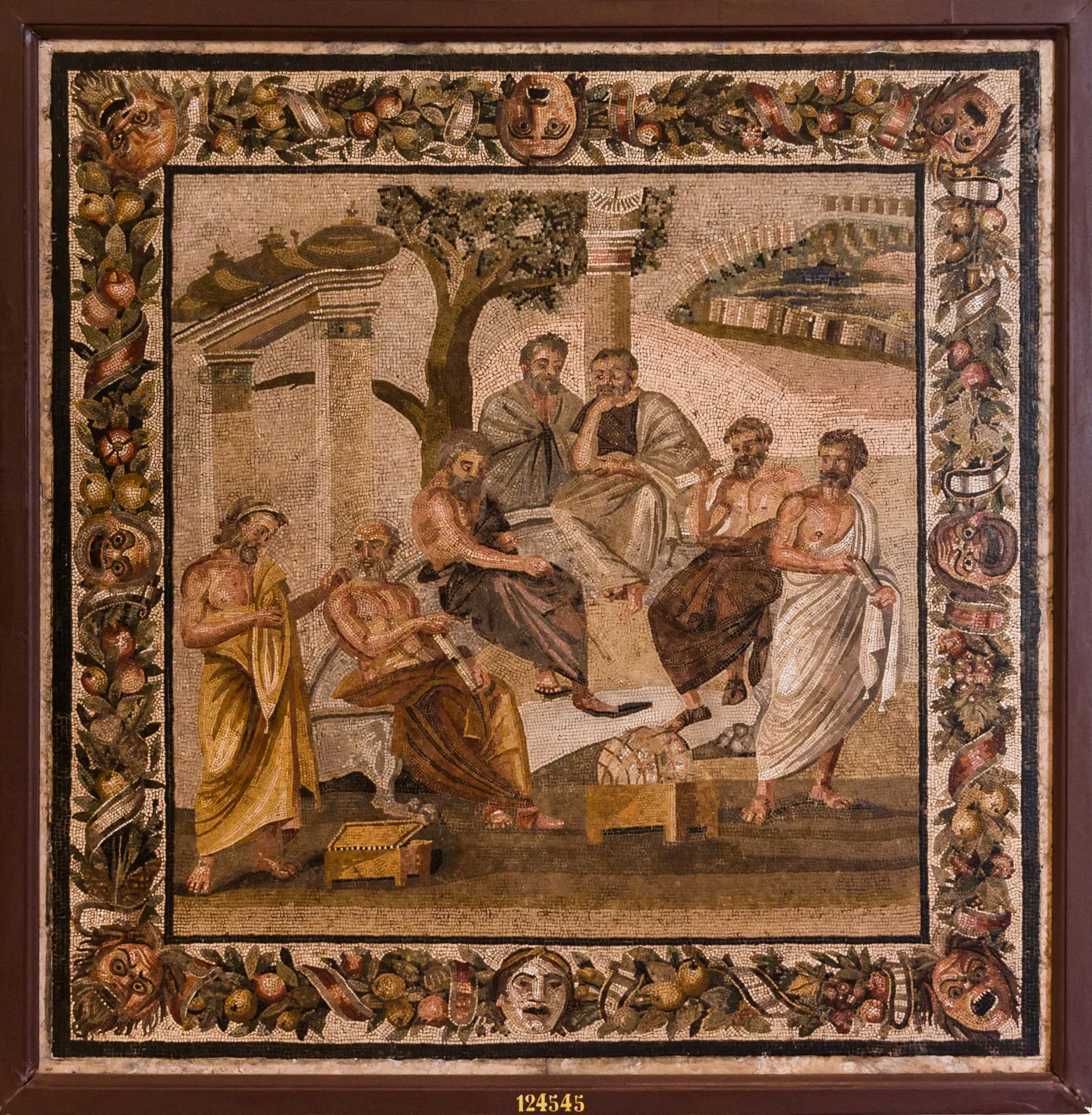
A philosopher in the slave market
On the island of Aegina, facing Athens, around the year 387 BC, a broad-shouldered Athenian past forty stood in the slave market, put up for sale like a piece of goods. He was no obscure prisoner of war. He had just come away from the court of Dionysius, the tyrant of Syracuse, where he had gone to try reforming a ruler by philosophy; the tyrant could not bear his frankness, and arranged the business that ended on the auctioneer's platform.
As God willed it, a man of Cyrene named Anniceris was passing through the market. He knew the face, bought him, and freed him on the spot. When the philosopher's friends collected the money and brought it to him, Anniceris refused a single coin: why, he said in effect, should you keep the honour of spending on philosophy to yourselves? So the ransom went to another use. With it the philosopher bought a garden in a suburb of Athens named after an old hero, Academus, and founded his school there. His name was Plato and his school was the Academy, the first lasting institution of learning in history. It lived nine centuries, until the emperor Justinian closed it in 529 AD, and its name is a byword to this day for every house of learning.
The problem Plato inherited
We will stop later, in the series on the meaning of life, at the trial and death of Socrates, and take from his life what we need there. What concerns us here is the problem he left to his student. Socrates went about Athens asking what justice itself is, and what beauty itself is. He did not want examples but a definition that takes in the whole of a thing and shuts out everything else, and the question always ended without an answer. The man died, and the question remained a debt owed by a student who had watched the most just man he knew killed in the name of the city's justice.
Along with the question, Plato inherited the two dilemmas of the second essay. In his youth he took from Cratylus the Heraclitean the view that sensible things are in a flux where nothing holds still, and that if what you know is changing while you look at it there is no knowledge of it, only opinions running along with the current. He had also heard Parmenides argue that the true object of knowledge must be fixed and unchanging. He joined the two sides in a way that had occurred to nobody before him: both are true, but each about a different world. Heraclitus described the world of the senses. Parmenides described another world, an intelligible one that the senses cannot reach.
That is the doctrine of the Forms. Behind every sensible plurality there stands a single intelligible reality that does not change: the Form. Beautiful things come and go and ugliness gets into them, while beauty itself is fixed, with no contrary mixed in; just acts are mixed, while justice itself is pure and entire. Sensible things only share in their Form, or imitate it imperfectly, as a statue imitates the man. Ask where true being is, and Plato answers in a way that turns Democritus on his head. True being is not this thing you touch and see. This is a shadow. True being is what the mind grasps and the eye never sees.
The cave
Plato cast his doctrine in the most famous image any philosopher has drawn. Picture people chained since childhood in a cave, their faces to the wall. All they see are shadows thrown on that wall by a fire behind them, with objects carried past in front of it. They know nothing of the world but the shadows; the shadows are the whole of reality to them, and they have sciences and prizes for naming them and for predicting the order in which they come.
Unchain one of them and turn him round, and the light hurts. He denies what he sees, and takes the shadows to be truer than the glare. Drag him up the road of ascent and out, and at first he is blind; then his eye learns the light by degrees. He sees shadows, then the images of things in water, then the things themselves, and at last he lifts his head to the sun and understands that it is the source of the light and the cause of everything he had been looking at. Then he remembers his companions down in the pit, and pities them, and goes back down to bring them the news. The dark closes over him now that his eyes are used to the light. He stumbles among their shadow-sciences, and they laugh at him: he went up and ruined his sight. Plato ends the image with a line that drips blood. If they could lay hands on the man who tried to loosen their chains and lead them up, they would kill him. We can only think that he saw, as he wrote it, the cup of poison in his teacher's hand.
The dark is the world of sense; the shadows are the knowledge of the people who live in it; the road of ascent is a philosophical education; the way out is the grasp of the intelligibles; and the sun is the highest Form of all, the Form of the Good, by which intelligibles are understood as visible things are seen by the sun.
The witness of mathematics
Someone may object: how do we know that this intelligible world exists at all, and is not a poet's fancy? Plato's strongest witness lay ready to hand in mathematics, and over the door of his Academy, so it is reported, stood the words: let no one enter who has not learned geometry. Look at any triangle a hand has drawn on sand or parchment. Its sides have width, its lines are crooked under close inspection, and its angles do not come out at the exact measure; in the whole sensible world there is not one perfect triangle. Yet the geometer builds his proofs on the perfect triangle, and judges every drawn triangle deficient. By what standard did we convict all the drawn ones of falling short, when we have never once seen with our eyes the perfect one we measure against? The intellect must have an object other than what the senses take hold of.
Plato went further and claimed, in the dialogue Meno, that knowledge is recollection. He shows Socrates drawing the solution of a geometrical problem out of a slave boy who had never learned geometry, simply by asking him question after question and teaching him nothing. Where did the boy get it? The soul saw the Forms before it came to dwell in the body, Plato answers, and learning is the recovery of what it forgot. In his work this is bound up with a doctrine of the soul's pre-existence and its passage through bodies, which he himself would present mixed with myth, in the manner of a man hinting that he is approximating something he cannot prove. We will weigh it in its place in this essay.
The craftsman: the first answer to "who" and "why"
Two questions have kept us company since the first essay, and natural philosophy kept dodging both: who is the agent, and to what end? Democritus answered both of them with a flat denial. When Plato grew old he wrote the dialogue Timaeus, and in it stands the first affirmative answer in the history of philosophy. This beautiful cosmos does not issue from a blind necessity. Behind it is a wise divine craftsman, whom he called the Demiurge, that is, the master workman: he found a matter in turmoil with no order in it, looked to the eternal Forms, and arranged the matter on their model. And why? Plato's answer has gone on echoing ever since. Because the craftsman is good, and the good neither grudges nor envies, he wanted everything to be as good as it could possibly be. The world, for Plato, is the trace of a generosity and not an accident of chance, and to study it is to read the wisdom of its maker.
To Plato's credit, he offered all of this modestly. He calls his account of the origin of the cosmos a likely story rather than a decisive proof — how should a creature encompass with certainty the details of its own making? In the weighing below we will look at how far this great answer got, and where it fell short.
Plato against Plato
Perhaps the finest thing in the man is a trait with few parallels among the founders of doctrines: he was the harshest critic of his own doctrine. Late in life he wrote a dialogue named after Parmenides, in which the old Eleatic examines a youth named Socrates on the theory of Forms and rains objections on him, some of which Plato never answered. What are the limits of the Forms? Is there a Form of mud, of hair, of filth? And how do things share in their Form: does the whole of it come to be in each thing, so that it is divided, or only a part of it, so that it is not one Form? Then there is the objection that Aristotle would call the third man. If beautiful things fall under one description because they share in the Form of beauty, then the Form itself is beautiful, so it and they must fall together under a second Form above them, and a third above those two, and so on without end.
Plato took these picks to the foundation of his own building, with his own hand, in a book he published to the world, and then went on holding the doctrine in a modified and developed form. This is the spirit of the critical tradition we watched being born in Miletus, and here it reaches a rare height: mutual criticism has become self-criticism. The greatest objection to the Forms would come from inside the house, from a student who kept to the Academy for twenty years. He is the subject of our next essay.
An influence that does not end
The English philosopher Whitehead made his famous remark, to the effect that the safest general description of the European philosophical tradition is that it is a series of footnotes to Plato. We will not get ahead of the story here. We will meet Plato recast by Plotinus in the sixth essay, then arriving among the Muslims mixed with other material in the seventh, and we will find his cave standing at the heart of Kant's distinction between the appearance and the thing in itself in the tenth.
One witness to the life of the doctrine is enough here. Ask a working mathematician today about the theorem of Pythagoras, and about the prime numbers that never run out: are they an invention human beings made, as they invented chess, or the discovery of standing truths that were true before any mind existed to grasp them? Many in the trade will answer the second, and to this day they call the position, in their own literature, mathematical Platonism. It is unjust, then, to count the theory of Forms a museum piece. It is alive and walking the corridors of mathematics departments.
Weighed against revelation
In this weighing Plato has a standing of his own. He is the man who broke the monopoly of matter over existence: he established by argument that not every existent is a body you can touch, that the visible world is not the end of reality but its lowest rung, and that the intellect has objects above sense. By widening the map of being in this way he pulled down the greatest barrier standing between the materialists and any belief in the unseen at all. But we must be exact in our own terms. Plato's world of Forms is not the unseen world of which revelation speaks. The Qurʾān fills that world with angels, a garden, a fire, and a living, self-subsisting Lord who does what He wills; Plato's is a set of bare, cold Forms that neither hear nor answer. The overlap lies in the division — the visible and what lies beyond it — and not in the content of the two halves. We do not make Plato a believer in the unseen of the prophets.
As for the craftsman of the Timaeus, in our weighing he is the furthest the Greek intellect got on its own, walking towards God: a wise, good, purposing agent, who pushed aside chance and blind necessity together. But see where his feet stopped. He is a craftsman, not a creator. He found an eternal matter he had not brought into being, and ordered it; he found Forms above him he had not laid down, and copied them. He is an engineer who inherited a site and a set of plans and had no hand in making either. The difference between him and what revelation brought is the difference between the limit of reason and the wealth of report: “Originator of the heavens and the earth; and when He decrees a thing, He only says to it "Be", and it is” [al-Baqara: 117]. A Creator who originated matter, forms and laws alike, with no prior model to follow, and not a craftsman bounded by what he found there. Glory to Him who guided the fiṭra so that it came close, and sent down revelation so that it completed the matter and made it plain.
At Plato's recollection it may occur to a reader to call up the verse of the covenant: “And when your Lord took from the children of Adam, from their loins, their offspring” [al-Aʿrāf: 172]. Here we press harder on the caution we have made a habit of, because the two claims part company in structure and in meaning. Plato's recollection is a branch of the pre-existence of the soul, its passage through bodies, and its viewing of abstract Forms, and all of that is rejected by the text of revelation. The covenant of the verse is a testimony the Creator took from created beings brought into existence, and its fruit is an implanted fiṭra that affirms His oneness, not a store of geometrical information. The boy of the Meno recovers a piece of knowledge; the newborn in the hadith of the fiṭra is born on the creed of pure monotheism and then the devils divert him, and that is the hadith with which we opened the series. The likeness is that there is something in a human being prior to instruction. The parting is over what that something is and where it comes from.
On to the next essay
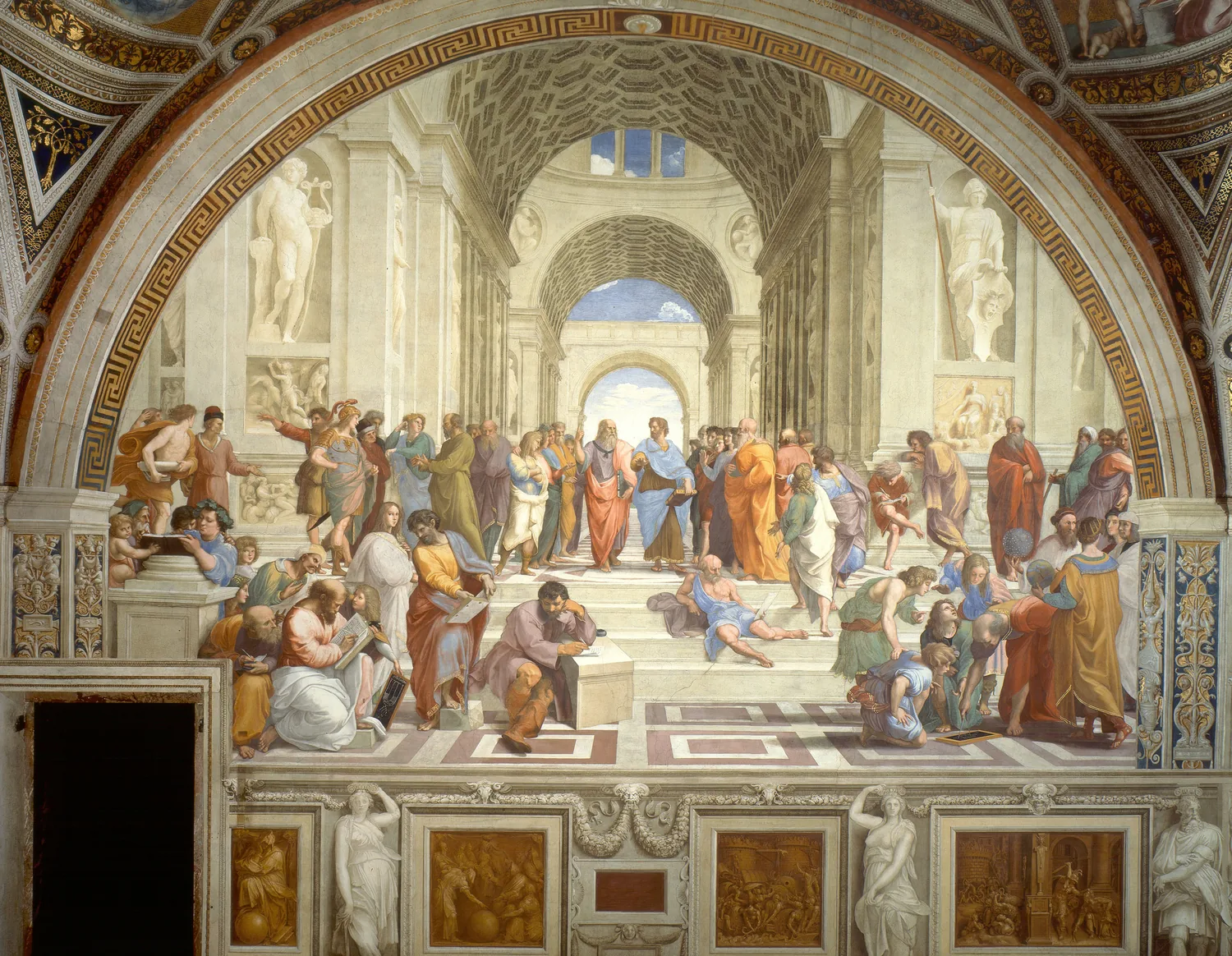
In Raphael's famous fresco The School of Athens, two men walk at the front of the picture, one old and one in middle age. The old man is Plato, his index finger raised to the sky, where true being lies for him. The other is his student, his palm spread out towards the earth, as if to say: no, here, in these things themselves, is where we should look for being. This student came to the Academy as a boy of seventeen, from a remote town called Stagira. His father was physician to the king's court, and from a household of medicine he inherited an eye that could not get its fill of dissecting what is seen and turning over what is touched. He kept to his teacher for twenty years, until Plato died, and then said the words that are reported by their sense: Plato is dear, but the truth is dearer to us. So he brought the Forms down from their heaven into the interior of things, and asked the question that made him the father of a new science: what is being, in so far as it is being? On, then, to the fifth essay: being in so far as it exists.
The "Mankind Was One Community" series — Essay Four
The "Mankind Was One Community" series — on the philosophy of being
Essay Five: Being qua Being
Aristotle and the birth of metaphysics
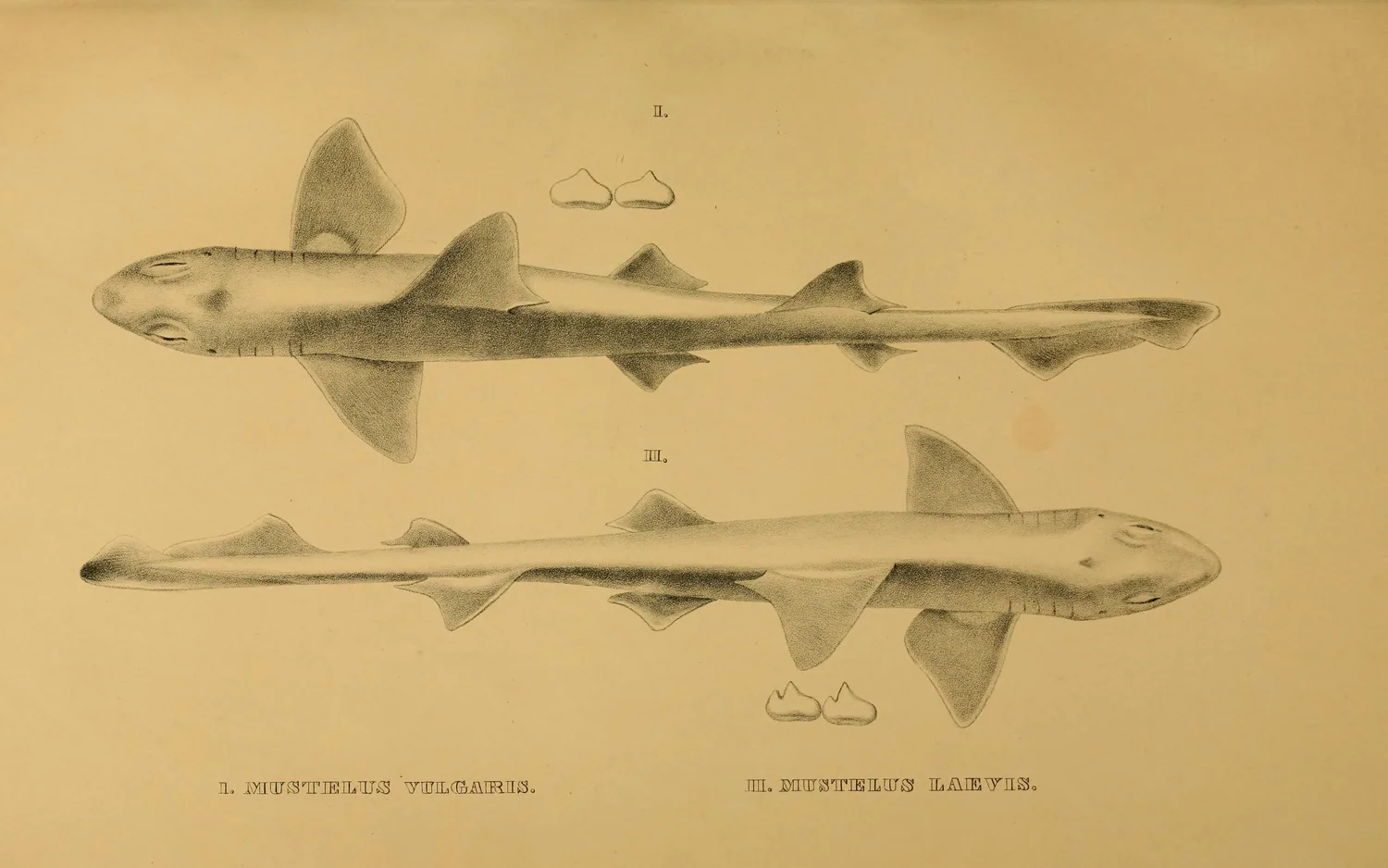
The philosopher in the lagoon
On the island of Lesbos in the Aegean, around 345 BC, the fishermen of the Pyrrha lagoon kept seeing a sight that puzzled them: a middle-aged man, Athenian in his bearing, standing knee-deep in the shallows. He would bend over a jellyfish and turn it about, open a cuttlefish with a practised hand, slit the bellies of small sharks to see how they carried their young. He was no fisherman and no cook; he was taking notes. This one lays eggs; this one bears its young alive; and this astonishing one, the smooth dogfish, has embryos joined to the mother's belly by a cord and a placenta, exactly as a human child is joined in the womb.
There is nothing surprising in the scalpel sitting so easily in his hand. The man came of a house of physicians who traced their line back to Asclepius, and his father Nicomachus had been court physician to Macedon. We are told that when students recoiled in pride from the study of worms and shells he would say to them, in effect: in everything in nature there is a wonder. And he would tell them about Heraclitus, whose visitors found him warming himself at the baker's oven and hung back at the door, until he called to them: come in, there are gods here too. This man wading in the mud of a lagoon, counting the eyes in a cuttlefish's head, is the same man who would found the science of logic and define God as thought thinking itself. His name is Aristotle, and it is time we met him.
The student who brought the Forms down to earth
Aristotle came to Plato's Academy as a boy of seventeen and stayed a full twenty years, until his teacher died; Plato, it is reported, used to call him “the intellect”. Yet for all that long affection, the physician's son could not settle into the doctrine of the Forms. What does a Form standing apart in some intelligible sky actually explain? How does a separate Form of horse produce a horse that whinnies in the stable? By what connection does the Form of health treat a sick man turning over in front of his doctor? Plato had doubled the world without explaining it: he moved the question from earth to heaven, and the question stayed a question.
Aristotle's break with him is preserved in the line reported from him: Plato is dear to us, and truth is dearer still. Its origin is a sentence in the Nicomachean Ethics where he excuses his criticism of the partisans of the Forms on the ground that truth deserves precedence over friends; later centuries turned it into a proverb. The content of the break is simple to state and enormous in effect. The forms do exist, and truly, but not in a separate sky. They are in the things themselves: the form of horse in this horse, the form of man in Zayd and in ʿAmr. There is no way, then, to know the forms except through the individuals that carry them. So let things be studied, one by one and species by species — and that is why the man went wading into the lagoon of Lesbos.
A science named by a librarian
Aristotle saw that the sciences had divided the existing things among themselves. The mathematician studies what exists insofar as it is quantity and number, the natural philosopher insofar as it is a moving body, the physician insofar as it grows well or falls sick. Who, then, studies what exists insofar as it exists? Who asks about being itself: what does it mean for a thing to be, what are the divisions of being qua being, and what are its first principles? That is a science standing above all the sciences. He called it first philosophy, and he called it the divine science.
The name that stuck to it has a story that belongs among the curiosities of history. Centuries after Aristotle, Andronicus of Rhodes put his works in order and set the books of first philosophy on the shelf after the books on nature, so that people came to refer to them as what comes after the physics: meta ta physika. Look at it: the oldest science in philosophy still carries, in every language on earth, a name it owes to a librarian's shelving order. Muslims took it into Arabic as الميتافيزيقا, and as علم ما بعد الطبيعة, the science of what comes after nature.
At the opening of this science Aristotle laid down his great rule: being is said in many ways. To call a self-subsisting substance existent, a horse for instance, is not the same as saying it of an accident that subsists in something else, such as the horse's colour or its height; and neither is the same as saying it of a privation, such as blindness. All these ways lead back to one primary sense on which they depend: substance. For Aristotle the question of being is the question of substance, and analysing substance called for new tools, which he made with his own hands.
Potentiality and actuality: unlocking Parmenides' prison
Every perceptible substance, on his account, is composed of matter and form. A statue is bronze and shape: the bronze is never found stripped bare of every shape, and the shape subsists only in bronze or in marble. Then came the key with which he undid the hardest knot philosophy had inherited, the knot of Parmenides that occupied our second essay: the distinction between existing potentially and existing actually.
Parmenides had said that change is impossible. What comes to be must come either from something already existing, in which case nothing has come to be at all, or from sheer nothing, and nothing gives birth to nothing. Aristotle answered: you divided, and your division was faulty; between what exists actually and sheer nothing there is a third position you overlooked, what exists potentially. An acorn is not an oak in actuality, but neither is it the sheer absence of an oak in the way a pebble is; inside the acorn an oak lies latent, in potentiality. Change is therefore not an emergence out of nothing but the passage of the potential into act: the sick man is healthy potentially, and so he recovers; the block of marble is a statue potentially, and so it is carved. Motion and change were restored to their standing after a century and a half under attack, and restored not by denying Parmenides' logic but by repairing his premise — on the pattern we have seen again and again in this series: examine the hidden premise and the knot comes undone.
The four causes: the return of two absent questions
Aristotle then laid down that knowledge of a thing is not complete until all four of its causes are known. Ask about this house. Out of what? Out of brick and timber, and that is the material cause. What is the shape by which it became a house rather than a heap? That is the formal cause. Who built it? That is the efficient cause. And why was it built? To be lived in, and to keep out heat and cold, and that is the final cause — which for him is the cause of causes, since it is for its sake that the agent moves at all.
Here the two questions we have been tracking since Miletus are reunited. The first school stopped at the material cause alone: water, or air, or the boundless. Democritus denied the wise agent and the purpose outright. Plato affirmed them both in the craftsman of the Timaeus, but affirmed them in the manner of a likely story. Then Aristotle came and wrote agent and purpose into the very definition of knowledge: there is no knowledge without the question “who” and the question “why”. He held that purpose runs through the whole of nature and not through the crafts alone. The incisors are at the front for cutting and the molars at the back for grinding, and the bird does not build its nest for nothing. He has a line he repeats across his books: nature does nothing in vain.
The unmoved mover
Aristotle then took the chain of causes up to its summit. Everything in the world that moves was set moving by a mover, and that mover is itself moved by another; and if moved movers run back in a series with no first, then motion as a whole has no starting point and there is no motion at all — but motion is there in front of our eyes. The chain must therefore end at a first mover that does not move: a mover with no potentiality in it waiting on an actuality, but pure act, separate from matter, one and eternal. And how does something that does not move cause motion? Aristotle's answer is strange and beautiful: it moves as the beloved moves the lover. The beloved is still, and the hearts run towards it. The outermost sphere longs for that pure perfection and turns out of longing, and by its turning the motions of the world run on. And what does that first mover do? It would not befit it to think what is beneath it, for that would drag down the dignity of its thinking; so it thinks the noblest of intelligible things, which is itself. It is thought eternally thinking itself.
This is the highest point Greek demonstration reached in establishing a first principle, and it would remain the pillar of divine science for its commentators for centuries. But an honest presentation has to record what is pale in the picture, and we shall weigh that below. There is even a snarl in the doctrine that Aristotle recorded himself: in one passage of the Metaphysics the astronomy of his day forced him into counting the separate movers by the number of the spheres, forty-seven of them or fifty-five, so that the “gods” multiplied according to the reckoning of astronomers — and in that same passage he argued for himself what requires the first principle to be one. The man who carried the demonstration to the door of the One stood on the threshold, counting.
The First Teacher: the legacy and the death-blow
Being was only one province of the man's empire. He is the founder of the science of logic in the Organon, the craft of the syllogism, which stood as he had left it until Kant said, two thousand years later, that logic since Aristotle had not been obliged to take a single step backwards; and at Kant himself we shall see that first step taken. He is the founder of zoology by the agreement of historians of science, and his books on politics, ethics, rhetoric and poetics are the foundations of those arts to this day. In our civilisation he was given the title of the First Teacher, and al-Fārābī was called the Second Teacher only because he came second to him.
Yet his legacy carries a lesson that has become a fixed point in this series and its companions. The First Teacher made grave mistakes. He said that heavier bodies fall faster, that the earth is the centre of the universe, and that some living things are generated spontaneously out of mud. That is not his scandal; every pioneer gets things wrong. The scandal was the scandal of the followers. They made his books sacred until they stood as evidence against the senses and against experiment, and the error about falling bodies was taught for two thousand years while the test lay within any man's reach, until someone came who put it to the test and brought it down, as we set out in the essay “From observation to the scientific revolution”. Consider the bitter irony: the man who waded into the lagoon with his own hands in order to see with his own eyes had his followers freeze science in his name, against wading and against seeing. Imitation has never killed anyone as it killed the man who founded the method of observation.
Weighed against revelation
On our scale Aristotle has two credits that cannot be denied. The first is that he returned the questions of agent and purpose to the front rank of any inquiry into the universe, after Democritus had banished them; and with that return the study of nature became a road to its governor rather than a substitute for him. On this foundation the arguments from wisdom and providence would be built, the arguments the Qurʾān crowds together when it commands us to consider the camel, the sky and the plants. The second is the argument from motion. Greek reason established, using its own instruments alone, that a chain of movers must have a first that is necessary and separate. This is a second approach after Plato's craftsman: firmer as a demonstration, and poorer in attributes.
That poverty of attributes is the paleness we promised to explain. Weigh Aristotle's mover on the scale of revelation and you find a god of proof, not a god of worship. He does not know this world or its particulars, since if he thought changing things his thinking would change with them; he is a mover who does not know whom he has moved. He does not will, and he does not act by any choice; things move out of longing for him, and he is heedless of them. He does not create, for on his account the world is eternal and has always been alongside him. How far is this from “Does He who created not know? And He is the Subtle, the Aware” [al-Mulk: 14]? How far from “Doer of whatever He wills” [al-Burūj: 16]? Between a thought that thinks itself, which no prayer reaches and to which no affliction is carried up, and a Lord who is near and answers the call of the caller when he calls on Him, lies the whole distance between the conclusion of a syllogism and a living object of worship. We shall see in a coming essay that the philosophers of Islam inherited this Aristotelian god and tried to make him religious, and that al-Ghazālī swung his pick at this very spot: the eternity of the world, and God's knowledge of particulars.
His line “nature does nothing in vain” we weigh by the usual test of resemblance, beside the word of God: “Our Lord, You did not create this in vain” [Āl ʿImrān: 191]. The observable evidence is one and the same. The precision of the teeth, of the eye and of the nest does not admit of futility. But Aristotle lodged the intention in “nature” itself, as a purpose running through things with nobody intending behind it, while the verse speaks in the name of the agent: You created. This is exactly the parting of ways we weighed at the logos in Heraclitus. Recognising the order is common ground, and the fiṭra cries out with it; naming the one who ordered it is where the two roads divide. We do not make Aristotle say what he did not say.
On to the next essay
Alexander, Aristotle's student, died in 323 BC, and Athens rose against everything that had any connection with Macedon. The same charge of impiety on which Socrates had been given the poison was brought against the philosopher. He left the city with the line reported from him: I will not let Athens sin against philosophy twice. He died in exile a few months later. With his death the page of the giants of being was turned; the schools after him were taken up with the questions of tranquillity and escape from anxiety, and the great question of being slept for five centuries and more. It woke in a land not its own, in Alexandria, in the hands of an odd Egyptian who was ashamed, as his student says, of having a body, who said that all of being is an emanation from a One above being and above intellect, and that Plato's Forms are the lowest degree of the light rather than the highest. On to the sixth essay: the One and emanation.
The “Mankind Was One Community” series — Essay Five
The “Mankind Was One Community” series — on the philosophy of being
Essay Six: The One and Emanation
Plotinus and Neoplatonism
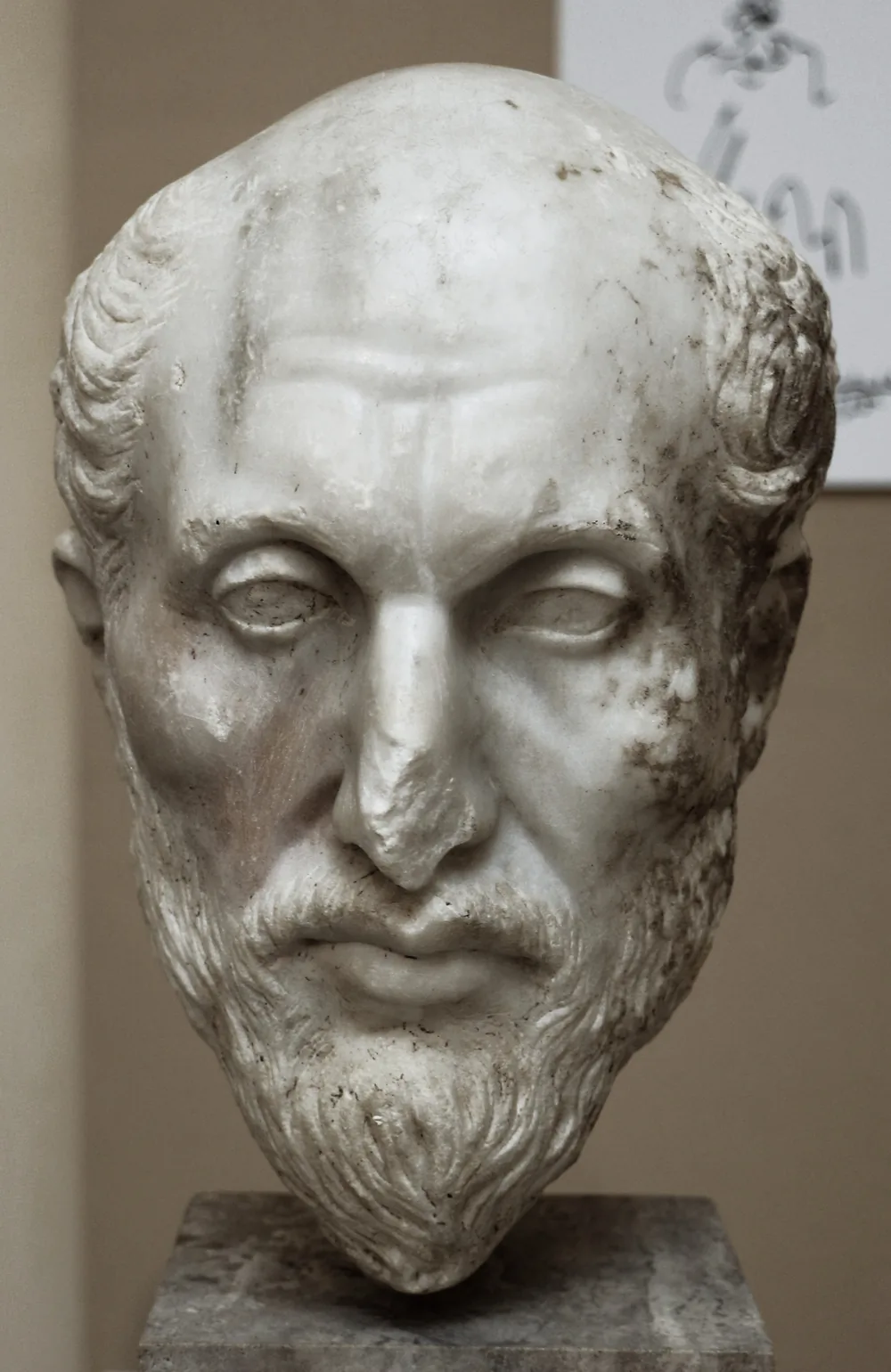
The painter smuggled in
In Rome, around the middle of the third century AD, one man in a crowded teaching circle did not look like the other students. His eyes never left the face of the master lecturing, and he wrote down not one letter of what was said. He was a painter named Carterius, and one of the senior students had smuggled him in. The master had refused to sit for any painter or sculptor. To the man who pressed him he answered, in effect: is it not enough that I am carried about in this phantom nature has dressed me in? Must I also leave posterity a phantom of the phantom, as though it were something worth looking at? So the painter came to fix the face in his memory, then went home and painted from memory, until the portrait was finished behind its subject's back.
His student Porphyry opens the life he wrote with a sentence that explains the whole scene: Plotinus was like a man ashamed of having a body. He never spoke of his birth, his family or his town, as though he counted the descent of the soul into a body an event not fit to mention. We do know that he was born around 204 AD at Lycopolis in Upper Egypt, the Asyut of today. He sought philosophy in Alexandria until he heard Ammonius Saccas and cried out: this is the man I have been looking for. He stayed with him eleven years. His longing for the wisdom of the East then grew so strong that at thirty-eight he joined the emperor Gordian III's campaign against Persia, hoping to get through to the sages of Persia and India. The emperor was killed, the army scattered, and the philosopher escaped with his life to Antioch; then he settled in Rome and taught there until his death in 270 AD. In Rome he dictated the books that Porphyry gathered into the Enneads: the last summit of Greek philosophy, and the strangest.
The question: where did multiplicity come from?
Plotinus turned the question of this series on its head. The men of Miletus had asked what the one origin behind all this multiplicity was; Plotinus asked how multiplicity issued at all, and why the One did not simply remain alone. If the first has several principles then it is not first, and everything composite depends on whatever composed it; the true first is purely one, with no composition in it in any respect. Then he pressed the stripping away further than anyone before him had gone: the One is above being itself. He took Plato's phrase in the Republic about the Good that exceeds being in dignity and in power, read it at face value, and built on it. Indeed the One is above intellect and thinking, since a thinker doubles into thinker and thing thought, and there is no duality in the One. So it cannot be defined or described, because every description is a limit and every limit a composition. Everything we say of it says what it is not: not a body, not an intellect, not a thing that changes. This road, the road of negation, would inherit a name in every religion: negative theology, transcendence affirmed by way of denials.
Emanation: a sun that is not asked about its light
How then did a world issue from this One, packed tight in its own unity? Plotinus did not say it created by will, since will for him is a motion and a want, and the One is above both. Nor did he say it happened by chance, which philosophy had left behind since Plato's day. He came instead with the image that travelled everywhere: emanation. Everything perfect overflows onto what is around it, without intending it and without being diminished. The sun pours out light and its disc is not reduced, the spring pours out water, the musk pours out scent. So it is with the One: its perfection overflows as being, eternally, necessarily, without its moving or turning towards anything or losing anything of itself.
The first thing to flow from it is Intellect, and in Intellect all of Plato's Forms came to rest as living intelligibles. The Forms are not in a sky subsisting on its own, as in the fourth essay, but thoughts in a universal intellect. Consider what he has done. This intellect, which thinks itself and thinks the Forms within it, is exactly the description of Aristotle's god: the thought that thinks itself. But Plotinus brought it one step down from the throne and seated above it the One, which neither thinks nor is thought. It is as if he said to the Greeks as a body: Plato's summit and Aristotle's summit are both below the summit. From Intellect there then flows the universal Soul, which governs the world and out of which our own souls spread. Soul overflows into what is below it, until the light reaches its outermost fringe and fades away there: matter, the poorest and darkest of things. From here comes his famous answer on evil. Evil is not a thing that anyone created; it is an absence of light and a poverty of being, as a shadow is not something made but the absence of light. That answer would have a long life ahead of it in religions and philosophies alike.
Look at what the man did. He accepted Plato and his dualism, and he accepted Aristotle and his mover, then joined the two on a single ladder of degrees of being. It hangs from a One beyond description down to a matter at the edge of nothingness, each rung generated by contemplating the rung above it and longing for it. It is the largest synthesis in the history of ancient philosophy, and the last word the Greeks spoke about being.
The way back: the flight of the alone to the Alone
For him this structure was no abstract theory; it was a map of salvation. The soul is a spark of light that fell into the darkness and forgot where it came from, and its misery is that it looks downward, to the body, its appetites and the phantoms of the senses. Philosophy for him is an ascent up the very ladder the soul came down: first a purification from the rule of the body, then a rise by contemplation from the sensible to the intelligible, and then a moment that no syllogism reaches. Here Plotinus parts company with demonstration altogether. The duality between the one looking and the thing looked at falls away, so that there is no knower and no known, but a contact with the One that speech cannot report. Porphyry closes his arrangement of the Enneads with his master's phrase, the most famous thing he said: it is the flight of the alone to the Alone.
With this, a grave change we had been watching came to completion. Philosophy was born in Miletus as a question about the stuff things are made of; in Rome it became a way of salvation whose end is a contact that is tasted and not demonstrated. Greek reason reached the last rung of its ladder, and then announced, on the tongue of the last of its great men, that what lies above the ladder is not climbed by reason. That claim would knock at the door of everyone who came after: some say that what demonstration cannot reach is reached by tasting, some say it is reached by revelation, and some say that beyond demonstration there is nothing at all.
The strangest manuscript in our history: the Aristotle who was not Aristotle
Neoplatonism ran through the ancient world like fire through dry grass. Augustine read the books of the Platonists in translation and found in them his crossing from Manichaeism to Christianity, and the most delicate terms of church theology were cast in their moulds. Proclus carried the doctrine in Athens until Justinian closed the schools in 529 AD — the year in which we took leave of Plato's Academy in its own essay — and the philosophers who were left carried their books east into Persia.
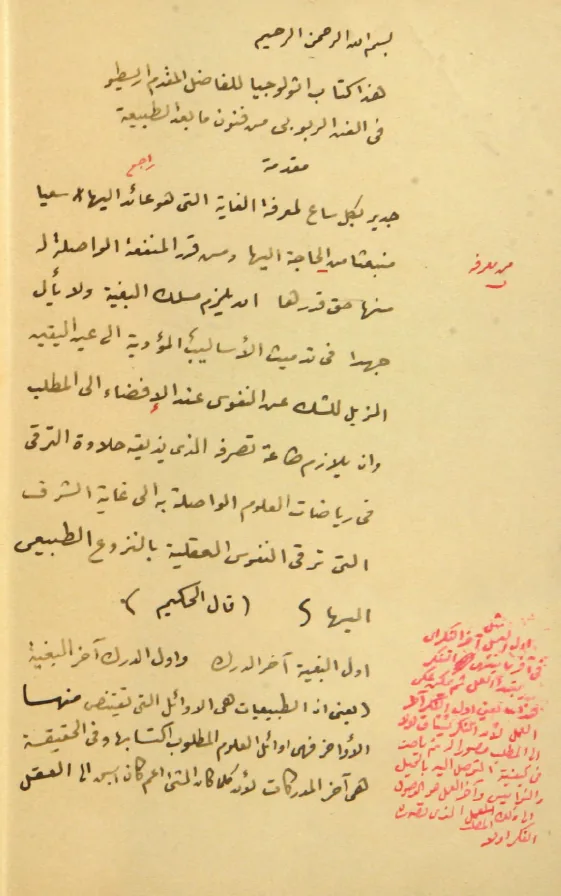
Then came the event that concerns us, the people of Arabic, more than everything that went before it. In Baghdad, in the great house of translation, treatises from Plotinus' Enneads were put into Arabic in al-Kindī's circle, from the fourth, the fifth and the sixth, on soul, intellect and the One, presented with adaptation and commentary. Then a title took hold on the manuscript that overturned an entire history: أثولوجيا أرسطاطاليس, the Theology of Aristotle. So the philosophers of Islam read the ripest of Plotinus' mystical texts believing them to be the crowning wisdom of the First Teacher, the master of logic and demonstration. In their minds there came together what never came together in history: Aristotle the demonstrator and Plotinus the emanationist, one man. On that fusion whole edifices were raised — al-Fārābī's emanation, Ibn Sīnā's ten intellects, and the saying of theirs that would harden into a rule: from the one, only one proceeds. The confusion was not entirely cleared away until much later, when scholars established the book's attribution to its true author.
We know of no mistaken title in the history of books that reached further than this one: an error of attribution on the face of a manuscript redirected the philosophy of a whole nation for centuries. It is a glaring witness to what these series have established more than once, that attribution and chain of transmission must be examined before anything is built on the text. Some of the cleverest people in the world built on a text that was sound in itself, but they took it from someone other than the man who said it. Their picture of the real author's system and their picture of the system they ascribed it to were thrown out at a stroke.
The credit and the debit
In the history of our question Plotinus has three services to his credit. He carried the denial of likeness to its furthest point, and so settled that the first principle cannot be a body, or a composite, or a limited thing. He unified the disputed Greek inheritance in a single tightly built structure. And he returned the question of our destiny to philosophy, after it had almost been left in the hands of the schools of therapy alone. Three things stand against him. His emanation is a necessity with no choice in it: the world follows from the One as rays follow from the sun, with no favour in it and no intent, and no meaning left for praise or thanks. The summit of his doctrine is a claim of taste that cannot be brought to trial, since whoever has not tasted it is told that he is not one of its people. And his stripping away of attributes turned into its own opposite — which is the one we now carry to the scale.
Weighed against revelation
The greatest thing in Plotinus is his longing to hold the first above every defect, every limit and every likeness. That is the meaning revelation brought and settled firmly: “There is nothing like Him” [al-Shūrā: 11], “and none is comparable to Him” [al-Ikhlāṣ: 4]. But see where his road ended. He held the One so far above everything that he stripped it of knowledge, will, life and action. The highest thing in existence, on his account, does not know that existence exists, does not hear whoever calls on it, and wills nothing at all. He purified until he nullified. Fleeing from likening God to creatures, he fell into denying the perfections, as though knowledge and power were defects from which the perfect must be kept clear. Revelation joined in half a verse what philosophy had torn apart: “There is nothing like Him, and He is the Hearing, the Seeing”. Transcendence without emptying, affirmation without likening. It is on this fine scale that the feet of the philosophers and the mutakallimūn would slip for centuries, and nobody held it steady but those who held fast to the text.
Emanation we measure by what we measured Aristotle's mover with. A sun that is not asked about its light and cannot withhold it: how far is that from “Doer of whatever He wills”? Emanation makes the world follow of necessity, and with that, favour, wisdom and trial all fall away together. Creation by will is the gift of one who is able, who might have willed not to create at all, and that is why it earns praise: “Praise be to God, who created the heavens and the earth” [al-Anʿām: 1]. And that is why nobody has ever worshipped the One of Plotinus, and no supplicant has ever raised his hands to it. How do you call on something that its own author holds does not hear?
What remains is the longing of the soul that the man gave voice to: the flight of the alone to the Alone. It is a clear echo of the yearning of the fiṭra for its Maker, the truest thing in his doctrine and the nearest to the hadith on which we founded this series: “I created My servants as ḥunafāʾ”. Still, we weigh it by the usual test of resemblance. The road of Plotinus is a passing away in which the twoness drops out, until no servant and no Lord remain distinct from each other. The road of revelation is a nearness in which servanthood is realised more fully: the servant is nearest to his Lord while he is prostrate — and prostration is the very distinction between one who prostrates and the one to whom he prostrates. So we do not make Plotinus a monotheist mystic who came before revelation, and we do not pour the worship of Islam into his moulds. We shall return to these limits in detail when we come to speak of the unity of being in its own essay.
On to the next essay
So Greek philosophy came to rest at its last station: a One above being, from which the world flows by emanation. Then one order passed away and another rose, and a revelation came down in clear Arabic speech saying: a Creator who knows and wills, who created by His power, and who knows the secret and what is more hidden still. In Baghdad the two rivers met. The texts of the Greeks crossed the bridge of translation, and among them that book disguised under a name not its author's, while the Qurʾān was being recited in the mosques. Then some of the sharpest minds any civilisation has produced set about the impossible. There was al-Kindī, the philosopher of the Arabs; then a young man from Fārāb who would be called the Second Teacher; then a chief master from Bukhara who memorised the Qurʾān at ten and confounded the physicians before he was twenty. They tried to reconcile the god of Aristotle and Plotinus with God Almighty, and with the religion Muhammad ﷺ was sent with, and the prophets before him. They tried to read being in a way that would satisfy both the demonstration and the qibla. In doing so they opened up in the question of being what nobody had opened before them: the distinction between a thing's essence and its existence, and between a contingent that does not tip either way of itself and a necessary by which everything else stands. Then a man came to them from Ṭūs who mastered their doctrine until he had it perfectly, and then pulled it down in twenty questions. He called his book The Incoherence of the Philosophers. On to the seventh essay: the necessary and the contingent.
The “Mankind Was One Community” series — Essay Six
The “Mankind Was One Community” series — on the philosophy of being
This is a translation of an essay written in Arabic. Quotations from the Qurʾān are rendered for sense; the Arabic page carries them in the original.
NEUTRAL FACT CHECKER
An independent checker went through the factual claims in these six essays — the dates, the reports, the attributions, and the quotations credited to Herodotus, Diogenes Laertius, Porphyry and others — without touching the argument. The result is published as it came out, and the essay was not edited to agree with it. The fact-check is in Arabic only. The result is published as it came out, and the essay was not edited to agree with it. The fact-check is written in Arabic: read the neutral fact-check →
© 2026 Husain Alkhaldy — published in the site's essays.