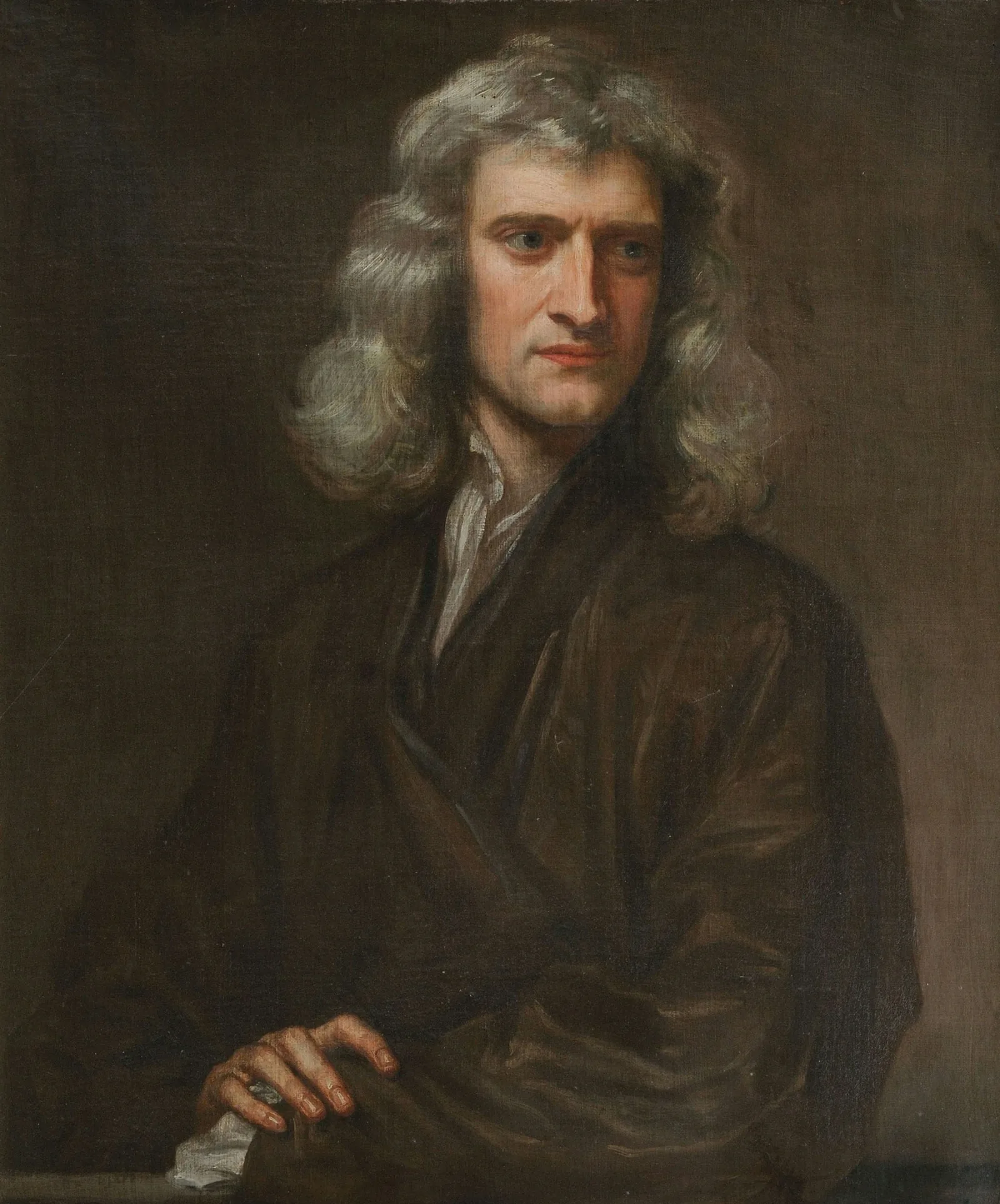
In the winter of 1690, a man of forty-eight sat in his rooms at Trinity College, Cambridge, writing a long letter to his friend the philosopher John Locke. The letter was not about gravitation, nor the decomposition of light, nor the calculus — the fields he had turned upside down three years earlier in his Mathematical Principles of Natural Philosophy. It was about one sentence and one letter: a sentence he said had been slipped into the text of the Bible, and a letter he said had been altered in it.
The man was Isaac Newton. Eighteen months after writing that letter, he wrote to Locke in haste: stop the printing. Do not publish it. Ask the publisher for the manuscript and get it back.
It was not published in his lifetime. It did not appear until twenty-seven years after his death.
The man who kept his secret
To understand the fear, one has to understand the man's position. Newton held the Lucasian chair of mathematics at Cambridge, and the university statutes of the day required the holders of such chairs to be ordained priests in the Church of England. In 1675 Newton obtained a special royal dispensation exempting him from that requirement. No reason was announced; but his private papers — which were not seriously studied until the twentieth century, after John Maynard Keynes bought a portion of them at a Sotheby's auction in 1936 — reveal what it was: Newton rejected the doctrine of the Trinity.
This was not an opinion one voiced. In the England of that time it was a crime. The Blasphemy Act of 1697 — seven years after Newton's letter — made denying the Trinity grounds for the loss of office and public employment, and for imprisonment on a second conviction. And when William Whiston, Newton's pupil and his successor in the Lucasian chair, declared a similar view openly, he was expelled from the university in 1710.
So the man who wrote this letter knew exactly what he was risking.
The two suspect passages
The letter turned on two passages, which are to this day the two most famous in the history of New Testament criticism:
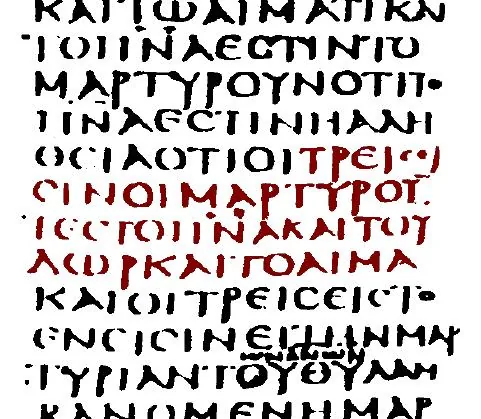
The first: the First Letter of John, chapter five, verse seven. In the King James Version and in the Latin Vulgate it says that there are three that bear witness in heaven — the Father, the Word and the Holy Spirit — and that these three are one. In critical scholarship the passage is known as the Johannine Comma. It is the most explicit Trinitarian text in the whole New Testament; indeed it is the only one that names the three persons and says in so many words that they are one.
The second: Paul's First Letter to Timothy, chapter three, verse sixteen: “Great is the mystery of godliness: God was manifest in the flesh.” It is among the clearest texts ever adduced for the divinity of Christ.
Newton's thesis in the letter is that the first passage was inserted, and that in the second a single letter was changed.
The method: how Newton investigated
What is striking in the letter is not its conclusion but its procedure. Newton did not argue theologically, and did not set verse against verse. He treated the text as he would a natural phenomenon: he gathered the evidence, sorted it, and asked about the chronology.
He relied on three classes of witness, as he himself named them: the ancient translators who carried the text into their own languages, the writers of the early centuries who quoted it, and the copyists who transcribed the manuscripts in every age. All three classes, he says, testify against the Johannine Comma.
As for the translators: the passage is absent from the Syriac, from the Ethiopic, from the Egyptian Arabic printed in Brian Walton's Polyglot Bible, from the Armenian, and from the Slavonic — translations the churches of the East have used for centuries. Newton summed this up by saying that all the eastern nations are strangers to this reading.
As for the writers of the early centuries, here lies the strongest thing in the letter. In the fourth century the church was convulsed by the fiercest dispute in its whole history over the nature of Christ and his relation to the Father: the Arian controversy. Every verse that could conceivably be adduced was ransacked, and volumes were written. Newton then lists them one by one — Athanasius, Basil, Gregory of Nazianzus, Gregory of Nyssa, Epiphanius, John Chrysostom, Cyril, Hilary, Ambrose, Augustine, the Council of Sardica — and not one of them cites the Johannine Comma. Not once.
A text that is today on every tongue, and is reckoned the fundamental text in the question — it could not have escaped them had it stood in their books.
Then he adds the observation that turns the argument into a proof: the absence of the text from their books was not a thing that could have passed unnoticed. For if the text had been there and the Arians deleted it — as some of its later defenders claimed — then those Arians must have conspired across the whole world in a single moment, and succeeded in collecting and correcting every copy in people's hands without anyone noticing, and without leaving a gap or a trace in the manuscripts; indeed they must have erased the memory from every head, so that not Athanasius himself nor anyone else could remember ever having seen it in his own book. The sarcasm is very sharp, but at bottom it is a sound methodological argument: a claim that needs a flawlessly executed conspiracy to account for its own absence is a claim without evidence.
How did the sentence get in?
Newton was not content with establishing the absence; he traced the route of entry step by step, and this is the original part of his work.
He says it began as an interpretation, not as a text. Some of the Latins used to read “the spirit and the water and the blood” in verse eight allegorically, as the Father, the Son and the Holy Spirit. Newton cites Eucherius, bishop of Lyon, to the effect that many in his day understood it so, and Augustine himself, who took it that way in his work against Maximinus. Then the interpretation became a gloss in the margin. Then the gloss passed into the body of the text as the copies were made.
And the first who is recorded as citing the passage outright , by Newton's tracing, is Eugenius, bishop of Carthage, in the confession of faith he presented to Huneric, king of the Vandals, in 484: more than four centuries after the letter itself was written. It spread after him in Africa, then crossed into Europe. And it did not become authoritative in the Latin manuscripts until the twelfth and thirteenth centuries, with the rise of the schoolmen.
Newton also offers a material proof that the sentence entered from the margin: the manuscripts disagree about where to put it. In most of them the witness of the three in heaven stands before the witness of the three on earth; in some of them, after it. And this , as he says, happens only when a copyist finds the sentence written in the margin and cannot tell whether it belongs first or last.
The press, Erasmus, and the manuscript nobody saw
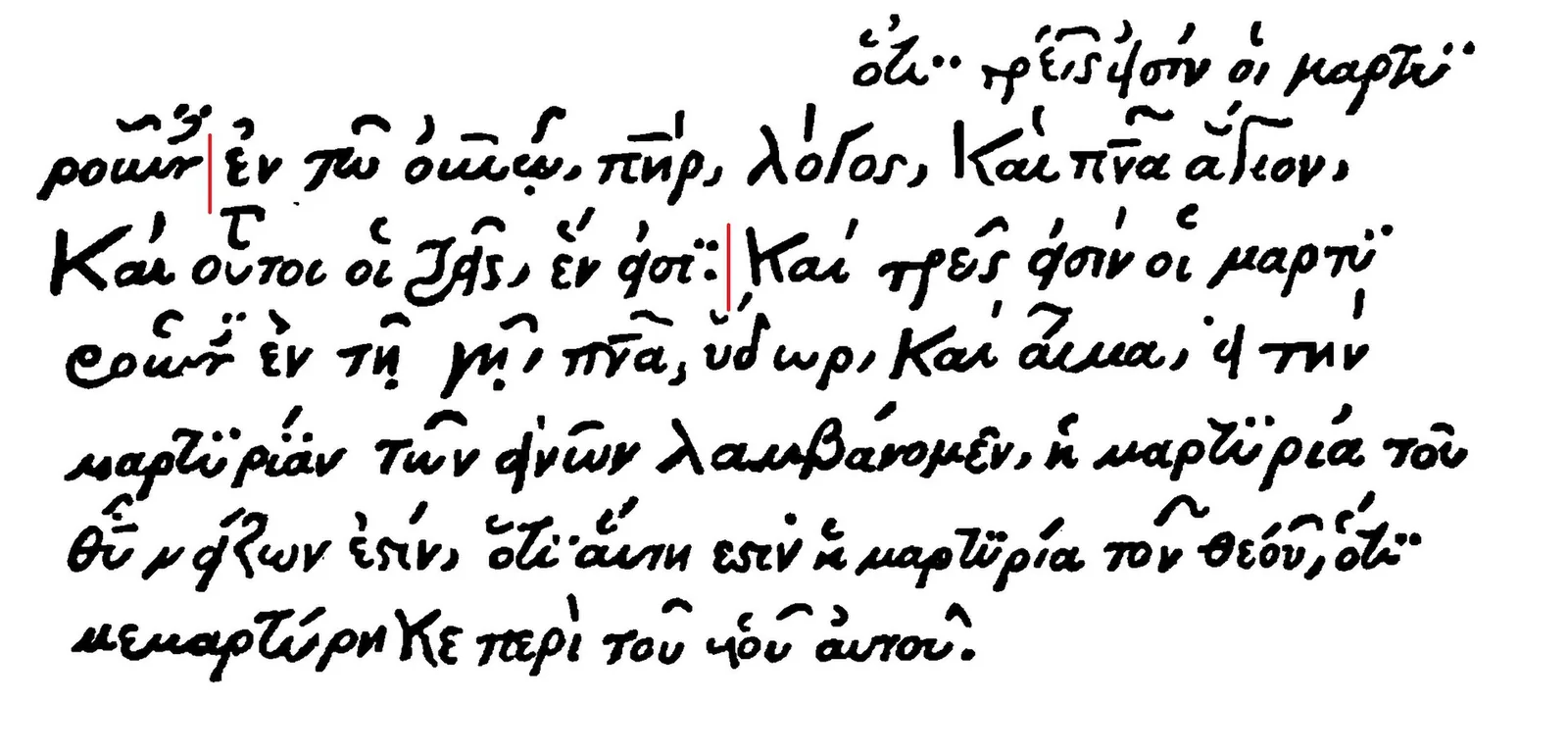
There remains the last link, and the drollest part of the story is that when the Greek New Testament was first printed, the sentence was not in it. It was not in Erasmus's first edition of 1516, nor in the second of 1519, nor in the Aldine edition at Venice in 1518, nor in the editions of Hagenau, Strasbourg and Paris. Newton counts them one by one.
Erasmus was then attacked by his opponents: the Englishman Edward Lee and the Spaniard Stunica. He answered , as Newton reports it, that he had examined more than seven Greek manuscripts and had found the passage in none of them, and that had he found it in a single manuscript he would have printed it. Then word came to him from England that there was a manuscript containing the text. So he put it into his third edition of 1522 — and from there it passed into the Textus Receptus, and from that into the King James Version, and from that into most modern translations until quite recently.
Then Newton asks his question: and where is that manuscript? Let whoever has such a manuscript tell us where it is.
He says that he searched, and found that nobody in England had heard of it except from Erasmus himself; that Erasmus never laid eyes on it; that he went on doubting its soundness in his writings for years; and that his opponents neither answered him nor pointed him to where it was — rather they “threw it away, if they ever had it, like an almanack out of date.” Newton's own view is that it was nothing but a trick contrived to draw him into printing the passage.
The manuscript is known today: it is the Montfortianus (number 61 in the modern classification), and it has been established that it was written at the beginning of the sixteenth century — that is, contemporary with the quarrel rather than a witness to it.
The single letter
The second passage rests on an argument of another kind: an argument in palaeography rather than in history.
Ancient Greek manuscripts were written in continuous capitals, and in them the sacred names were abbreviated by convention: the word for “God” (ΘΕΟΣ) was written with its first and last letters and a stroke above them, ΘΣ. And the original word in the text , according to Newton, is ΟΣ, “who”. Between the two readings there is nothing but a small stroke inside the first letter and a stroke above it.
So the original sense becomes “Great is the mystery of godliness: he who was manifest in the flesh” instead of “God was manifest in the flesh.”
His evidence is the same as before: the ancient translations — Latin, Syriac and Ethiopic — all read “who”. And the writers of the first five centuries, who wrote volumes on the divinity of the Son, never cite this text; he lists their names again. Then he brings forward a deft witness: in the Nestorian controversy of the fifth century, Nestorius argued from the passage that the one manifest in the flesh was a creature — which he could not have done had the word “God” stood in his text. More remarkable still, his opponents, Cyril of Alexandria and John Cassian foremost among them, did not accuse him of corrupting the text, but disputed only his interpretation of it. This , as Newton concludes, means that both sides were reading “who”.
Newton also relays a report he takes from Liberatus, deacon of Carthage, in the sixth century: that Macedonius, patriarch of Constantinople, was exiled at the beginning of that century on a charge of corrupting the Gospels, and specifically of altering this letter.

What remains once both passages fall?
Here the question towards which this whole essay has been moving becomes a definite one that can be answered: if these two passages fall, does there remain in the New Testament an explicit text establishing the doctrine of the Trinity?
Before answering, the question must be fixed precisely. The matter here is not the trial of a doctrine, nor a verdict on its truth, but a purely textual question: is there in the book a place that gathers the three persons and states their unity in substance explicitly? That is a question answered by examination, not by argument.
The first thing to note is that the word “Trinity” itself does not occur in the New Testament at all. The oldest known appearance of the Greek word (τριάς) is in Theophilus of Antioch around 180, and of the Latin (trinitas) in Tertullian a little after him — more than a century after the letters were written. As for the term on which the whole formula rests, “of one substance” (ὁμοούσιος), it is not a scriptural word in the least; it was framed at the Council of Nicaea in 325, and was itself sharply contested precisely because it does not occur in the text.
The texts adduced once the two passages fall are “triadic” rather than Trinitarian: they mention the three together without defining the relation between them. Among them are the baptismal formula in Matthew 28:19, the closing benediction in 2 Corinthians 13:14, and the prologue of John. These — by the textual measure alone — establish that the three occur together in one context; they do not establish the Nicene formula. The difference between the two is the difference between a mention and a definition.
And the truest witness to this distinction comes from inside the tradition rather than from outside it. The New Catholic Encyclopedia states that the formula “one God in three persons” was not firmly established, and not fully assimilated into Christian life and its profession of faith, before the end of the fourth century; and that among the Fathers of the first apostolic generation there was nothing even remotely approaching such a conception. That is the people of the house speaking about their own house.
A limit must be set here, at which this essay stops. To establish that a doctrine has no explicit proof-text is not to establish that it has no basis for those who hold it; they do not claim that it is stated in a single verse, but build it on a composite argument from a body of texts, and on what the two fourth-century councils settled. The difference between “no explicit text” and “no basis” is a real one, and whoever confuses the two has built a straw man and knocked it down.
But what has been established stands: that of the two clearest texts which could have been adduced directly — the two Newton examined — neither survives textual criticism; and that the doctrine, whatever one's verdict upon it, is a doctrine inferred and not stated. That alone is what this essay claims, and it goes no further.
Why was he afraid?
Newton sent the letter to Locke, and Locke sent it on to Holland — where the press was freer — to be published without an author's name, at the hands of the scholar Jean Le Clerc. Then Newton drew back. He wrote to Locke early in 1692 asking him to stop the business and recover the manuscript.
The reason is no mystery. The man had just become the most famous scientist in Europe, and a candidate for offices of state — and did in fact become Warden of the Mint in 1696 and then its Master, and President of the Royal Society in 1703. He knew that this letter, though on its face an inquiry into manuscripts, in fact removed the two clearest textual supports of the doctrine of the Trinity. He did not say so outright in the letter; he left the reader to draw the conclusion. But nobody would have mistaken the point.
At its close he wrote something like an apology in advance, asking his friend to put the best construction on his boldness, and saying that the matter was not doctrine nor church government, but a criticism concerning a text.
He does not seem to have convinced himself.
The manuscript that slept for sixty years
Newton died in 1727. The letter was published for the first time in London in 1754, from a copy preserved in the Remonstrants' library in Holland — an incomplete and inaccurate printing. Samuel Horsley then published a more exact text in 1785 among Newton's works. The original manuscript is today held in the library of New College, Oxford, and has been made available in full online through the Newton Project at the University of Oxford.
And what does textual criticism say today?
On the first passage: Newton is right, and the critical consensus today is entirely with him. The Johannine Comma is absent from all Greek manuscripts before roughly the fourteenth century, absent from all the ancient translations, and cited by none of the Greek Fathers. It is omitted from every modern critical edition of the Greek New Testament, and from most modern English translations — or else printed in a footnote with a statement that it is not authentic. The Catholic Church itself acknowledged this in the twentieth century.
On the second passage: Newton is right about the reading as well. The modern critical editions read “who” rather than “God”, on the authority of the oldest manuscripts. Codex Alexandrinus has long been discussed here: editors hold the internal stroke in the letter to be a later addition in later ink, not the work of the first copyist, and so they read the original as “who”.
Why does this story matter to us?
To my mind this is not a story about theology. It is a story about method.
What Newton did here is exactly what he did in physics: he refused to accept a claim on the authority of whoever made it, demanded the evidence, asked about the chronology, distinguished what is established from what is asserted — and then said, in a matter he knew costs men their offices and their liberty, that the strongest thing his opponent had was not a manuscript but “a manuscript somebody said existed”.
In this he continues a thread we have been following through this series: that the gravest thing a researcher faces is not ignorance, but the claim repeated so long that it is no longer questioned. The Johannine Comma stayed in the text of the printed Bible for four centuries because nobody dared to ask the simple question: where is the manuscript?
And the second lesson is the heavier one: that the man knew, and wrote, and did the work well — and then was afraid, and kept silent. What he wrote was not published until he had been twenty-seven years in his grave. And how many discoveries we know nothing of, because the one who made them never carried them through those twenty-seven years.
❊ ❊ ❊
Sources
- • The full original text of the letter: Isaac Newton, “An Historical Account of Two Notable Corruptions of Scripture”, Ms. 361(4), New College Library, Oxford — published in its own words on the site of the Newton Project at the University of Oxford, document THEM00261 and following.
- • Samuel Horsley's edited text, in: Horsley, Isaaci Newtoni Opera quae exstant omnia, London 1785, vol. 5, pp. 493–550.
- • The first edition: Two Letters of Sir Isaac Newton to Mr Le Clerc, London 1754.
- • For the historical background to Newton's private creed: Rob Iliffe, Priest of Nature: The Religious Worlds of Isaac Newton, Oxford University Press, 2017.
- • For the present critical standing of the two passages: Bruce M. Metzger, A Textual Commentary on the Greek New Testament, 2nd ed., 1994 — the entries on 1 John 5:7-8 and 1 Timothy 3:16.
- • For the tradition's own acknowledgement that the formula was late: New Catholic Encyclopedia, 1967, vol. 14, p. 299 — the article “Trinity”.
- • For the history of the Johannine Comma in early modern Europe: Grantley McDonald, Biblical Criticism in Early Modern Europe: Erasmus, the Johannine Comma and Trinitarian Debate, Cambridge University Press, 2016.
On the links above: the text of the letter at the Newton Project, and the 1754 and 1785 editions at the Internet Archive, are complete open texts. Iliffe, Metzger and the New Catholic Encyclopedia are lending copies from the Archive's libraries and need a free account. McDonald's book has no free copy; the link goes to the publisher's page.
NEUTRAL FACT CHECKER
The factual claims in this essay were checked against their sources — first among them the text of Newton's own letter in the New College, Oxford manuscript as published by the Newton Project, together with the critical editions, Metzger's commentary, the New Catholic Encyclopedia and the colophon of the collated Greek New Testament — along with a citation scan. The result is published as it came out, and the essay has not been edited to agree with it. The fact-check is in Arabic: read the neutral fact-check →
© 2026 Husain Alkhaldy — published in the site's essays. Translated from the Arabic.