On a Wall at Deir el-Bahari
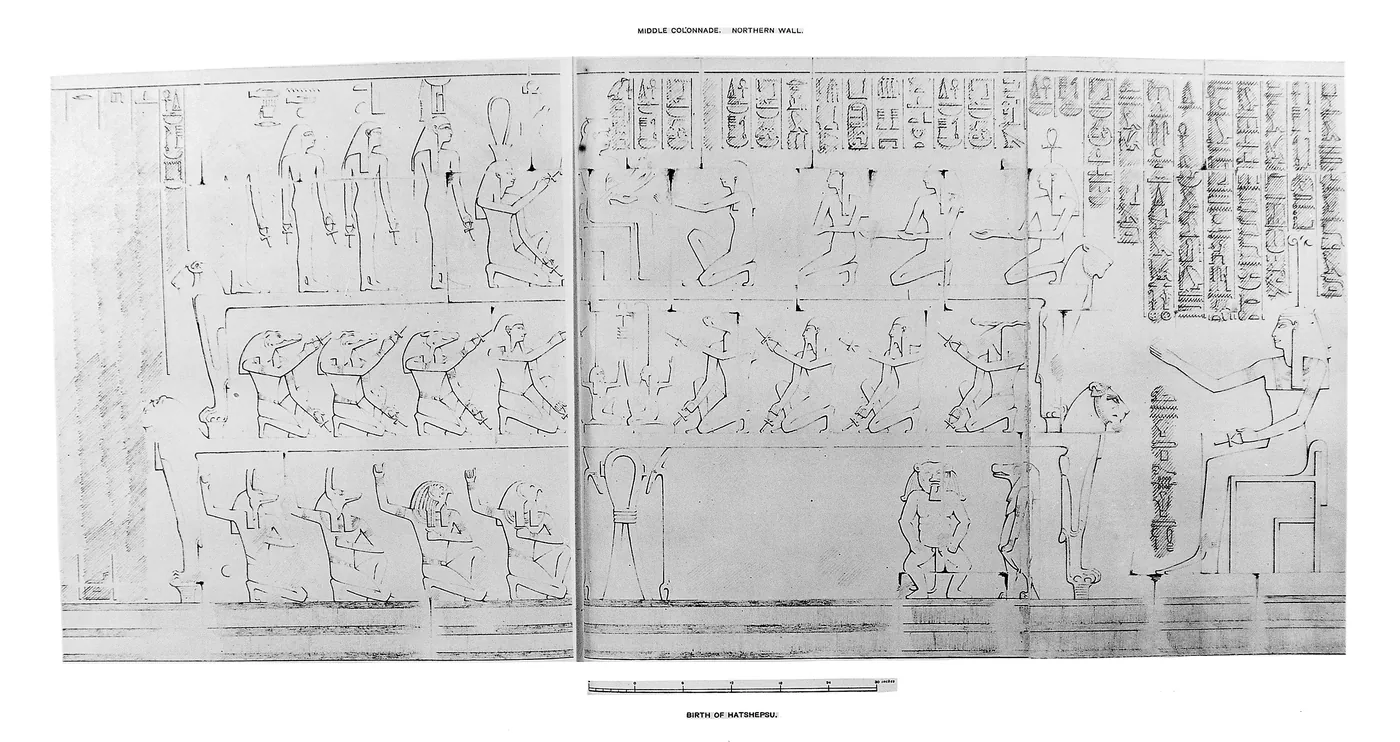
On the west bank of the Nile, across from Luxor, the temple of Hatshepsut has stood in the lap of the mountain for thirty-five centuries. Along one of its walls runs a series of reliefs that Egyptologists call the "divine birth cycle": the god Amun-Re takes on the form of the king, goes in to the queen, and she conceives the pharaoh who is to come. This was not art, and it was not a poetic figure; it was a constitutional document. In Egyptian belief the pharaoh is "son of Ra" in the literal sense, and the Egyptian word for son is the same as the word for heir, so his sonship to the god is the warrant of his right to rule.
When we read the words of God in Sūrat al-Tawba — "The Jews said, ʿUzayr is the son of God; and the Christians said, the Messiah is the son of God. That is their saying with their mouths; they imitate the saying of those who disbelieved before them" — the phrase "before them" opens a wide door. Who were these people who disbelieved before? And how long have human beings been saying that God has a son? The answer that modern discoveries have brought to light is far wider than most of the ancients ever imagined — and older than the wall at Deir el-Bahari itself.
A Tour of the Map of the Ancient World
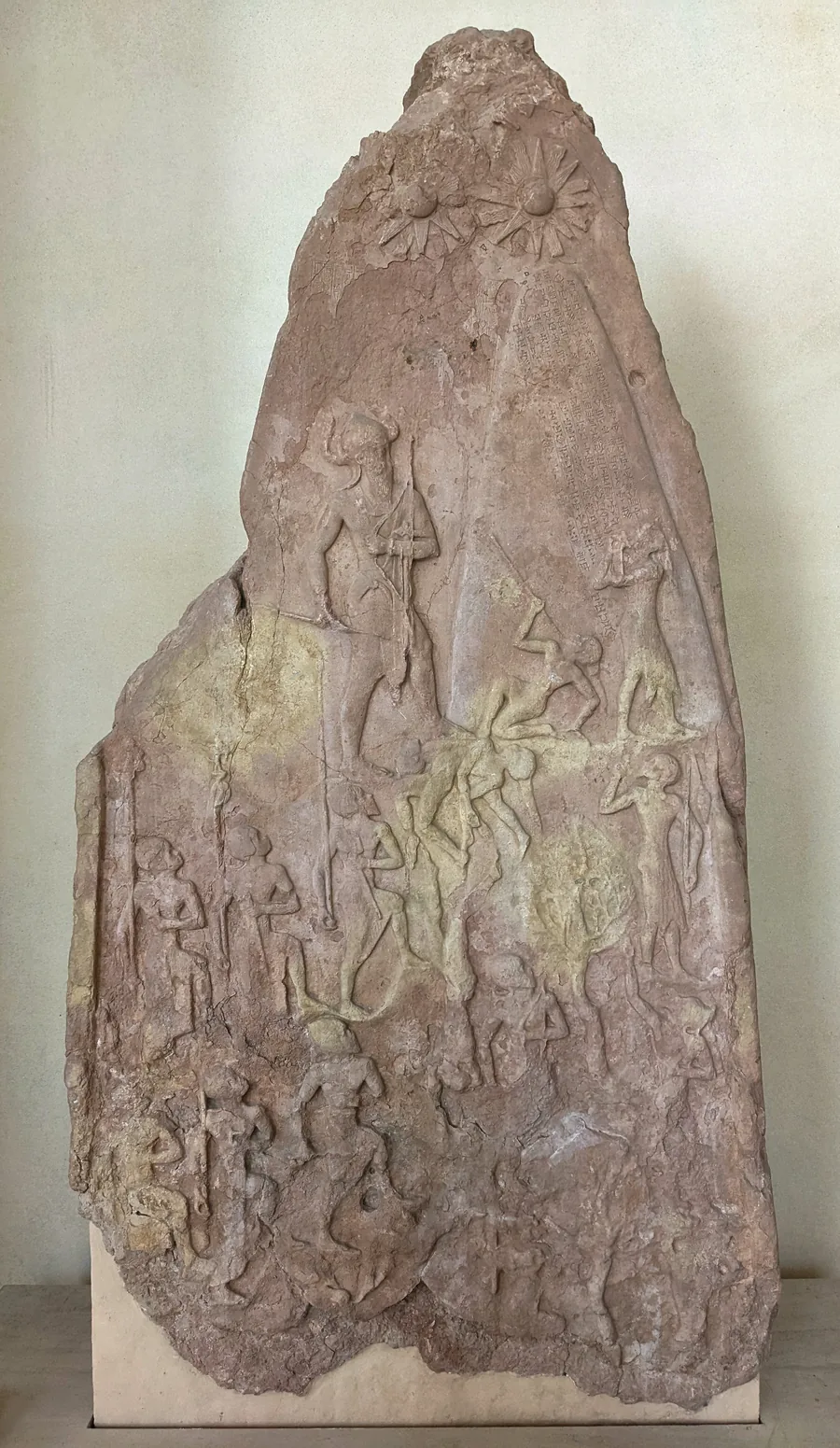
Let us begin with Mesopotamia, the oldest land to keep written records. Around 2250 BC the Akkadian king Naram-Sin declared himself a god and took the title "god of Akkad." On his famous stele — held today in the Louvre — he is depicted wearing the horned crown that none but the gods wear. The genealogies of the gods themselves made up a complete family tree: Marduk son of Ea, Inanna daughter of heaven. And in the texts of Ugarit on the Syrian coast, around 1400 BC, we read of the "sons of El," the sons of the chief of the gods. In the Kirta epic the king is portrayed as a favoured son of the god.
In India the idea took a third form: the avatar, the god Vishnu coming down incarnate in human form — as Rama, and then as Krishna — born of an earthly mother and living among people. In Greece, Zeus fathered a whole generation of demigods on goddesses and on mortals, until Alexander of Macedon himself claimed sonship to Zeus-Ammon when he visited the Siwa oasis. Rome, for its part, struck the idea onto its money. After the Senate deified Julius Caesar in 42 BC, his adopted son Octavian, later Augustus, bore the title Divi Filius, "son of the deified one." He put it into circulation on the coinage of the empire as political propaganda.
Nor did the idea stop at the edges of the ancient world as we know it. In China the emperor bore the title "Son of Heaven." In Japan the imperial house traced its descent directly to the sun goddess Amaterasu, a doctrine that remained official until AD 1946 — until after the Second World War, that is. In the Andes, on the opposite side of the planet and with no contact whatever with the ancient world, the Inca emperor was "son of the Sun." And in Arabia, shortly before Islam, Quraysh claimed that the angels were the daughters of God — a claim the Qurʾān rejected in Sūrat al-Najm and Sūrat al-Ṣāffāt.
Put the whole of this map together and we find ourselves looking at a human phenomenon that crosses continents: wherever there has been power or sanctity, there has been someone to ascribe a child to heaven.
Three Patterns, Not One
A closer look, however, shows that "divine sonship" is not one idea but three distinct ideas wearing a single word.
The first pattern is a functional royal sonship: "son of the god" is a title for the ruler, and it means delegated authority and inheritance, not a share in the divine nature. This is the pattern of Egypt, Babylon, China and Rome. We even find its echo in the Old Testament. Israel is "my firstborn son" in the book of Exodus, and the Davidic king in the second Psalm is told "You are my son; today I have begotten you." Their authors understood these expressions in the sense of covenant and election, even if the wording was open to sliding later into something further than that.
The second pattern is a mythic procreative sonship: the god actually begets, by a goddess or by a woman. This is the pattern of Greece and of the genealogies of the gods of Babylon.
The third pattern is an incarnational sonship: the god himself comes down and takes flesh. This is the pattern of the Indian avatar, and it is the pattern on which Christian doctrine settled after the Council of Nicaea in AD 325, when it was determined that the Son is "begotten, not made, consubstantial with the Father."
This threefold distinction is not a classifier's luxury; it is what gives the word "they imitate" in the verse its depth. Muḍāhāt, imitation, is — as Ibn ʿAbbās said — resemblance. The verse does not say that these people copied one particular creed; it says that they ran along the same pattern that the nations before them had run along, whatever form it took.
What Did the Mufassirūn Say?
Here a curious and telling observation meets us. If we open the major works of tafsīr at this verse, we find the commentators passing down three sayings about "those who disbelieved before them." Qatāda and al-Suddī said: the Christians imitated the saying of the Jews who came before them. Mujāhid said: no, they imitated the Arab polytheists, who said that the angels were the daughters of God. Al-Ḥasan al-Baṣrī answered in general terms: their disbelief, he said, was likened to the disbelief of the unbelieving nations of the past — without naming any nation at all.
And in al-Ṭabarī, in al-Rāzī, in al-Qurṭubī and in Ibn Kathīr we find no mention of Pharaoh as "son of Ra," none of the sons of Zeus, none of the deified kings of Babylon. That is no failing on their part. Hieroglyphic was not deciphered until 1822, cuneiform followed decades later, and the comparative study of religion was not born at all until the nineteenth century. Al-Ḥasan al-Baṣrī — with his undifferentiated generalization — came closest of them to the reach of the verse, because he left "the nations" unqualified, just as the text had left them.
This, weighed on the scales of historical criticism, is a point in the text's favour and not against it: the verse's unqualified "before them" took in what its earliest readers had no way of knowing, and the discoveries arrived twelve centuries later to fill the space that the unqualified phrase had left open.
Before we go further, this series' method of separating what is established from what is only supposed calls for a pause. The first half of the verse — "The Jews said, ʿUzayr is the son of God" — has raised an old question. In the known Jewish sources we find no text that makes Ezra the Scribe a son of God. (ʿUzayr is Ezra, on the reading most widely held among the commentators.) The commentators answered long ago that the speakers were one faction among the Jews of Medina and not the Jews as a whole. The context of the verse itself, "that is their saying with their mouths," points to a statement made by particular people. Modern research has added further possibilities, supported by circumstantial evidence. Jewish tradition itself venerated Ezra to an extreme degree. In the Babylonian Talmud, Ezra "was worthy that the Torah be given through his hand, had Moses not preceded him," and in the apocryphal 4 Ezra he recovers all the lost books by divine inspiration. Some scholars, among them Gordon Newby in his history of the Jews of Arabia, have held that the Jews of the Ḥijāz knew mystical traditions that elevate Ezra and set him on a level with Enoch, "the scribe of God." They may have called him one of the bnei elohim. The question, then, is not an objection without an answer. But neither is it settled by any decisive document, and saying so plainly does scholarship more honour than claiming a certainty the sources do not support.
The Trap of Resemblance: A Lesson in Method
At the beginning of the twentieth century a wave swept through Western scholarly circles: the parallelism school. James Frazer, in The Golden Bough, gathered Osiris, Tammuz, Adonis and Attis under a single pattern that he called "the dying and rising god," and hinted that Christ might be entered into it. The German Religionsgeschichtliche Schule then adopted the reading of Christianity in its entirety as a borrowing from the pagan mystery religions. The echo of this wave reached the Arabic library early. In 1912 Muḥammad Ṭāhir al-Tunayr of Beirut wrote al-ʿAqāʾid al-wathaniyya fī al-diyāna al-naṣrāniyya (Pagan Beliefs in the Christian Religion). The Egyptologist Arthur Weigall's The Paganism in Our Christianity was translated into Arabic. And ʿAbbās Maḥmūd al-ʿAqqād wrote his most comprehensive book of all, Allāh: Kitāb fī nashʾat al-ʿaqīda al-ilāhiyya (God: a book on the genesis of belief in the divine).
Then the correction came from inside the academy itself. In December 1961 the Jewish scholar Samuel Sandmel delivered his famous address to the Society of Biblical Literature under the title Parallelomania. He defined it as the extravagance of scholars in magnifying the resemblance between texts and then leaping from that resemblance to a claim of borrowing, as though every likeness were a theft. Sandmel did not deny that cultures influence one another; what he denied was the method that makes resemblance by itself the proof of influence. After him, Jonathan Z. Smith took apart Frazer's pattern itself. Attis dies and does not rise. Osiris is "raised," but as a king over the dead and not as one returning to the living. And the resurrection of Adonis is a modern construction, assembled by scholars out of fragments.
The rule that scholarship has settled on is a simple one — to my mind the most useful thing in the whole story — and it serves the physician as well as it serves the historian: resemblance alone does not establish borrowing, just as association alone does not establish causation. There must be a chain of contact in time and in place; there must be a correspondence in structure and not merely in the label; and independent origination must be ruled out. The Inca emperor, "son of the Sun," borrowed nothing whatever from Pharaoh, for there is no bridge between them at all. It is simply one and the same human nature, reproducing the same deviation whenever the corrective of revelation is absent. And this — if you think it through — is precisely what the verse says: yuḍāhiʾūn, that is, they resemble, they run along the same pattern. It does not say "they borrow" or "they transmit." The Qurʾān's expression is more exact, as a matter of method, than the expressions of the parallelism school, which were written thirteen centuries after it.
Conclusion: The Answer in Four Words
We have surveyed civilizations from the Nile to the Andes, and three patterns of sonship: the sonship of commissioned kings, the sonship of mythic procreation, and the sonship of incarnation and indwelling. And when, after this tour, we return to Sūrat al-Ikhlāṣ, we find that its answer encompassed all three patterns in four words: "He did not beget, nor was He begotten." He did not beget: so there is no son by commission and no son by procreation. Nor was He begotten: so there is no god who becomes incarnate and is born of a mother. Then the closing clause comes and shuts the door of imitation entirely: "and there is none comparable to Him."
The most remarkable thing in this story is this. A text revealed in the seventh century AD, in an environment that knew neither hieroglyphic nor cuneiform nor Sanskrit, described a phenomenon whose map was not completed in the hands of researchers until the last two centuries. And it described it with the very term at which the modern critical method arrived: imitation, not borrowing.
Praise be to God, praise good, abundant and blessed; praise be to God for the blessing of pure monotheism: "Unto God belongs religion made pure" (al-Zumar: 3).
Principal sources: the tafsīrs of al-Ṭabarī, al-Baghawī, al-Rāzī, al-Qurṭubī and Ibn Kathīr on verse 30 of Sūrat al-Tawba; Samuel Sandmel, "Parallelomania", Journal of Biblical Literature 81 (1962); Adela Yarbro Collins & John J. Collins, King and Messiah as Son of God (2008); Michael Peppard, The Son of God in the Roman World (2011); Gordon D. Newby, A History of the Jews of Arabia (1988); Jonathan Z. Smith, "Dying and Rising Gods", Encyclopedia of Religion (1987); Muḥammad Ṭāhir al-Tunayr, al-ʿAqāʾid al-wathaniyya fī al-diyāna al-naṣrāniyya (pagan doctrines in the Christian religion, 1912); ʿAbbās Maḥmūd al-ʿAqqād, Allāh: Kitāb fī nashʾat al-ʿaqīda al-ilāhiyya (a book on the origin of belief in God).
On the links above: the five tafsīrs are on al-Maktaba al-Shāmila — full text with the pagination of the printed edition. Sandmel's article is given in its full text, posted by permission of the Society of Biblical Literature — while the original on JSTOR is closed behind a subscription. Newby's book is a lending scan from the Internet Archive's libraries and needs a free account. Jonathan Smith's entry is given in its full text from the Encyclopedia of Religion under licence. The scan of al-Tunayr's book is of a later edited printing and not of the 1912 printing, and its text is in the public domain. Al-ʿAqqād's book is a complete free text from the Hindawi Foundation. As for the books of Collins and Peppard, there is no free copy of either — they are in print only, and the uploaded copies of them have not been linked because they infringe copyright.
This is a translation of an essay written in Arabic. Quotations from the Qurʾān are rendered for sense; the Arabic page carries them in the original.
NEUTRAL FACT CHECKER
The factual claims in this essay were checked against their sources — the Deir el-Bahari reliefs and the victory stele of Naram-Sin, the opinions of the commentators on this verse as they stand in al-Ṭabarī, al-Baghawī, al-Rāzī, al-Qurṭubī and Ibn Kathīr, Samuel Sandmel's address to the Society of Biblical Literature and Jonathan Z. Smith's dismantling of Frazer's pattern, and the dates of the decipherment of hieroglyphic and of the Council of Nicaea — along with a citation scan. The result is published as it came out, and the essay was not edited to agree with it. The fact-check is written in Arabic: read the neutral fact-check →
© 2026 Husain Alkhaldy — published in the site's essays.