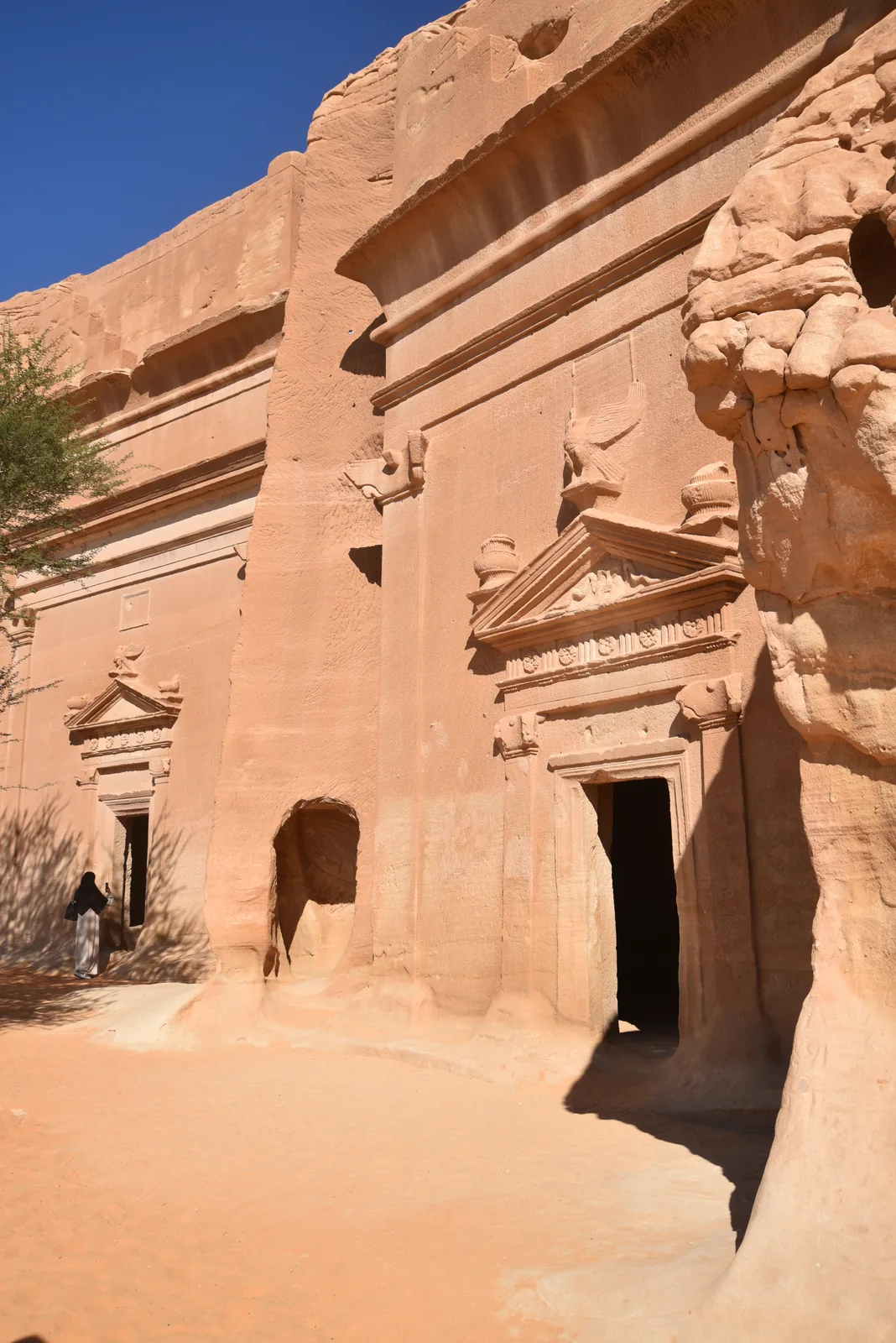
The army reached al-Hijr in the seventh month of the ninth year after the Hijra, worn out by the long summer march toward Tabuk. What the men saw there was nothing they knew. Houses had been cut into the face of the rock. The facades carried columns, capitals and carved birds. The lettering was still sharp after centuries. Some of them went to the wells, drew water, and used it to make dough. When the Prophet heard, he told them to pour out what they had drawn, to feed the dough to the camels, and to draw only from the one well the she-camel used to drink from. Then he said: 'None of you is to enter the town. Do not drink their water. Do not go in among these punished people unless you are weeping, or the same thing may strike you that struck them.'
Look closely at what is being forbidden. Nobody was told not to look. They had camped at the site and walked between its facades. Nobody was told to shut his eyes or turn his face away. Something else entirely was forbidden: going in the way a tourist goes in on an outing. Seeing was not the point. Seeing was going to happen anyway. The point was what the seeing does to the person doing it. A man who stood in front of those facades and felt nothing had looked at them and seen nothing at all.
That same distinction — between seeing something and being changed by it — governs one word in the Qur'an. The word occurs forty-nine times. It never once occurs as a noun.
The Count: Forty-Nine Times, Every One a Verb
The root '-q-l appears in forty-nine places in the Qur'an. I counted them one by one through the text. They come in five forms and no more:
Ya'qilun, 'they reason', in twenty-two places (twenty-four in variant readings). Ta'qilun, 'you reason', in twenty-four. Na'qil, 'we reason', once, in what the people of the Fire say about themselves: 'Had we listened, or reasoned, we would not be among the companions of the Blaze' (67:10). Ya'qiluha, 'grasps them', once: 'These parables We set forth for people, but none grasps them except those who know' (29:43). And 'aqaluhu, 'they had understood it', once, describing a group among the Children of Israel: 'They used to hear the word of God and then distort it after they had understood it, knowingly' (2:75).
Twenty-two, twenty-four and three. Forty-nine. All five forms are verbs. There is no verbal noun, no active participle, no adjective. As for the noun al-'aql — the word on which theologians and philosophers built whole shelves, and around which almost everything we say about human beings now turns — it does not appear in the Qur'an at all. Not once, in any form, with or without the article, on its own or in a construct. I searched for every prefixed variant of it. The result was zero.
That fact is the argument of this essay. If the word were meant to point at a piece of equipment inside a person, or at a faculty someone can be said to have, it would have come as a noun. Nouns are what hold substances and instruments. Instead it came as a verb in all forty-nine of its places. And a verb in Arabic carries time and event: something that happens or fails to happen, that is taken up or dropped, exercised or shut down. So reason, in the Qur'anic picture, is not an organ you own. It is something you do. That is why blame in the Qur'an always falls on the failure to do it — 'will you not reason?' — and never on a defect in the equipment. The Qur'an never tells anyone that he has no mind. It tells him that he is not using it.
The difference between those two sentences is the difference between a verdict and an invitation.
In classical philosophy — from Aristotle through Muslim commentators like al-Farabi and Avicenna, down to modern Western epistemology — reason has almost always been framed as a substance or a distinct faculty (a facultas or substance): an entity to be named, dissected, and located. The English language reflects this exact conceptual commitment, rendering 'aql through nouns such as Mind, Reason, Intellect, or Rationality. Each of these English terms operates as a reified noun, treating cognition as a static possession or an internal apparatus. The Quranic idiom breaks radically with both this philosophical tradition and English linguistic framing. It strips reason of its status as a substance or static organ, restoring it to its dynamic, event-based origin: a living verb that demands continuous practice, rather than an innate instrument whose mere possession guarantees insight.
The World, Put in Front of You
The commonest setting for 'they reason' in the Qur'an is the natural world. Verse after verse describes night and day, water, crops and fruit, and then closes: 'signs for a people who reason' (2:164; 13:4; 16:12; 30:24; 45:5). What is striking is that nothing is being argued. There is no proof with its premises in order. There is a raw scene: a ship moving through the sea, winds turned about, dead ground that takes in water and stirs.
The sharpest case is in Surat al-Ra'd. One piece of land, one supply of water, different fruit: 'On the earth are neighbouring plots, and gardens of vines, and cultivated fields, and palm trees sharing a single root and palm trees standing alone, all watered with one water — and We make some of them better to eat than others. In that are signs for a people who reason' (13:4). Anyone farming that land sees this every day and walks past it. The verse adds no information to what he already knows. It asks him to stop walking past, and to ask a question: one water, one soil — so where did the difference come from?
Restarting AstonishmentWhat are these verses actually asking of a reader? Not that he learn that water revives dead ground; a man who has never opened a book knows that. They ask him to stand still in front of something familiar until it becomes strange again. Reasoning, here, is the act of restarting your own astonishment. It is not the act of acquiring a fact.
A Book Sent Down to Be Reasoned Through
The second group of verses describes revelation itself. 'We have sent it down as an Arabic Qur'an, so that you may reason' (12:2), repeated in Surat al-Zukhruf: 'We have made it an Arabic Qur'an, so that you may reason' (43:3). The same formula recurs wherever the text speaks of explaining and setting out: 'Thus God makes His signs clear to you, so that you may reason' (2:242); 'We have sent down to you a Book containing your own reminder — will you not reason?' (21:10).
The most interesting instance in this group is not about the cosmos or about doctrine at all. It is about table manners, entering houses and greeting people, and it ends with the same words: 'Thus God makes the signs clear to you, so that you may reason' (24:61). Reasoning is not reserved for the higher kind of contemplation. It is asked for in the etiquette of a visit exactly as it is asked for in the making of the heavens.
In this category a verse sets a condition for understanding: 'These parables We set forth for people, but none grasps them except those who know' (29:43). The parable is set out for everyone without a veil, yet fails to reach its purpose except with a certain kind of reader. The meaning is not hidden in the text to be picked out with a key; it is on the surface. What varies is the reader.
Conformity: Shutting Down the Act by Inheritance
The third group of verses blames unexamined following. The mother verse is: 'When it is said to them, "Follow what God has sent down," they say, "Rather we follow what we found our fathers doing." Even if their fathers reasoned through nothing and were not guided?' (2:170).
A word of fairness is needed before critique. Following is not in itself a vice. No human being can start from zero in every matter presented to him; most of what we know was handed to us, and most of what we receive we have no way of checking for ourselves. What the verse blames is not receiving from ancestors, but one particular answer: being shown evidence and answering that this is what our fathers were doing. The answer does not discuss the evidence or deny it; it replaces one question with another, turning 'Is this true?' into 'Who are we?'.
In the same line, a passage in Surat al-Zumar reaches acute sharpness: 'Or have they taken intercessors besides God? Say: Even if they own nothing and reason through nothing?' (39:43). It denies that the object of worship can reason. The worshipper ends up attached to something incapable of the very act he was blamed for neglecting.
These verses ask something heavy of a reader: to separate the truth of an opinion from its familiarity. Familiarity is an honest feeling, but tells us nothing about truth. The hardest part of reasoning is that it begins where familiarity stops.
Knowledge Reasoned, Then Betrayed
The fourth group deals with another case: neither the ignorant nor the conformist, but the man who understood and then tampered with his understanding. Its clearest statement is: 'Do you hope that they will believe in your favor, when a group of them used to hear the word of God and then alter it after they had reasoned through it, knowingly?' (2:75).
Notice the order: hearing, then reasoning, then alteration. The act was complete — 'aqaluhu, in the past tense — and the alteration came after, not before or in its place. This is the only place in the whole Qur'an where the verb comes as an affirmative past assigned to named actors. Reasoning was no shield. A man who understood may alter out of understanding, and understanding itself becomes his sharpest instrument of alteration; the untaught alterer ruins the text and gets caught, while the man who understood knows where to put his hand.
In the same category is the verse addressed to those who preach without practicing: 'Do you command people to righteousness and forget yourselves while you recite the Book? Will you not reason?' (2:44). The address is to scholars, not to laymen. The defect is not in knowledge or recitation, but in separating both from action. That is why the rebuke comes as 'will you not reason?' rather than 'do you not know?'.
Individual Accountability and Later Remorse
The fifth group appears in the aftermath of lost opportunity, where the dwellers of the Fire cry out over their cognitive breakdown: 'Had we listened, or reasoned, we would not be among the companions of the Blaze' (67:10). Hearing and reasoning are placed on equal footing; hearing receives the address, and reasoning connects it to conduct and destiny.
The Semantic Field and Cognitive Hierarchy
As detailed in our earlier work ('Between Thinking and Reflection'), 'ya'qilun' operates within a wider semantic field of Quranic cognitive concepts:
- Tafakkur (Reflection): Moving the mind to restart astonishment in natural signs — e.g., 'And they reflect upon the creation of the heavens and the earth' (3:191) [﴿وَيَتَفَكَّرُونَ فِي خَلْقِ السَّمَاوَاتِ وَالْأَرْضِ﴾], and 'Indeed in that are signs for a people who reflect' (13:3).
- Tadabbur (Contemplation): Looking at the hidden ends and consequences of things — e.g., 'Do they not then contemplate the Qur'an, or are there locks upon their hearts?' (47:24) [﴿أَفَلَا يَتَدَبَّرُونَ الْقُرْآنَ أَمْ عَلَى قُلُوبٍ أَقْفَالُهَا﴾], and 'A blessed Book We have sent down to you so that they may contemplate its verses' (38:29).
- Fiqh (Deep Comprehension): Penetrating surface layers to grasp subtle meanings — e.g., 'They have hearts wherewith they understand not' (7:179) [﴿لَهُمْ قُلُوبٌ لَا يَفْقَهُونَ بِهَا﴾], and 'What is with these people that they hardly understand any discourse?' (4:78).
- 'Aql (Reasoning/Tethering): Synthesizing insights into a firm cognitive tether that holds back desires — e.g., 'Indeed in that are signs for a people who reason' (2:164) [﴿لَآيَاتٍ لِقَوْمٍ يَعْقِلُونَ﴾], and 'Had we listened or reasoned, we would not be among the companions of the Blaze' (67:10).
- Lubb (Pure Insight): The essence of intellect purified from caprice, addressed in scripture to 'people of understanding' (Oolul-Albab) — e.g., 'And none will remember except people of understanding' (2:269) [﴿وَمَا يَذَّكَّرُ إِلَّا أُولُو الْأَلْبَابِ﴾], and 'And there is life for you in legal retribution, O people of understanding' (2:179).
A Pause at 'Hearts Wherewith to Reason'
One verse remains that deserves a pause on its own, because it is the only place where the Qur'an mentions a location for reasoning: 'Have they not travelled through the land, so that they might have hearts wherewith to reason, or ears wherewith to hear? For it is not the eyes that grow blind, but the hearts that are in the breasts that grow blind' (22:46).
What did the commentators say? Ibn al-Jawzi (d. 597 AH) says in Zad al-Masir that the meaning is: Have your people not travelled so that they might have hearts wherewith to reason when they look at the traces of those who perished, or ears wherewith to hear accounts of destroyed nations? He quotes al-Farra' that the pronoun in 'for it is' is intensive, and that the meaning is that their eyes were not blind, but their hearts were. As for 'which are in the breasts', he calls it rhetorical emphasis, 'because the heart is nowhere but in the breast', comparing it to 'that is ten complete' and 'they say with their mouths'. Ibn Kathir (d. 774 AH) writes that 'have they not travelled' includes travelling 'with their bodies and with their thoughts', and that the blindness denied is not physical blindness but blindness of insight.
The classical scholars did not read the verse as anatomy. They read 'heart' as the locus of perception in Arabic usage, and 'which are in the breasts' as rhetorical emphasis.
In modern commentary, another trend has appeared that reads the verse as an account of heart physiology. Muhammad al-Hilal, in Tafsir al-Qur'an al-Thari al-Jami', argues that the heart pumps blood to the brain without which it would shut down, that the brain and heart connect via lymph, electric fields and nerves, and that heart muscle contains adrenergic receptors and nerve cells with a role in memory and emotion — 'which explains His saying: hearts wherewith to reason'.
And I hold that it does not stand as an interpretation of the verse, for three reasons:
First, the verse makes no such claim. Its context is entirely about travelling, observing, and taking warning from ruins, not defining body organs. Commentators centuries before modern anatomy understood what the verse wanted, and hit its mark: that blindness is blindness of meaning, not of sense.
Second, the logic does not hold. If pumping blood to the brain makes the heart the seat of reason, it would be equally true to say that a human being reasons with his lungs and liver and every organ that keeps the brain alive. Distant causal links do not create a seat for an act.
Third — and heaviest — this style of commentary ties the meaning of scripture to the state of science at a single moment. If what we know about heart cells changes two decades from now, the Quranic meaning in the eyes of whoever read that commentary becomes vulnerable to change with it. The verse is firmer and richer than that: it speaks of a man standing among ruins untouched by what he sees, a meaning that does not age and does not wait for laboratory confirmation.
This is no slight to the commentator's standing or intention; his motive was care for scripture and eagerness to see it agree with science. But scripture does not need that kind of help, and what is given to it today may be taken against it tomorrow.
'Had We Listened, or Reasoned'
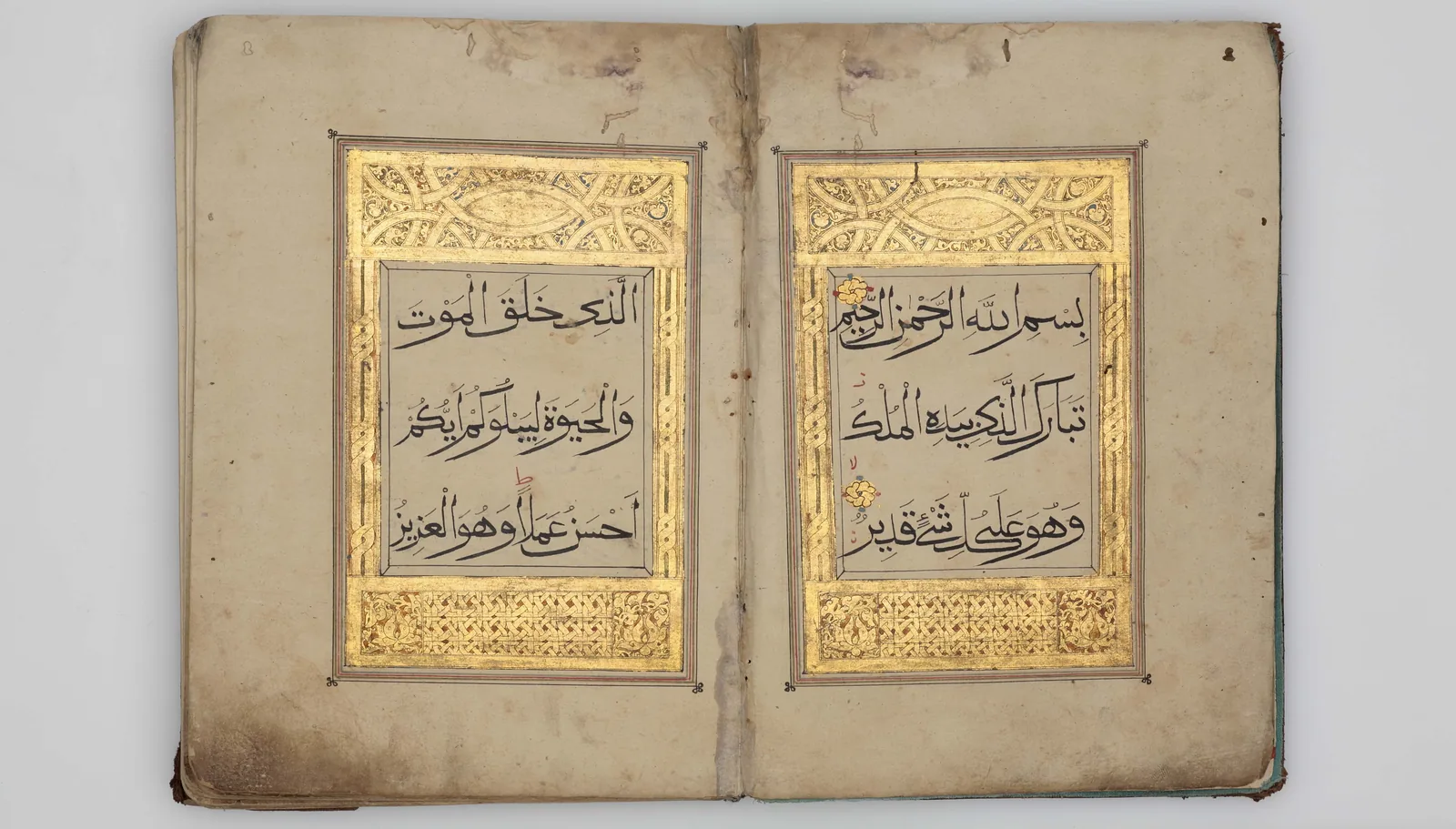
One place remains in the Quran where people speak about reason for themselves — not addressed with it, not described by it. It comes in Surat al-Mulk, in a scene where the deniers are cast into Hell group after group, and its keepers ask a question whose answer they already know: 'Did no warner come to you?' The people answer: yes, a warner came, and we called him a liar. Then they say the words that seal everything this essay has argued: 'Had we listened, or reasoned, we would not be among the companions of the Blaze' [al-Mulk: 8–10].
Look at the form of the confession. They do not say: if only we had possessed hearing and reason. They do not complain of a missing tool or a broken organ. The warner came; they heard him with sound ears and answered him with fluent tongues — and only someone equipped for argument argues. They say: had we listened, or reasoned. Two verbs. The Arabic construction is the one used for what you could have done and left undone. They confess a suspended act, not a missing faculty. So the Quran holds to its rule even in the speech of the people of the Fire: the word appears forty-nine times as a verb, and when the losers speak of their loss, it runs on their tongues as a verb too. Even regret is phrased as a verb.
After the form, look at the timing. The confession is entirely correct — and it comes in the one place where it no longer helps. There is nothing rare in realizing that reason is an act to be performed. What is rare is realizing it while the door is open. That is why the Quran's reproach to the living comes as an invitation — 'will you not reason?' — because as long as a person lives, the act can be resumed. Once the door closes, the tense flips: from a present that can begin again to a past tense of grief. Had we.
Here the essay's argument closes from its far end. We began with a count: forty-nine occurrences, every one a verb, not a single noun. The confirmation comes from a source no one can dispute: the mouths of people who saw the outcome. They lost nothing that can be owned and mourned; they lost something that had to be done, and it lay within reach every morning. The question they neglected — do you reason? — is still asked of every living person, every morning. It is not asked forever.
One door this essay has not opened. If reason is an act to be performed, what suspends it while the faculty is intact? Return to the verse we stopped at, which places the fault precisely: 'it is not the eyes that go blind, but the hearts within the breasts' [al-Hajj: 46]. The sight is sound and the report arrives; the damage lies past them both. That is another matter, and it deserves an essay of its own.
References & Sources
- The enumeration in this essay — 49 occurrences of the root '-q-l, 16 for al-albab, 4 for tadabbur, 2 for oolun-nuha, 1 for dhee hijr — was conducted directly on the Quranic text, form by form, in the Hafs 'an 'Asim reading.
- Ibn al-Jawzi, Zad al-Masir fi 'Ilm al-Tafsir, at Surat al-Hajj: 46.
- Ibn Kathir, Tafsir al-Qur'an al-'Azim, at Surat al-Hajj: 46.
- Al-Baghawi, Ma'alim al-Tanzil, vol. 2, p. 212, on the Prophet's encampment at al-Hijr during Tabuk; reported by al-Bukhari (433, 4420, 4702) and Muslim (2980).
- Muhammad al-Hilal, Tafsir al-Qur'an al-Thari al-Jami', vol. 17, p. 158, at Surat al-Hajj: 46.
This is a translation of an essay written in Arabic. Quotations from the Qurʾān are rendered for sense; the Arabic page carries them in the original.
NEUTRAL FACT CHECKER
A neutral fact-checker went through this essay's factual claims — the count of forty-nine places and the verse references, the report of the Prophet's encampment at al-Hijr and its chain of transmission, and what is attributed to Ibn al-Jawzi, Ibn Kathir, al-Farra', al-Baghawi and Muhammad al-Hilal — without touching its argument. The result is published as it came out, and the essay was not edited to agree with it. The fact-check is written in Arabic: read the neutral fact-check →
© 2026 Husain Alkhaldy — published in the site's essays.