On the morning of 27 October 1553, guards led a man of forty-two up the hill of Champel, south of the city of Geneva. The wood was green and damp, so it burned slowly and his agony was long. Nor did the executioners content themselves with binding the man to the stake: they tied a copy of his book to his leg and his arm, so that book and author would burn in one fire.
That book contained a chapter of theology that brought its author to this end. It also contained — and no one noticed it that day — the first printed description in Europe of the path of the blood from the heart to the lungs and back again: the pulmonary circulation. Six pages inside a massive work of religion, which went into the fire along with a thousand copies. Three survived.
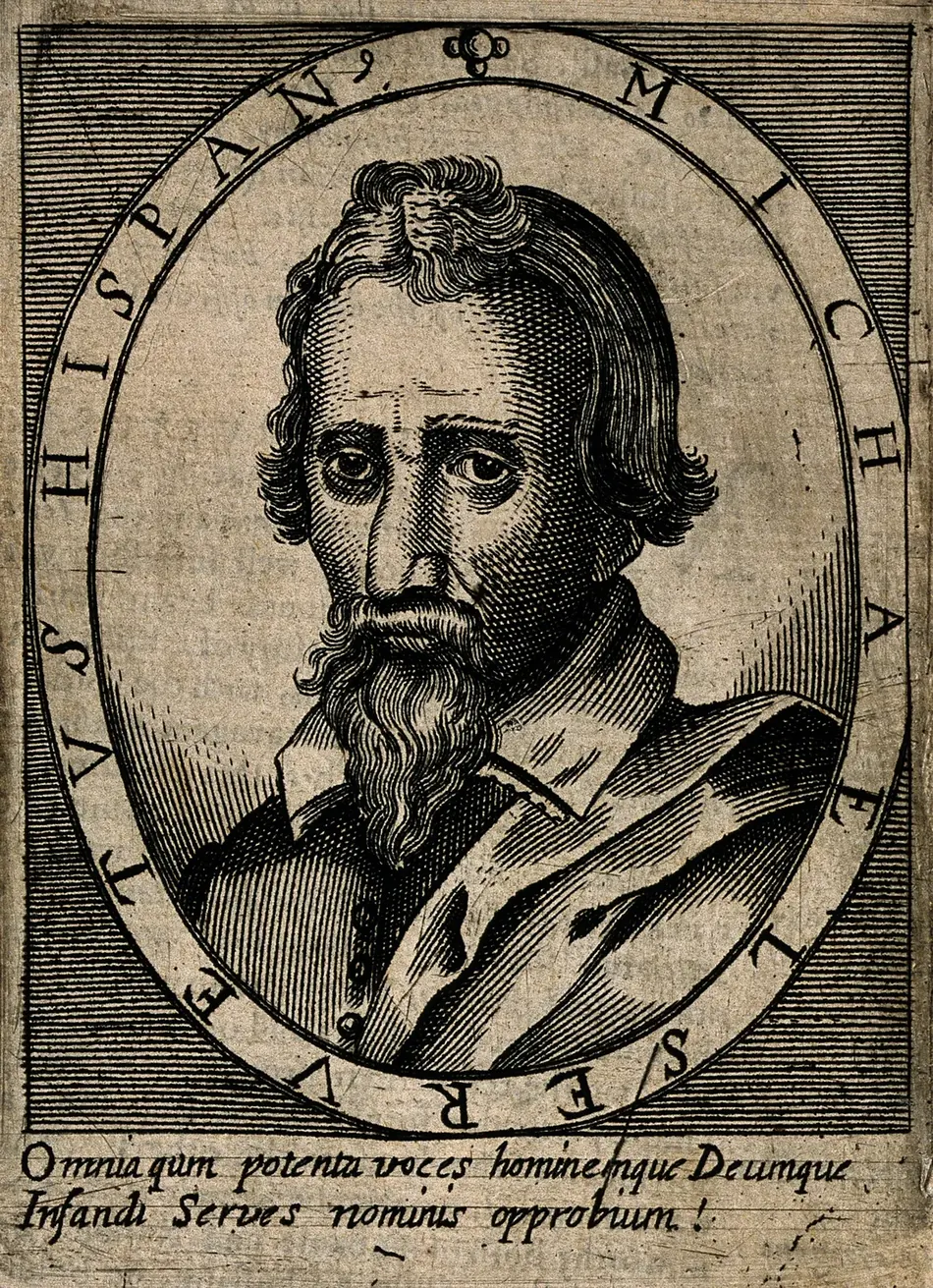
A Man from Aragon
Miguel Servet was born in the town of Villanueva de Sigena in the kingdom of Aragon, in north-eastern Spain, most probably in 1511. His was the first generation born after the fall of Granada and after the decrees of forced conversion and expulsion, in a country whose recent memory was still crowded with Muslims and Jews compelled to change their religion. This would leave its mark on his thinking later on, though scholars differ over how large a mark.
He studied law at Toulouse in France, and there — as the story about him goes — he read the Bible from cover to cover for the first time. He then accompanied the confessor of Charles V to Bologna in 1530, where he witnessed the emperor's coronation at the hands of the pope: the sight of the Supreme Pontiff carried on men's shoulders while the people kissed his feet. Servetus says that scene overturned something inside him.
In 1531, at roughly twenty years of age, he published his book On the Errors of the Trinity (De Trinitatis Erroribus). It was not the book of a hesitant man: in it he rejected the formula of the Council of Nicaea, described the Trinity as "a three-headed dog," and held that this doctrine produces nothing in the believer's soul but confusion. In arguing his case he drew — and this is what concerns us in this series — on Qurʾānic texts, and reckoned Muslims to have a better grasp of divine oneness than his Christian opponents; he even described the Prophet Muhammad as a reformer who called to a pure monotheism that the theologians of the Church had corrupted. This does not mean that he became a Muslim; he remained within a Christianity of his own devising. But it does mean that Islamic monotheism was one of the tributaries feeding the anti-Trinitarian movement in Europe — which is what we set out in the essay on the Arians and the Unitarians.
The result was that Catholics and Protestants condemned him alike. A man of twenty with no protection and no community behind him, disowned by everyone. So he disappeared.
Twenty Years Under an Assumed Name
What appeared afterwards, in Lyon and Paris, was a man named Michel de Villeneuve: a proofreader, and then a physician. He worked on the great scholarly editions of his age, among them a new edition of Ptolemy's Geography and an edition of Pagnini's translation of the Bible. He studied medicine in Paris, where he learned anatomy under Johann Günther of Andernach, in the very circle that produced Andreas Vesalius, author of On the Fabric of the Human Body, which turned anatomy upside down in 1543.
He then settled in the town of Vienne in the Dauphiné as personal physician to the city's archbishop. A respected doctor, close to a senior churchman, living a quiet life for some twelve years. And at night he was writing the book that would kill him.
A Book Smuggled in Bales of Straw
The Restoration of Christianity (Christianismi Restitutio) — the title itself a sardonic reply to John Calvin's Institutes of the Christian Religion. It was printed secretly at Vienne in early 1553, in about a thousand copies. And because printing it was a crime, the copies left hidden: a first consignment in January, tucked into bales of straw on their way to the Frankfurt fair; a second to Geneva; a third to Lyon.
Servetus had for years been corresponding with Calvin, a correspondence that began as inquiry and ended in open enmity. Calvin sent him a copy of his own book, and Servetus returned it filled with sarcastic notes in the margins. And Calvin had written to a friend that if Servetus ever came to Geneva, he would not leave it alive.
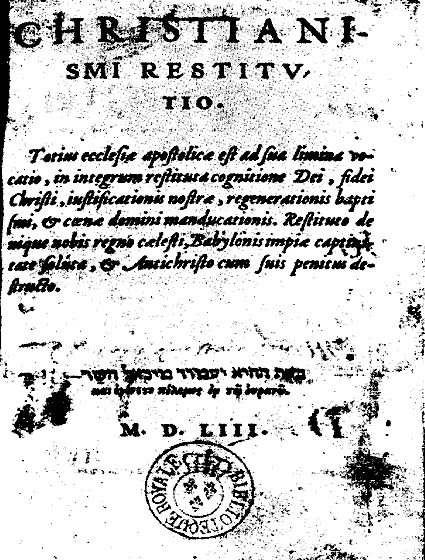
Where Did the Discovery Hide?
The anatomical description occurs in the fifth book of The Restoration of Christianity, on pages 168–173. To understand why it was placed precisely there, one has to follow Servetus's own reasoning.
His question was a theological one: how does the divine spirit connect with a human being? And he had found in the Old Testament a text saying that "the life of the flesh is in the blood." If life is in the blood, then one must understand how this life-bearing blood is made, and from where it draws what it draws. That is to say, anatomy for him was not an end but the only road to completing a theological argument.
And here he collided with Galen. For more than a thousand years the prevailing view had been that blood passes from the right ventricle to the left through invisible pores in the septum between them. Servetus said, in substance: no. The septum is solid and dense, and blood does not pass through it. Blood leaves the right ventricle through a wide artery into the lungs, where it spreads out, thins, changes colour to red, and mixes with the air drawn in by breathing; it then returns from the lung to the left ventricle through the pulmonary vein. And he supported this with a simple, convincing anatomical argument: that the artery running to the lung is far wider than the lung needs in order to feed itself, so it must have some larger function.
That is the whole passage. No chapter of medicine, no book of anatomy, not a single anatomical drawing. A passing observation inside an argument about the soul, in a book that would be burned within months.
And the precise point here is that Servetus was not looking for the circulation of the blood. He was looking for the seat of the soul, and stumbled on the road while doing so. Which recalls something we said in the essay "How the Sciences Evolve": discovery does not always come from the right question; it may come from a wrong question pursued honestly.
The Denunciation and the Fire
In February 1553 a letter reached the inquisitors at Lyon from a man named Guillaume de Trie, resident in Geneva, disclosing the true identity of "Doctor de Villeneuve." And when proofs were demanded, documents arrived in Servetus's own hand: his old letters to Calvin. The contested question, which historians have long debated, is how those letters left Calvin's possession and how much he knew of it; Calvin himself later admitted that he had not concealed his wish to silence the man. As for the details of his direct role, they remain disputed among scholars, and one should not be more certain about them than the documents allow.
Servetus was arrested at Vienne, then escaped from prison a few days later. The court sentenced him in absentia, and his effigy and his books were burned in June. And instead of making for Italy, where he had supporters, he stopped in Geneva. Why? No one knows for certain. He entered a church one Sunday and was recognised by someone in the congregation, and was arrested on 13 August 1553.
The councils of four Swiss cities were consulted about his case, and the replies came back agreed on his condemnation. He was sentenced to burning. Calvin asked that he be beheaded with the sword instead of burned — a "mercy" by the standards of that age — and the council refused. On 27 October the sentence was carried out on the hill of Champel, and the executioner bound to him a copy of his book.
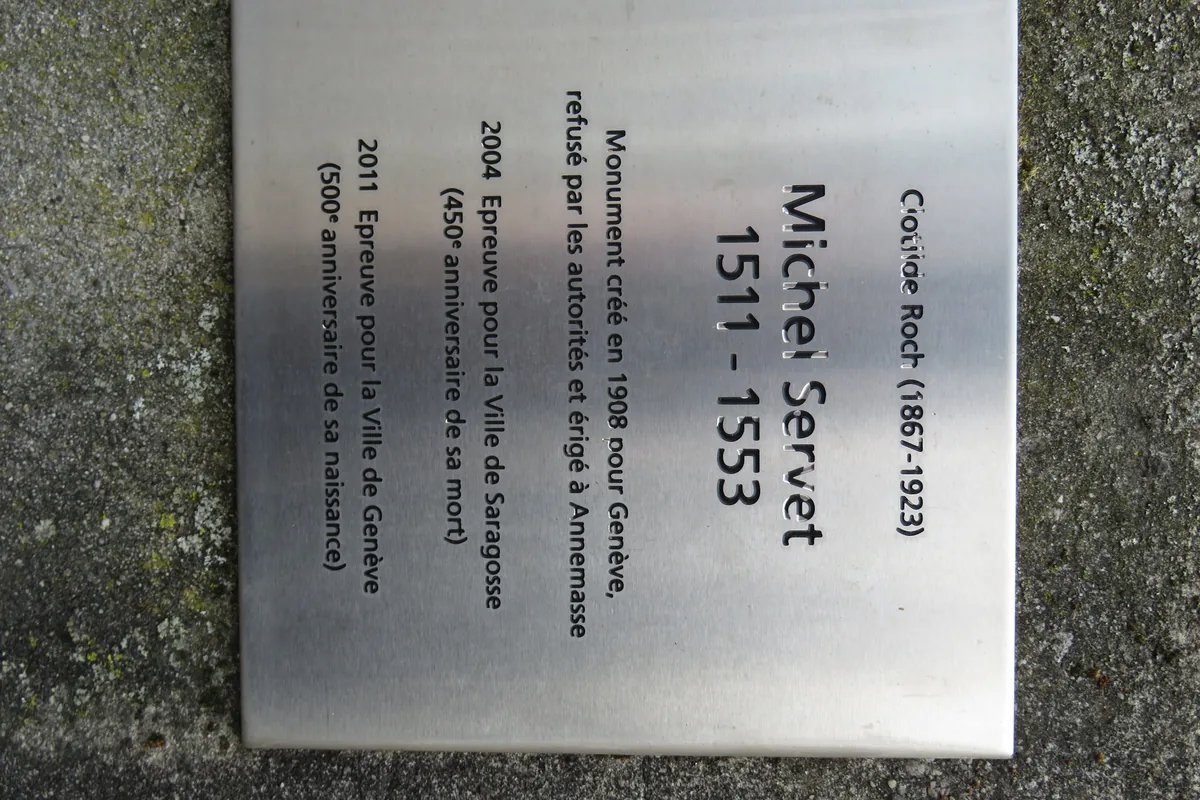
Three Copies
Of roughly a thousand copies, three survived: one in the Austrian National Library in Vienna, one in the French National Library in Paris, and a third, missing its opening pages, in the library of the University of Edinburgh. The book remained on the lists of forbidden works, and its full text was not published again until the eighteenth century, when a German scholar copied out the Vienna copy by hand.
Realdo Colombo described the pulmonary circulation in 1559 in On Anatomy, and Juan Valverde — another Spaniard — described it three years before him. Then came William Harvey in 1628, who completed the whole picture in On the Motion of the Heart and Blood. Did these men read Servetus? There is no conclusive evidence. Harvey does not mention him in his book. Some historians of medicine hold that the copies sold before the confiscation travelled with Servetus's supporters to northern Italy, and to Padua in particular — where Harvey studied — so that the possibility stands. But the most that can be said is that it is a possibility; and honesty requires that it remain one.
And the Older Description
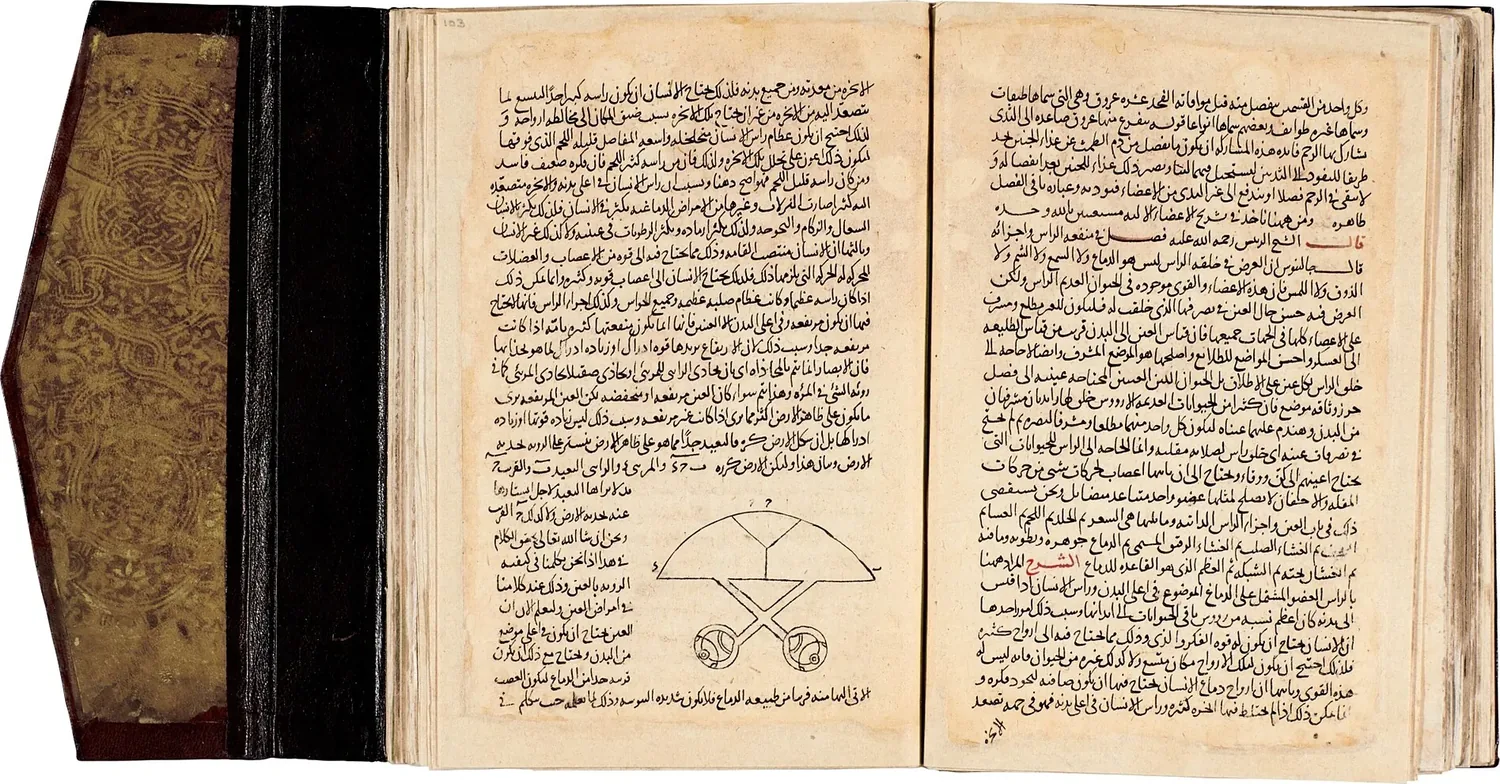
The Arabic reader knows the rest of the story: that ʿAlāʾ al-Dīn Ibn al-Nafīs al-Qurashī, the Damascene physician resident in Cairo, wrote in his Commentary on the Anatomy of the Canon, in the middle of the seventh century of the Hijra (the thirteenth century AD), the very same description: that the septum between the ventricles is solid with no passage through it, and that the blood must therefore take its way to the lung to mix with air and then return. A priority of some three centuries over Servetus.
This was not known in Europe until 1924, when the Egyptian physician Muḥyī al-Dīn al-Ṭaṭāwī came upon the text in a manuscript in Berlin and presented it in his dissertation. Three and a half centuries between the writing and the discovery — not by fire this time, but by neglect and by the breaking of the chain of readers.
Did Ibn al-Nafīs's words reach Servetus? There is a possible channel: Andrea Alpago's Latin translations of some of Ibn al-Nafīs's works, printed in Venice in the 1540s, that is, some years before The Restoration of Christianity. But we have nothing in hand to prove that Servetus read them. The prudent verdict: two independent discoveries in all likelihood, arriving at the same result by the same route — by objecting to Galen, not by dissection in a laboratory.
The Lesson: Producing Knowledge Is Not Enough
We picture the history of science as an unbroken chain: a scholar discovers something, and those who come after build on it. The truth is that the chain is broken in a great many places. Knowledge is not served by being born; it needs a carrier to bear it, a language it can be read in, a community that sees it as worth something, and an authority that does not burn it.
Servetus wrote what was true, and wrote it in the wrong place, and at the wrong time, and signed it with his own name after twenty years in hiding. So he died, and his discovery died with him for seventy years. Ibn al-Nafīs wrote what was true in exactly the right place — a book of medicine, a commentary on the Canon — but the chain of readers broke after him, and the text slept on a shelf until a student in Berlin woke it.
And this is another face of "the missing evidence" that we have written about: we see what survived. We read the history of medicine in the books that reached us, and suppose they are all there was. And we do not know — and never will — how many sound ideas burned at Champel and elsewhere, or slept in a manuscript nobody opened. As for our own share in all this, it is a practical question: what are we writing today in the place where no one reads?
And let us note that the story did not end at the fire. One year after the affair, Sebastian Castellio published his book Concerning Heretics: Whether They Are to Be Persecuted, and in it he said the sentence that became the most famous thing ever said on the subject: that to kill a man is not to defend a doctrine, it is to kill a man. The idea had not been born out of nothing, but it found in the burning of Servetus its tangible proof. And in 1903 Calvin's own followers raised a memorial at Champel, acknowledging in it that this had been the error of their age.
And after all that, we had to wait until 1924 to learn that the same road had already been described in Cairo seven centuries earlier.
Further Reading
- — Goldstone, L. & N. — Out of the Flames: The Story of One of the Rarest Books in the World (2002).
- — Bosmia, A. et al. — "Michael Servetus (1511–1553): Physician and heretic who described the pulmonary circulation", International Journal of Cardiology 167 (2013): 318–321.
- — Williams, G. H. — The Radical Reformation (expanded edition, 1992).
- — Hughes, P. — "Servetus and the Quran", Journal of Unitarian Universalist History (2005).
- — al-Ṭaṭāwī, Muḥyī al-Dīn — his dissertation on the pulmonary circulation in Ibn al-Nafīs, Berlin 1924.
The links above have been loaded and checked: the Goldstone and Williams books are scans on the Internet Archive, readable through digital lending rather than free download, and the Bosmia paper's link is its official DOI, with the full text behind the publisher's paywall. Hughes's article "Servetus and the Quran" appeared in the Journal of Unitarian Universalist History, volume XXX (2005), pp. 55–70, and I found no free copy of it; likewise al-Ṭaṭāwī's 1924 dissertation is not available in a free digital copy.
This is a translation of an essay written in Arabic. Quotations from the Qurʾān are rendered for sense; the Arabic page carries them in the original.
NEUTRAL FACT CHECKER
The factual claims in this essay — the dates, the names, the page numbers, the count of surviving copies, and the story of Ibn al-Nafis and al-Tatawi — were checked against the published sources and against the local Shamela library. The result is published as it came out, and the essay was not edited to agree with it. The fact-check is written in Arabic: read the neutral fact-check →
© 2026 Husain Alkhaldy — published in the site's essays.