Introduction
I came to write this essay because of a story I read on social media, told by the man it happened to, about his own return from the edge of death. What stopped me was not the strangeness of the story alone. It was that the story is not unique. Accounts like it recur, and they resemble one another across different tellers and different ages. That recurrence and that resemblance seem to me a reason to take such accounts seriously rather than dismiss them with a stroke of the pen. I set out from that intuition, and where the argument led is what follows.
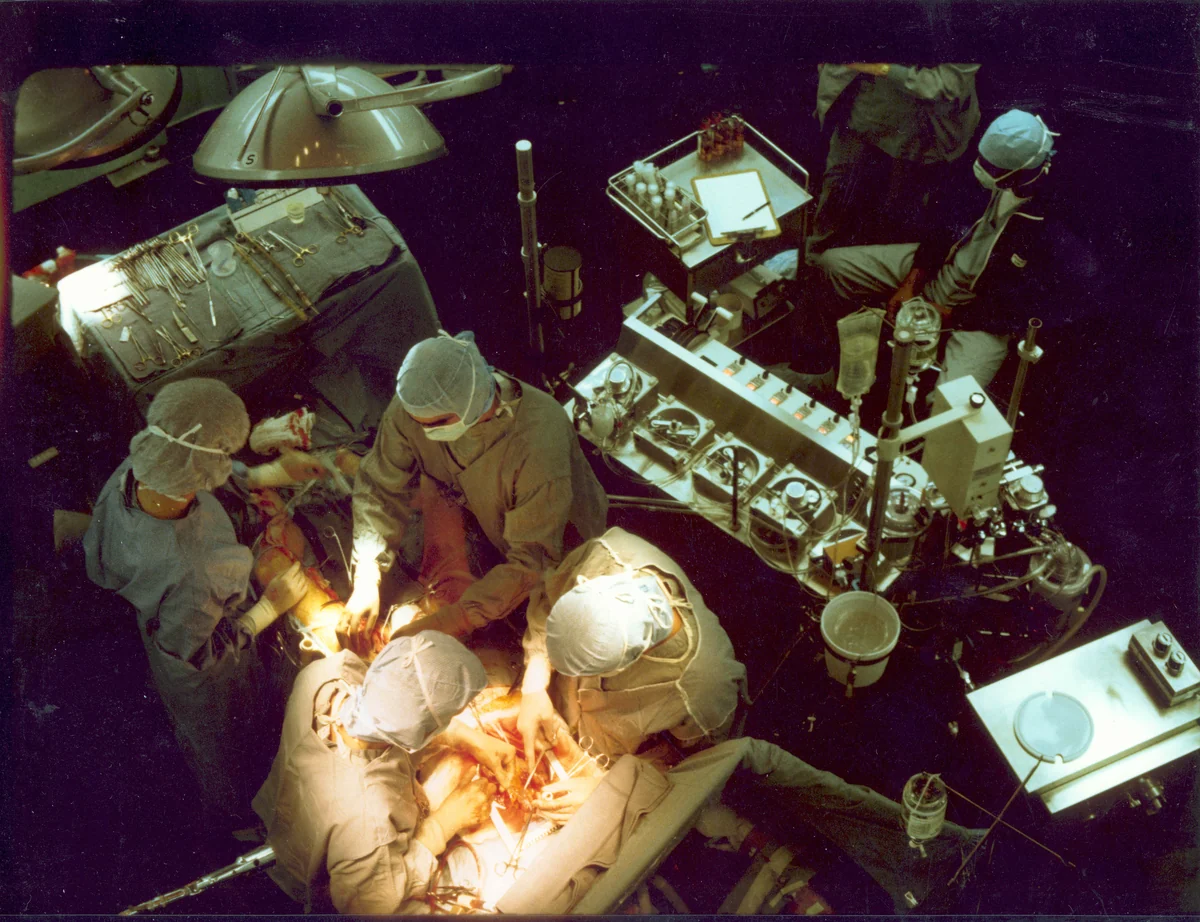
In the summer of 1991, a 35-year-old woman named Pam Reynolds lay on an operating table at the Barrow Neurological Institute in Phoenix, Arizona. Deep in her brain, near the brainstem, surgeons had found a large aneurysm that ordinary surgery could not reach. Her surgeon, Robert Spetzler, chose a rare procedure called deep hypothermic circulatory arrest. The body is cooled to about 15 degrees Celsius, the heart is stopped, and the blood is drained from the head the way a basin is emptied, until every electrical signal in the brain dies away.
They plugged her ears with small speakers emitting loud, continuous clicks, so that the brainstem could be monitored, and they taped her eyelids shut. By every clinical measure we have, her body was now at the edge of complete death: a still heart, a flat EEG, and the blood outside the skull.
Then she woke. She later described the electric saw used on the skull bone, which she said was like an electric toothbrush, and she repeated a conversation held in the room about how small the vessels in her thigh were. Some of what she described proved correct. How did she see and hear, with her eyes taped shut, her ears blocked, and her brain silent?
This is the puzzle that stops anyone who reads a single account of a return from death, then reads dozens more and finds that they resemble one another closely enough to stop the heart.
A Phenomenon Not Bound to One Age
The story is not a child of our own time. Plato told a version of it some 24 centuries ago, at the close of the Republic. His narrator is a soldier named Er, taken for dead on the battlefield, whose body lay 12 days without decay. Er then revived on the funeral pyre and described the journey his soul had taken. In Plato's hands this is a philosophical myth, made for a teaching purpose, not a clinical report; that has to be said plainly. But it shows that the shape of the story is as old as philosophy itself.
The same structure then recurs in places that knew nothing of one another. In 731 the Venerable Bede recorded the story of an Englishman named Drythelm, who died in the night and came back in the morning describing a valley, a light, and a guide who led him. Tibetan tradition describes a class of people it calls délok, literally “one who returns from death.” A sick person lies inert for days, then wakes and recounts a passage through intermediate worlds in the company of a being who guards him and explains what he sees. He returns with a message for the living. In 1975 the American physician Raymond Moody collected 150 contemporary accounts in a book that became the foundation of the field, and coined the term we still use: the near-death experience.
Twenty-four centuries, cultures with no link between them, and very nearly one story. Which brings back the question I started from: is this recurrence, this resemblance, not a reason to believe these accounts rather than reject them?
What Exactly Recurs?
Set the colourful details aside, and a fixed core remains. It recurs across the accounts whoever the teller happens to be. There is a sense of leaving the body and seeing it from above; a passage down a dark tunnel towards a light; a rapid life review; a meeting with the known dead, or with a being of light; an overwhelming peace; and then a boundary the person feels he will not come back from if he crosses it.
In 1983 the psychiatrist Bruce Greyson built a 16-item scale to pin that core down quantitatively, and it became the most widely used instrument in the field. The first large prospective study of the phenomenon came only in 2001. The Dutch cardiologist Pim van Lommel ran it and The Lancet published it: 344 patients who had been resuscitated after cardiac arrest, of whom 18% reported an experience of this kind. That is not a marginal proportion, and the resemblance between the accounts is real rather than imagined.
The Argument from Similarity, and Where It Fails
The argument that occurs to any reasonable person runs like this. When many testimonies, independent of one another, converge on a single description, the likeliest explanation of that convergence is that they are describing something real. This is a sound principle, and we use it in science, in the courts, and in life generally: when witnesses who have not colluded agree, their agreement is evidence that they are telling the truth. I have taken up the logic of this inference in “From Observation to the Scientific Revolution.”
But the argument carries a hidden premise. The similarity does show that the experiences have a common cause, and that much is true. On its own, it does not show what that cause is. The experiences may be a truthful glimpse of a world everyone passes into, alike because the destination is one. Or they may be the product of a dying human brain, and our brains are alike in their structure and in the way they shut down, so the experiences are alike because the injury is one. Both explanations predict exactly the same similarity.
As long as the two explanations predict the same degree of similarity, similarity cannot favour one over the other, however great it grows. Matching testimony establishes that there is a common cause. It does not establish that the cause is the one we would wish for. So the right question is not “why are they alike?” but “is there anything in these accounts that a dying brain alone cannot explain?”
The Decisive Test: Veridical Perception, Not Similarity
The one thing that can break the tie between the two explanations is not the similarity of the feelings. The light, the tunnel and the calm are all states the brain is capable of manufacturing. What breaks the tie is veridical perception: a patient who comes back and describes something that really happened in the room, at a moment when his brain was demonstrably offline, in terms he could not have guessed and could not have heard beforehand.
Here we return to Pam Reynolds. She described the shape of the saw and the sound it made. She reported a conversation about the vessels in her thigh. Had that happened with her heart stopped and her EEG flat, it would be something no materialist model we possess could explain.
But the timetable of the operation does not allow it. The saw and the talk about the thigh came at about 8:40 am. The heart did not stop until 11:05, the EEG did not go flat until 11:10, and full arrest was not reached until 11:25. These are the times given by Michael Sabom himself, who published the case and defended it, and who conceded them in 2007. The anaesthetist Gerald Woerlee has shown that anaesthesia at that stage can lighten, that sound reaches the inner ear through the bone of the skull even with the earphones in place, and that a memory built retrospectively after waking can dress what the patient already knew as what she had witnessed. None of this refutes the story. It does stop us from treating it as conclusive proof. The strongest of the famous cases fails at precisely the detail that decides it.
Because individual anecdotes settle nothing, the intensive-care physician Sam Parnia designed an experiment to cut through the doubt. Hidden visual targets would be placed high up in resuscitation rooms, where they could be seen only from above. If a patient who had left his body described one of them, the evidence would be unanswerable. In the first AWARE study, published in 2014, he mounted about a thousand such shelves. But 78% of the cardiac arrests happened in rooms that had no shelf, and the only two patients who reported visual awareness were in two of those rooms. So this was not a test that was run and failed. It was a test that was never run. AWARE II came in 2023, with a tablet at the bedside and a pair of headphones, and its decisive result was a silence. Nobody identified the image, and one patient out of twenty-eight identified the auditory stimulus. Even so, the researchers recorded brain activity consistent with consciousness, in the delta, theta and alpha bands, emerging as far as 35–60 minutes into resuscitation, and around 40% of those interviewed carried memories from that period. But Greyson and van Lommel pointed out in 2024 that the EEG was readable in only 53 patients out of 567. The two interviewed patients who did have a reading were not among those reporting explicit recall, and so no correlation was established between the electrical activity and what was reported. Parnia's own verdict was a fair one: the experience was neither proved nor disproved.
The Strongest Case for the Materialist Explanation
The materialist explanation has its evidence, and it is not simple obstinacy. Hypoxia in the brain produces many of these states on its own: visual tunnelling, euphoria, the sense of detachment. The tunnel in particular is traced to failing blood supply to the retina and the occipital cortex. That is a human structure, not a religious one, so there is nothing surprising in its appearing to a believer of any creed. In 2013 a team at the University of Michigan led by Jimo Borjigin recorded what happened in the brains of rats at the moment the heart stopped. There was a violent, synchronised surge of gamma waves, greater than anything seen in full waking. It came in the first thirty seconds after arrest, before everything went quiet. In 2022 a similar pattern was recorded in the brain of a human patient who died while connected to an EEG. To all this add the hypothesis of an endogenous substance resembling the drug DMT, flooding the brain at the moment of crisis, and the REM intrusion model, which accounts for the paralysis and the visions.
All of this is strong, and to my mind it explains the greater part of the shape of the experience and of its timing. But fairness has a second limit. Greyson answered the rat experiment with a precise observation. Every one of the rats showed the same gamma surge, whereas only a minority of human beings report the experience at all. If the surge were what produced it, the experience would be universal rather than rare. Beyond that, the presence of a neural correlate of consciousness does not necessarily make it the author of what consciousness contains. Recording the activity is one thing. Saying that this activity is what "saw" the room is another. Matter explains the occasion and the imagery. Before veridical perception alone it stands helpless, if veridical perception is ever established.
The Absent Evidence: Whom We Hear, and Whom We Never Hear
A structural flaw remains in the question, and many people never notice it. I have given it an essay of its own, "The Absent Evidence". In this matter we hear from the returning only. Whoever crossed over and did not come back has no account and no voice. The entire sample of stories, however many of them there are and however alike they sound, is drawn from the survivors alone. It has been filtered in advance, and that filtering leaves it structurally incapable of telling us anything about death itself. It tells us about the edge, not about what lies past it.
This overturns even the name of the subject. These are not returns from death in any exact sense. Whoever came back never reached the death from which there is no return. He stood at its edge and was sent back. So far as these stories go, what lies beyond the edge remains a closed door, and no witness has come out through it.
The Scale of Revelation
The scale of revelation has one decisive sentence about the very place where we hesitate. God says: ﴿until death comes to one of them and he says: My Lord, send me back, so that I may do some good in what I left behind. No. It is a word he speaks, and no more than that. Ahead of them lies a barrier, until the day they are raised﴾ (al-Muʾminūn 99–100). The barzakh is the barrier between death and the resurrection, and it is not crossed in the direction of return. Whoever has been met by death in earnest is not sent back. So what we call "a return from death" is not, on the scale of revelation, a death from which the way back was cut. It is a close approach to the throes of death, and then a return before the limit is reached. This agrees with where unaided reasoning left us. These people have come back from the edge, not from the barzakh.
But before we make the differences carry more than they can bear, we have to separate two things that much of the writing on this subject runs together: the raw shape of the experience, and the interpretation of it. Take the raw shape first, the darkness and then the light, the calm, the sense of a boundary. It is more widely reported than people assume, and Muslims who have been through the experience have described it themselves. It is true that Pasricha & Stevenson did not find the tunnel in the Indian accounts. But Allan Kellehear did not draw his dividing line between West and East. He drew it between societies of long-term settlement with historical religions and hunter-gatherer societies, where the tunnel is not a familiar form. He counted Islam among the first group, alongside Christianity and Hinduism. The tunnel does appear among Iranians: 5 of 17 of them described one, and 4 described a life review. That does not refute his generalization, because it is not something he predicted would be absent. What would press on his account is the tunnel turning up among hunter-gatherers. Jeffrey Long found the tunnel in non-Western accounts as well. The matter is disputed, and the sound conclusion is that the formal core is not the property of one culture rather than another.
What a person's culture shapes is the interpretation, not the form: who that "light" is, and what those regions are. Here the differences are plain and cannot be denied. The Christian reads the light as a being that resembles what he already knows. The Japanese subject does not report the life review, and he deals with the light differently, as Ohkado & Greyson have shown. The Muslim refers what he saw back to what is settled in his heart. This is exactly where one has to guard against parallelomania, the forced hunt for parallels, which I warned of in "They Imitate the Speech of Those Who Disbelieved". The raw shape is neutral and belongs to no particular creed, and the interpretation is added to it after the person wakes. We are therefore not entitled to make the tunnel and the light a witness that confirms our own hereafter, any more than anyone else is entitled to make them a witness that confirms his. The form is one; the claims built on it contradict one another. If it were a glimpse of one determinate reality, its interpretations would not conflict as sharply as they do.
One great thing survives from the intuition we began with. In every age and place people have recoiled from the idea that death is sheer nothingness, and they agree that something comes after it. That is one of the signs of the fiṭra, the innate disposition of human nature. Even the resemblance of the formal core across religions may be read in the same way: one created nature, giving one response as it nears the limit. But the fiṭra points to the door. It holds no report of what is behind it. This is "the impoverished God of the philosophers," whose thread I followed in the series "Mankind Was One Community". Reason, and these experiences along with it, reaches the threshold, and of itself has no trustworthy message about what lies past it. The truthful report of the barzakh and the raising of the dead did not come from a monitor screen or from the memory of someone who came back. It came by one road only: revelation. In "The End of Atheism" I showed that sensory evidence, once it is established, stands above the disputations of theology. The believer here does not wait for the testimony of those who came back before he can rest in what his Lord has told him. Nor does he deny that a servant may be shown, in the throes of death, something he had not been able to see.
What These Stories Are Able to Tell Us
We return to that table in Phoenix. Pam Reynolds woke, the aneurysm was lifted out of the base of her brain, and she lived to tell her story for years afterwards. But she did not, strictly speaking, cross the barzakh and come back. She reached the furthest edge that medicine can reach with the instruments it has, and from there she was sent back. That is the limit of what all these stories are able to tell us. They are reports — truthful or mistaken — from the edge, and they are necessarily silent about what lies past it. The report of what lies past the edge remains what it has always been: a trust in the hands of revelation alone.
Further Reading
- 1. Raymond Moody, Life After Life (1975) — the origin of the term, and the first collection of accounts. — archive.org (borrowable: one-hour digital loan, free account)
- 2. Pim van Lommel et al., “Near-death experience in survivors of cardiac arrest,” The Lancet (2001). — doi.org (abstract only; full text paywalled)
- 3. Sam Parnia et al., the AWARE project (Resuscitation, 2014) and AWARE II (Resuscitation, 2023). — doi.org (AWARE — abstract only) · doi.org (AWARE II — abstract only)
- 4. Bruce Greyson, “The Near-Death Experience Scale” (1983), and his book After (2021). — doi.org (abstract of the scale paper only; no free copy of After)
- 5. Carol Zaleski, Otherworld Journeys (1987) — for the visions of the Middle Ages and their parallels with the modern experiences. — archive.org (borrowable, free account)
- 6. Allan Kellehear, “Census of Non-Western Near-Death Experiences to 2005” — for the debate over features that cross cultures and features that belong to one, the tunnel among them. — digital.library.unt.edu (full text — the Journal of Near-Death Studies version)
- 7. Gregory Shushan, Conceptions of the Afterlife in Early Civilizations (2009) — for the comparison across the ancient civilizations. (no free copy)
- 8. Ibn al-Qayyim, Kitāb al-Rūḥ — for the states after death and the barzakh on the scale of revelation. — shamela.ws (full text)
This is a translation of an essay written in Arabic. Quotations from the Qurʾān are rendered for sense; the Arabic page carries them in the original.
NEUTRAL FACT CHECKER
The facts and sources in this essay were put to an independent fact-checker. The result is published as it came out. Two passages in the essay were corrected before publication on the strength of it; every other finding stands beside the essay unedited. The fact-check is written in Arabic: read the neutral fact-check →
© 2026 Husain Alkhaldy — published in the site's essays.